

$449.00

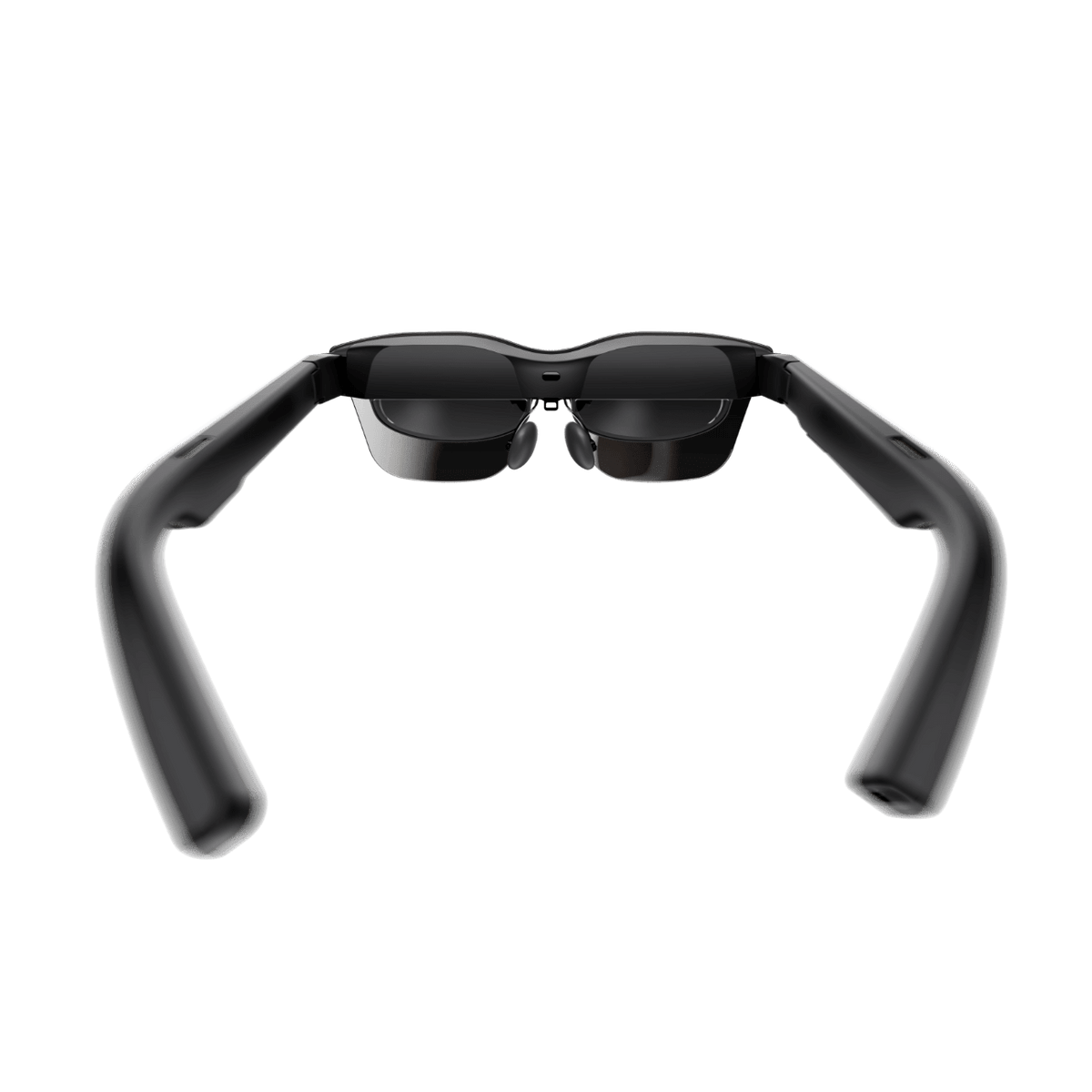
A custom prescription insert handles both. It is a real lens made to your prescription, so it carries the cylinder and axis that correct astigmatism in exactly the way your everyday glasses do. Strong minus powers work the same way, with slim, light high-index lens material keeping the insert compact. On RayNeo GT, GT Max and Air 3s, lenses can be customized for myopia from 0 to -10.00D and astigmatism up to -2.00D.
Across the RayNeo lineup, RayNeo GT Max, RayNeo GT, RayNeo X3 Pro, RayNeo Air 4 Pro, RayNeo Air 3s Pro and RayNeo Air 3s take custom prescription lenses made individually by our optical partner Lensology. GT and GT Max add a second route: the prescription-lens frame (sample) included in the box can be taken to a local optical store for fitting. Our AI glasses, RayNeo iO, are ordered with prescription lenses directly from RayNeo. Our prescription availability guide walks through every model's prescription path in turn.
Astigmatism means the eye focuses light differently along two directions, usually because the cornea is curved more steeply one way than the other. On a prescription it appears as two linked values: the cylinder (CYL), which is how much astigmatism there is, and the axis, written in degrees from 1 to 180, which is the direction it lines up in.
Some display glasses handle vision with a built-in focus or diopter adjustment instead of a lens, an approach our guide to AR glasses and myopia compares with inserts. A simple focus correction shifts everything by the same amount in every direction. That handles plain nearsightedness, but it cannot fix a power difference that exists only along one axis. Correcting astigmatism takes a lens ground with that cylinder power and turned to that exact angle.
That is what a custom insert is. The cylinder and axis are built into the lens itself, so the insert corrects astigmatism the same way a pair of everyday glasses does, and the correction travels with the glasses rather than depending on any setting.
Two practical details follow from this:

High myopia is generally defined as -6.00D or stronger. Optically, an insert corrects it the same way it corrects a mild prescription. What changes is everything around the optics.
Lens thickness. Minus lenses are thin in the center and thicker at the edge, and the edge grows with the prescription. Two things keep that in check: high-index lens material, which bends light more strongly so less material is needed, and a small lens size, since a smaller lens never reaches the thickest outer zone. Insert lenses are compact by design, and Lensology makes GT, GT Max, X3 Pro and Air 4 Pro inserts with slim, light high-index lenses.
Use a glasses prescription, not a contact lens prescription. A contact lens sits on the eye, while an insert sits in front of it, like spectacles. The two prescriptions differ more as myopia gets stronger, so a contact lens prescription cannot simply be copied into an insert order. Our guide to contact and glasses prescriptions explains why the numbers differ.
The -10.00D range spans the high-myopia band. On GT, GT Max and Air 3s, the myopia range takes in every prescription from the -6.00D line all the way to -10.00D.
High myopia also carries its own eye-health considerations, such as a higher risk of retinal problems, so regular dilated eye exams matter more than which glasses you wear.
| Model | How the prescription is added |
|---|---|
| GT Max | Custom clip-in insert made to order by Lensology (GT Max inserts), or the included prescription-lens frame (sample) fitted at a local optical store |
| GT | Custom clip-in insert made to order by Lensology (GT inserts), or the included prescription-lens frame (sample) fitted at a local optical store |
| X3 Pro | Custom insert made to order by Lensology, clicks into the frame (X3 Pro inserts) |
| Air 4 Pro | Custom insert made to order by Lensology (Air 4 Pro inserts) |
| Air 3s Pro | Custom lenses made to order by Lensology, for near-sighted and far-sighted users |
| Air 3s | Lensology prescription lenses; Air 2s prescription lenses also fit |
| iO (AI glasses) | Custom prescription lenses added at checkout for $159, ordered with the glasses from RayNeo |
X3 Pro takes its Lensology insert by clicking it into the frame, no tools needed. For GT Max, GT, X3 Pro and Air 4 Pro, Lensology fits the lenses into the insert without you sending in your glasses, and the finished insert ships ready to clip into place. Lensology ships the inserts worldwide: next day within the UK, 2 to 4 working days to the US, Canada and Europe, and 6 to 7 working days to Australia, with import tax and customs fees covered by Lensology. For GT and GT Max prescriptions that can be made from stock lenses, Lensology aims to complete the insert within about 1 to 2 working days.
iO works differently. Its Blue Lake optical waveguide is engineered to integrate seamlessly with prescription lenses, so on iO the prescription lenses are part of the glasses themselves. iO is ordered through the "Buy with Prescription" option, with custom prescription lenses added for an additional $159. Because they are custom-configured, prescription iO glasses can be returned or exchanged only for a product quality defect, so a current, double-checked prescription at checkout is what makes the order right the first time. Prescription lenses ordered with iO from RayNeo also carry a 30-day manufacturing guarantee: lenses that arrive with a factory defect or incorrect prescription fitment are repaired or replaced free within 30 days of delivery.

A prescription slip carries more numbers than most people look at. For an AR insert, each one has a job:
For optimal visual clarity, the display should line up with your line of sight. A few fitting steps get it there:
Do toric contact lenses work instead of an insert?
Do I still need my everyday glasses under the AR glasses?
Can my existing Air 2s inserts move to Air 3s?
Is a prescription from a few years ago good enough?
Can HSA or FSA funds be used for RayNeo iO prescription lenses?
For AI glasses that wear like everyday eyewear, RayNeo iO with prescription lenses is ordered with the correction built in from the start. For a private cinema with your exact cylinder and axis behind the display, RayNeo GT Max pairs a custom Lensology insert with three IPD sizes and three nose-pad heights, so both the correction and the alignment are matched to your eyes.





Share:
RayNeo GT and GT Max Device Compatibility: iPhone, Android, iPad, and Mac, Explained
Live Captions With Multiple Speakers, Accents, and Rapid Turn-Taking