

$449.00

AR display glasses work outdoors in daylight, and the two main types get there in opposite ways. See-through heads-up glasses such as RayNeo iO and RayNeo X3 Pro pair a bright MicroLED waveguide display with a transparent lens, placing useful information directly in your field of view. Virtual-screen glasses such as RayNeo GT Max and RayNeo GT take the other route: run the display at full brightness and cut down the light coming in from around it.
Outdoor clarity comes down to three things: the display type, the brightness at your eye, and whether a shade sits over the front.
A see-through display adds its image on top of the world behind it. Your eye sees both at once, which is why brightness at the eye is the number that matters most for this type.
A virtual-screen display works more like a private cinema. The image is meant to be the main thing you look at, so alongside the display's own brightness, the second lever is a shade that reduces the ambient light reaching your eyes around the picture.
| Model | Display type | Brightness |
|---|---|---|
| iO | Monochrome green MicroLED, waveguide | 1,300 nits at eye level |
| X3 Pro | Full-color MicroLED, waveguide | 3,500 nits average, 6,000 nits peak |
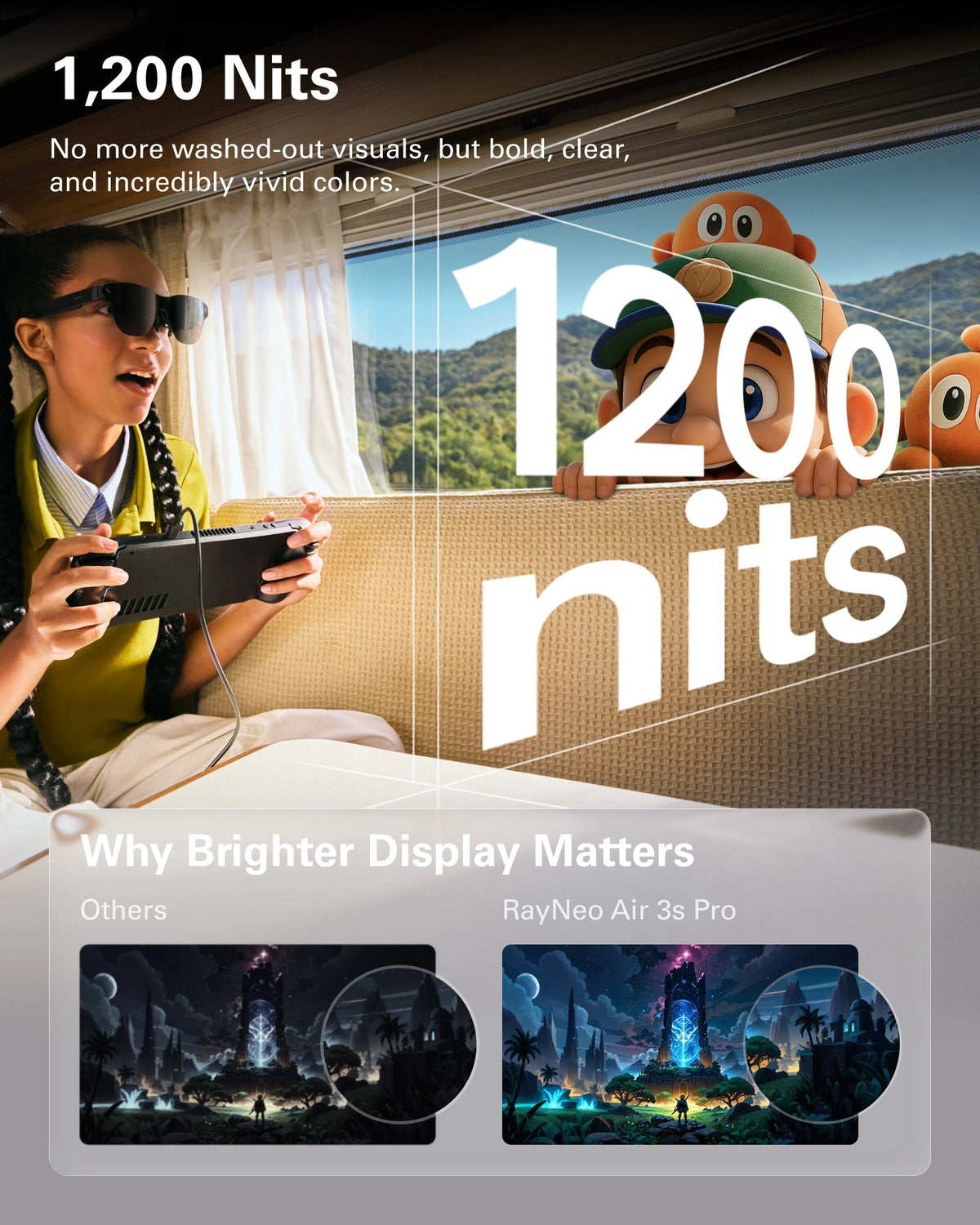
| GT Max and GT | Micro-OLED virtual screen | Up to 1,200 nits perceived brightness |
| Air 3s Pro | Micro-OLED virtual screen | 1,200 nits to-eye |
Each figure is measured on its own basis. Our explainer on nits covers how the unit itself works.

iO is designed for quick glances. Its binocular MicroLED engine and diffractive waveguide deliver 1,300 nits at eye level in a monochrome green image across a 23.5-degree field of view, while the Blue Lake lens keeps 97% transparency. In practice, schedules, weather, notifications, and live captions appear directly in your field of view, without constantly checking your phone.
Four iO features that carry straight over to outdoor use:
Our deep dive on iO brightness goes further into what eye-level brightness means for this display.
X3 Pro covers the full-color end. Its MicroLED waveguide display runs at 3,500 nits average and 6,000 nits peak with 16.77 million colors, equivalent to a 43-inch screen at two meters across a 30-degree field of view. Its built-in sensors include ambient light sensing, alongside an accelerometer, gyroscope, magnetometer, and wear detection.
Navigation is where X3 Pro earns its place outdoors. It projects real-time navigation and nearby landmarks directly in your view, helping you find routes, restaurants, and transit without looking down at your phone, and real-time translation in 14 languages appears as on-screen text. Control stays hands-free as well, through voice control, the "Hey RayNeo" assistant, and the five-dimensional temple touch control.
GT Max and GT are built for films, games, and travel, and both deliver up to 1,200 nits of perceived brightness. Brightness on both models runs across 12 levels plus 3 extra gain levels.
Each model also offers three spatial modes, and a short press of the Spatial Mode Button on the glasses switches between them:
| Spatial mode | What it does | Ideal for |
|---|---|---|
| Steady | Stable viewing with subtle natural movement | Travel and commuting |
| Pinned | Keeps the screen fixed in one position | Focused, cinema-like viewing |
| Follow | Keeps the screen centered as you move your head | Casual and everyday viewing |
Our guide to GT spatial modes explains when each mode fits.

The second step is the Lens Shade, made in a version for each model: the Lens Shade for GT Max and the Lens Shade for GT. Both block surrounding light to reduce distractions and create a more private, cinema-like viewing environment. On GT, the shade also reduces reflections, helping improve perceived contrast and visibility in bright environments. On GT Max, it creates a darker viewing environment, improving perceived contrast and immersion when watching content in bright surroundings.
GT and GT Max do not require charging: the USB-C port receives power, video, and audio from the connected source, so a single cable is the whole setup. Two power-saving features in the RayNeo XR App look after the phone side: Eco Mode in the XR Space video player and Auto-Dim Brightness during Immersive Casting both dim the phone's own screen while the video keeps playing on the glasses.
From the Air series, Air 3s Pro follows the same approach: 1,200 nits of to-eye brightness for viewing everywhere from a bedroom to a sunlit park, 3840Hz PWM dimming for eye comfort, and its own Lens Shade accessory. Its Vision Boost color mode optimizes brightness for extreme sunlit settings and keeps the display colorful, and its updated self-developed optical module provides higher transmission efficiency and reduces glare interference.

| Outdoor activity | Best fit | Setup that helps most |
|---|---|---|
| Walking a new city with directions | X3 Pro | Heads-up turn-by-turn directions and nearby places |
| Reading captions or translations at an outdoor table | iO or X3 Pro | iO for a lighter frame, X3 Pro for full color |
| Checking schedule, weather, and notifications on the go | iO | HeadUp Display glances, brightness by voice |
| Watching a film on a park bench, a beach chair, or by a train window | GT Max or GT | Lens Shade on, Steady mode for the train |
| Handheld gaming on a sunny patio | GT Max or GT | Lens Shade on, brightness raised through the gain levels |
| Streaming on a sunlit balcony | Air 3s Pro | Vision Boost mode, Lens Shade on |
For safety, a virtual movie screen is for sitting still, never for walking through traffic, cycling, or driving, because in Follow mode the picture stays in front of your eyes and blocks part of your view.
How do I change brightness on Air 3s Pro without picking up the phone?
Is the brightest number always the best choice for outdoor use?
Is the Lens Shade included, and does one fit both GT and GT Max?
Which RayNeo glasses suit outdoor use with no phone screen involved at all?
Ready for daylight: iO for glanceable text in the sun, X3 Pro for full-color navigation and translation outdoors, GT Max or GT with a Lens Shade for a big screen on a sunny afternoon, and Air 3s Pro with Vision Boost for streaming on a sunlit balcony.





Share:
What Does Smart-Glasses AI Handle on the Glasses Themselves?
How Do You Use a Smart-Glasses Teleprompter at a Trade Show?