

$429.00

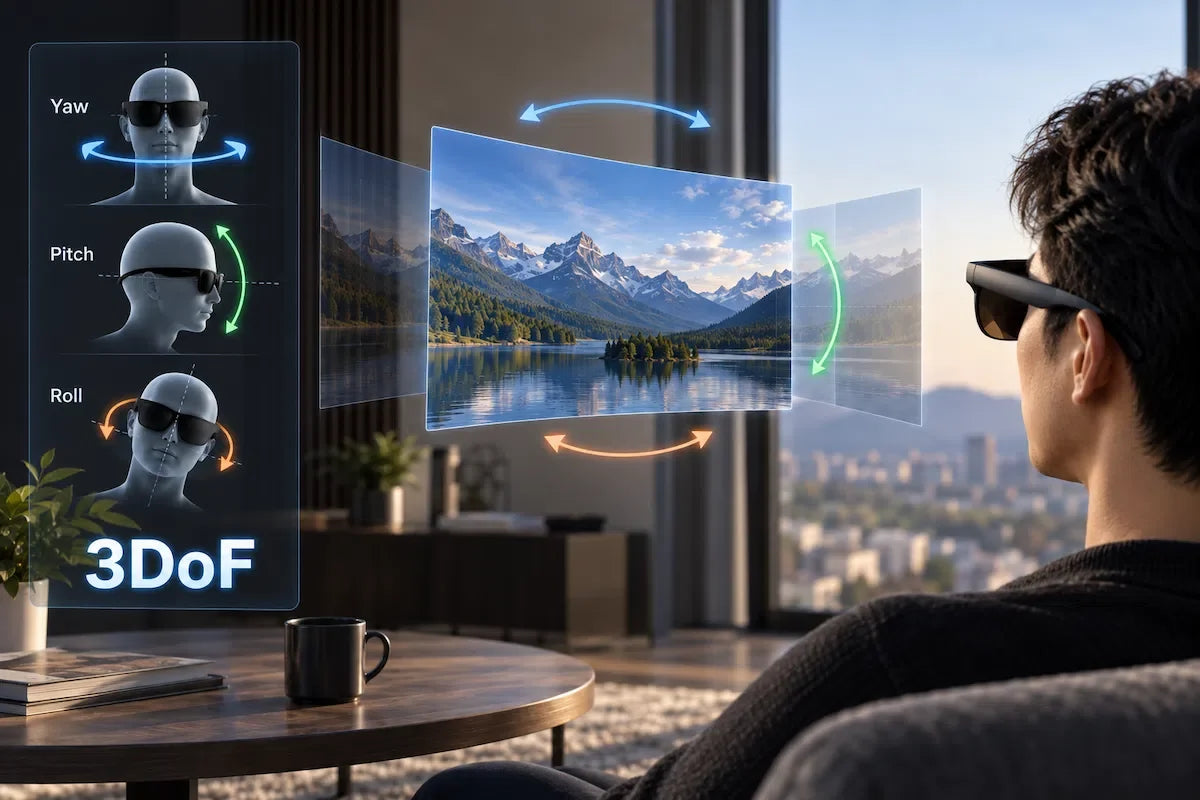
Three different jobs hide under the same label, and picking the right pair starts with naming which one you want. Some glasses put information in front of your eye: captions, schedules, translations, directions. Some turn into a large private screen for whatever you plug them into. Some carry a camera and capture what you are looking at. A few try to do all three, at a price and a battery cost that reflects the ambition.
Which of the three you need comes from what your week looks like rather than from a spec sheet. For each capability taken apart in detail, how the voice assistant works, what translation actually does, how the camera and battery behave, our feature-by-feature breakdown goes there instead.
RayNeo's current lineup happens to map cleanly onto that split, with a separate product for each job rather than one device that blends them, which is what makes it a workable example to think through the category with: iO for information, GT and GT Max for the big screen, X3 Pro for everything including a camera.

| Your scenario | The job you need | RayNeo model that fits | Why |
|---|---|---|---|
| Commuting with a phone in your pocket | Big screen | GT Max or Air 3s Pro | Wired video from the phone, whisper-quiet audio, no phone in your hands |
| Back-to-back meetings | Information | iO | Captions, recording with speaker labels, AI summaries, camera-free so it is welcome in the room |
| Travel where you do not speak the language | Information | iO, or X3 Pro if you also need signs and menus read | 55 languages and 109 accents on iO; camera-based text translation on X3 Pro |
| Long flights and hotel evenings | Big screen | GT Max with Pocket TV Pro | A cinema screen without a laptop, and a player with its own battery |
| PC or console gaming in a shared space | Big screen | GT Max or Air 3s Pro | 120Hz, private screen, Whisper Mode for late nights |
| Filming what you are doing, hands free | Capture | X3 Pro | 12MP stills, up to 4K video, plus AI that can see the same view |
| Presenting or public speaking | Information | iO | Teleprompter with three modes while you keep eye contact |
| Hearing support in conversations | Information | iO | Real-time captions with the microphone array filtering out your own voice |
Job one: putting information in your sightline. Live captions of the conversation in front of you, translation of a language you do not speak, your next meeting, a teleprompter script, a notification you can glance at. The iO does this in a 33-gram frame with a binocular MicroLED display that stays invisible to everyone else, covering 55 languages and 109 accents for captions and translation, and recording meetings into transcripts with speaker labels and AI summaries.
Job two: a big private screen. No AI required, just a display you carry. GT Max presents a 267-inch virtual screen across a 59-degree field of view at up to 120Hz, fed by a USB-C cable from a phone, laptop, console, or handheld. It is the most immediately useful job of the three, because the value proposition is concrete: a large screen in a small bag.

Job three: capturing what you see. X3 Pro's 12MP camera shoots up to 4K video from your own point of view, and the same camera is what lets its assistant answer questions about a menu, a sign, or an object in front of you.
All three are companions to a phone rather than replacements. Nothing in this category browses the web comfortably, types a long message, or runs a full day of heavy use without charging. How each capability performs in detail is a separate story, told feature by feature in the companion piece linked above.
Being specific here is more useful than a disclaimer.
All-day heavy use is not on the table. The iO's 240mAh battery is rated for up to two days of typical use, 18 hours of continuous recording, or 6.2 hours of continuous translation, which is the strongest battery story in the lineup precisely because it drives a monochrome display and no camera. At the other end, TechRadar Pro's testing of the X3 Pro put active use at one to two hours, sometimes 45 minutes, against RayNeo's stated five hours for light use. Ambition costs power.
Display glasses need a source. GT Max, GT, and the Air series are displays, not computers. They show what a connected device sends, which means a phone or PC port that supports video output, or an adapter, or a separate player.
AI assistants still have seams. Gizmodo, testing the X3 Pro, found the voice assistant unaware of reminders set in the glasses' own to-do app. Integration between an AI model and a device's own features is where this whole category is still maturing, which makes what a pair does today the number that counts.
Camera-free is a feature, not a gap. iO has no camera at all. That is a deliberate trade: it gives up capture and buys a welcome in rooms a camera cannot enter.
Picking the right lane is most of the decision, and each one comes with a straightforward requirement.
Information glasses run on their own battery, so the question is session length rather than cabling. iO covers up to two days of typical use, 18 hours of continuous recording, or 6.2 hours of continuous translation, which is built for a working day rather than a demo.
Display glasses run on the device you connect them to, which makes them light, and means the source needs a USB-C port with video output or the HDMI adapter that covers everything else. One cable, and the screen is yours.
Capture glasses run in bursts, because a camera, a full-color display, and onboard Wi-Fi in a 76-gram frame is a power budget you spend deliberately. X3 Pro is built around that rhythm, with a full charge in 38 minutes.
Match the rhythm to your day and these stay in use. That is the difference between glasses you wear and glasses you owned once.
| Model | Category | Price | Weight | Defining feature |
|---|---|---|---|---|
| iO | AI glasses | $449 | 33g | Camera-free heads-up captions and meeting notes |
| GT | AR display glasses | $299 | 68g | 201-inch screen, 49 PPD, fixed 64mm IPD |
| GT Max | AR display glasses | $429 list, $399 after the automatic checkout discount | 78g | 267-inch screen, 59-degree view, three IPD sizes |
| X3 Pro | AI and AR glasses | $1,299 | 76g | Camera, onboard Wi-Fi, navigation, standalone operation |
| Air 3s Pro | AR display glasses | $279 | 76g | 201-inch screen, 1,200 nits, the value entry point to the big-screen job |
Two pairs of numbers in that table look strange until you place them in the right job. The iO costs $150 more than GT while showing a much smaller image, because it is not competing on image size at all: it is buying a 33-gram camera-free frame that runs all day and puts captions in your eyeline. GT and Air 3s Pro sell screen area per dollar. Comparing their prices directly is like comparing a notebook with a television.
For a deeper feature-level breakdown of what each capability involves, see our feature-by-feature guide; for a direct spec comparison of these four, see the full model comparison.
Do AI glasses work without a phone?
It depends on the model rather than the category. X3 Pro has its own Wi-Fi 6 and Bluetooth 5.3 radios and runs an Android-based system, so it operates independently on a known network. The iO pairs to a phone over Bluetooth 5.4 and expects the phone's connection for its cloud-backed features. Display glasses always need a source device.
Can you wear them with a prescription?
Yes, through RayNeo's optical partner Lensology. Air 3s Pro accommodates both near-sighted and far-sighted prescriptions, and the GT series supports prescription lenses through the same partner. For the display models this is a swap: your everyday glasses come off while these go on, the way sunglasses work. iO goes further, sold with a Buy with Prescription option so it arrives ready to wear all day, HSA and FSA eligible in the US.
Are AI glasses the same as VR headsets?
No, and the difference is what you can see while wearing them. These glasses leave your view of the room intact, whether they are overlaying text or floating a virtual screen in front of you. A headset replaces your view entirely, which is why one weighs 33 to 78 grams and the other several hundred.
Which type holds its value for the longest?
Display glasses age more slowly, because a screen with a set resolution and refresh rate does what it did on day one. AI features depend on models and services that change. A simple test before buying: write down the three things you expect the glasses to do, then check which of them depend on a cloud service or a future update. If two of the three do, you are buying a promise as much as a product.
Is there a model that does everything?
X3 Pro comes closest at $1,299, with the burst-use battery pattern that comes with carrying a camera, a display, and its own radios. For most people, two focused devices, or one focused device plus a phone, does the job better than one device that compromises on all three.
Start with the job you need done: RayNeo iO for information all day, GT Max or Air 3s Pro for the big screen, X3 Pro when you want to capture what you see.





Share:
Which Smart Glasses Have the Best Display? Nits, FOV, and PPD
AR Glasses Without USB-C DP Alt Mode: Every Connection Path