People with a strong nearsighted prescription tend to ask one question before anything else about a new frame: will it take their lenses at all. For AR glasses with a large virtual screen, RayNeo GT Max and RayNeo GT answer it with custom prescription lenses covering nearsightedness anywhere from 0 to -10.00D, ordered from our optical partner Lensology or made by a local optical store using the sample frame in the box.
That range reaches well into strong prescriptions, and both GT models share it, so a wearer can pick between them on the viewing experience they want. RayNeo Air 4 Pro, RayNeo X3 Pro and RayNeo iO each take a prescription too, each through its own route.
A strong prescription and the space in front of the eyes
The stronger the prescription, the more the position of the lens matters. Every glasses prescription is written for a lens worn a short distance in front of the eye, and at low powers a few millimeters either way makes little difference. At strong powers it starts to count. A -8.00D lens moved 5 millimeters further from the eye acts like a lens of roughly -7.70D, a difference that can matter for fine detail, which is why opticians measure fitting distances carefully for strong prescriptions. Tilt matters as well: a strong lens tilted away from the angle it was fitted for picks up unwanted astigmatism, and the effect grows with both the lens power and the tilt, so the angle of the frame on the face gets attention too.
Stacking everyday glasses underneath display glasses can work against that. The everyday frame may push the display glasses forward, and the everyday lenses may no longer sit where they were measured to sit.
A prescription insert removes the second frame. The lens is made for the display glasses and sits inside them, so a strong prescription wearer puts on one pair, with the correction carried inside the display glasses.
Myopia correction up to -10.00D on GT Max and GT
The GT Series sets one myopia range, 0 to -10.00D, for both GT Max and GT. On a prescription slip, myopia is the SPH (sphere) value written with a minus sign, so a slip reading -7.50 or -9.25 sits inside the range, and so does a mild -1.00.
The range matters because a virtual screen is presented optically as a large screen at a distance, not as a phone held close to the face. As a simplified guide, an uncorrected eye at about -8.00D focuses only out to roughly 12 centimeters, and at about -10.00D to roughly 10 centimeters, so a virtual cinema screen sits far beyond that point. A strong myope needs distance correction in front of the eyes to see that screen sharply, which makes a range reaching -10.00D the deciding detail for this group.
Both GT models carry the same range, so the decision between them comes from how the glasses will be used. For a strong nearsighted prescription and a large virtual screen, GT Max is the pick for films and games on the largest virtual screen in the series, while GT suits a wearer who wants the lighter frame of the two for travel and everyday viewing.
Lensology or the sample frame: two ways to order for GT Max and GT
GT Max and GT offer two routes to the lenses, and a strong prescription can suit either one.
The first route is Lensology, our official prescription lens partner, which makes custom lenses for GT Max and GT; it is the route we recommend for clearer visuals and greater comfort during extended AR use. The lenses are ordered separately with the wearer's prescription through the Lensology link on the GT Max and GT product pages, which suits a wearer who prefers to order online with a current prescription already in hand.
The second route starts with the box. GT Max and GT each include a prescription lens sample frame, and a local optical store can use it to fit custom lenses. This route suits a strong prescription wearer who already has a long relationship with one optician, someone whose current glasses were made with care for fitting distance and lens centering and who wants the same hands on the insert.
At the store, the optician works from the same slip used for everyday glasses and fits custom lenses to the sample frame. In standard optical practice, the PD sets where each optical center goes horizontally, and for a strong prescription some wearers like having that centering done by a store they already know.
For the store visit, the sample frame from the box and the latest prescription, PD included, are the two things to bring.
Prescription lenses can also be added to GT Max and GT after purchase. The glasses can arrive first, and the lenses follow by either route once the prescription is in hand.
Details to have ready for a strong prescription
A strong prescription leaves less room for small errors, so the order goes smoothest with four details gathered in advance:
- A recent prescription. Nearsightedness can change over time, so the latest eye exam gives the insert the best starting point.
- The PD, short for pupillary distance and measured in millimeters from the center of one pupil to the center of the other. With a strong lens, centering carries real weight: the further the lens's optical center sits from the pupil, the more the lens shifts the image sideways, and the effect grows with lens power. An accurate PD lets the lens maker line up each optical center horizontally with the pupil.
- The distance prescription. Some strong myopes also own a weaker pair made for computer work or reading. A virtual screen is presented as a screen some distance away, which makes the distance prescription the natural starting point for an insert.
- A glasses prescription. Contact lens prescriptions are written for a lens sitting on the eye, and the two numbers drift further apart as the prescription gets stronger.
Air 4 Pro, X3 Pro and iO for prescription wearers
For a strong nearsighted prescription combined with a large virtual screen, GT Max and GT are our recommendation. The other RayNeo models are built for different jobs, and each takes a prescription in a way that suits that job.
RayNeo Air 4 Pro, the current Air model for movies and gaming, supports prescription lens inserts ordered through Lensology, with a prescription-lens frame sample in the box.
RayNeo X3 Pro, our AI+AR glasses with a full-color display and camera, has its custom prescription lenses made by Lensology.
RayNeo iO with prescription lenses has the prescription built into the glasses when they are made, and every submitted prescription is checked by hand by our in-house optical team before production.
Across the lineup, each pair has its own job: the GT Series for a large virtual screen, iO for a pair worn all day for captions and reminders, and X3 Pro for AI assistance with a camera.
For a broader look at how nearsighted wearers use AR glasses, our guide to AR glasses for myopia covers the viewing side.
Strong-prescription FAQ
Can each eye have a different power in one insert?
Each eye gets its own lens, made to its own value, so a slip reading -6.50 in one eye and -8.75 in the other becomes two different lenses in the same insert. For GT Max and GT, each eye's value is read against the myopia range of 0 to -10.00D. Opticians routinely make pairs with unequal powers. Many slips also list the PD as two numbers, one for each eye, measured from the center of the nose, which lets the lens maker place each optical center for each eye individually.
Can a strong prescription and astigmatism go into the same insert?
A single lens can carry both corrections, with the sphere handling the nearsightedness and a cylinder handling the astigmatism. For GT Max and GT, the astigmatism side of that lens can be customized up to -2.00D, so a strong nearsighted prescription with moderate astigmatism is normally made as one lens per eye, with the sphere and the cylinder each read against their own range.
An insert is a glasses-style lens, so it is ordered from a glasses prescription, and a wearer of both glasses and contacts usually has two different slips. At low powers the two prescriptions are close, and opticians generally start adjusting for the difference between lens-on-eye and lens-in-front-of-eye from around 4.00D upward. In a simple conversion at a typical fitting distance of about 12 millimeters, a -8.00D glasses power works out to roughly -7.30D at the eye; the eye care professional fitting contacts makes the final call.
Our guide to converting a contact prescription explains why the numbers differ.


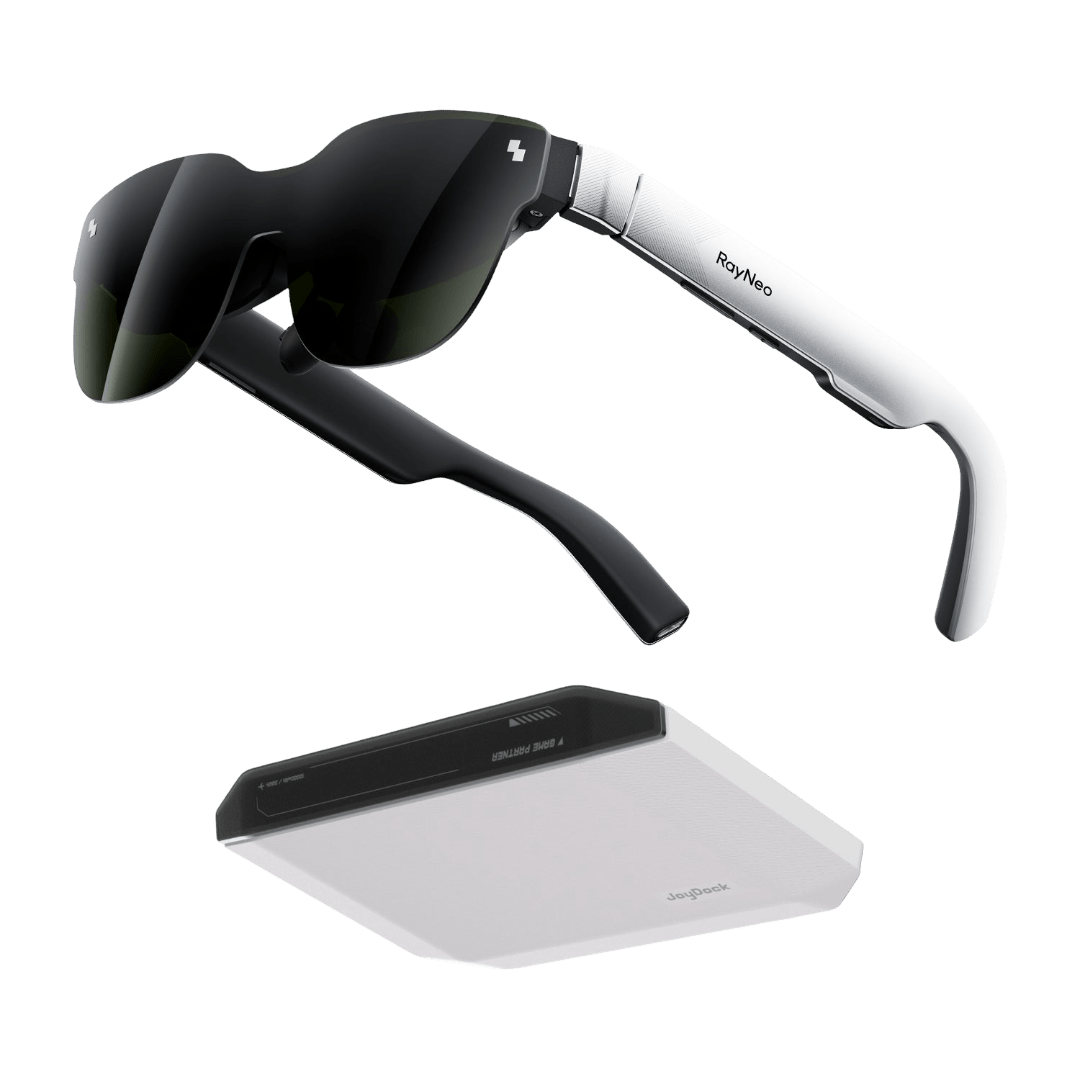


People with a strong nearsighted prescription tend to ask one question before anything else about a new frame: will it take their lenses at all. For AR glasses with a large virtual screen, RayNeo GT Max and RayNeo GT answer it with custom prescription lenses covering nearsightedness anywhere from 0 to -10.00D, ordered from our optical partner Lensology or made by a local optical store using the sample frame in the box.
That range reaches well into strong prescriptions, and both GT models share it, so a wearer can pick between them on the viewing experience they want. RayNeo Air 4 Pro, RayNeo X3 Pro and RayNeo iO each take a prescription too, each through its own route.
A strong prescription and the space in front of the eyes
The stronger the prescription, the more the position of the lens matters. Every glasses prescription is written for a lens worn a short distance in front of the eye, and at low powers a few millimeters either way makes little difference. At strong powers it starts to count. A -8.00D lens moved 5 millimeters further from the eye acts like a lens of roughly -7.70D, a difference that can matter for fine detail, which is why opticians measure fitting distances carefully for strong prescriptions. Tilt matters as well: a strong lens tilted away from the angle it was fitted for picks up unwanted astigmatism, and the effect grows with both the lens power and the tilt, so the angle of the frame on the face gets attention too.
Stacking everyday glasses underneath display glasses can work against that. The everyday frame may push the display glasses forward, and the everyday lenses may no longer sit where they were measured to sit.
A prescription insert removes the second frame. The lens is made for the display glasses and sits inside them, so a strong prescription wearer puts on one pair, with the correction carried inside the display glasses.
Myopia correction up to -10.00D on GT Max and GT
The GT Series sets one myopia range, 0 to -10.00D, for both GT Max and GT. On a prescription slip, myopia is the SPH (sphere) value written with a minus sign, so a slip reading -7.50 or -9.25 sits inside the range, and so does a mild -1.00.
The range matters because a virtual screen is presented optically as a large screen at a distance, not as a phone held close to the face. As a simplified guide, an uncorrected eye at about -8.00D focuses only out to roughly 12 centimeters, and at about -10.00D to roughly 10 centimeters, so a virtual cinema screen sits far beyond that point. A strong myope needs distance correction in front of the eyes to see that screen sharply, which makes a range reaching -10.00D the deciding detail for this group.
Both GT models carry the same range, so the decision between them comes from how the glasses will be used. For a strong nearsighted prescription and a large virtual screen, GT Max is the pick for films and games on the largest virtual screen in the series, while GT suits a wearer who wants the lighter frame of the two for travel and everyday viewing.
Lensology or the sample frame: two ways to order for GT Max and GT
GT Max and GT offer two routes to the lenses, and a strong prescription can suit either one.
The first route is Lensology, our official prescription lens partner, which makes custom lenses for GT Max and GT; it is the route we recommend for clearer visuals and greater comfort during extended AR use. The lenses are ordered separately with the wearer's prescription through the Lensology link on the GT Max and GT product pages, which suits a wearer who prefers to order online with a current prescription already in hand.
The second route starts with the box. GT Max and GT each include a prescription lens sample frame, and a local optical store can use it to fit custom lenses. This route suits a strong prescription wearer who already has a long relationship with one optician, someone whose current glasses were made with care for fitting distance and lens centering and who wants the same hands on the insert.
At the store, the optician works from the same slip used for everyday glasses and fits custom lenses to the sample frame. In standard optical practice, the PD sets where each optical center goes horizontally, and for a strong prescription some wearers like having that centering done by a store they already know.
For the store visit, the sample frame from the box and the latest prescription, PD included, are the two things to bring.
Prescription lenses can also be added to GT Max and GT after purchase. The glasses can arrive first, and the lenses follow by either route once the prescription is in hand.
Details to have ready for a strong prescription
A strong prescription leaves less room for small errors, so the order goes smoothest with four details gathered in advance:
Air 4 Pro, X3 Pro and iO for prescription wearers
For a strong nearsighted prescription combined with a large virtual screen, GT Max and GT are our recommendation. The other RayNeo models are built for different jobs, and each takes a prescription in a way that suits that job.
RayNeo Air 4 Pro, the current Air model for movies and gaming, supports prescription lens inserts ordered through Lensology, with a prescription-lens frame sample in the box.
RayNeo X3 Pro, our AI+AR glasses with a full-color display and camera, has its custom prescription lenses made by Lensology.
RayNeo iO with prescription lenses has the prescription built into the glasses when they are made, and every submitted prescription is checked by hand by our in-house optical team before production.
Across the lineup, each pair has its own job: the GT Series for a large virtual screen, iO for a pair worn all day for captions and reminders, and X3 Pro for AI assistance with a camera.
For a broader look at how nearsighted wearers use AR glasses, our guide to AR glasses for myopia covers the viewing side.
Strong-prescription FAQ
Can each eye have a different power in one insert?
Can a strong prescription and astigmatism go into the same insert?
Can a contact lens prescription be used to order an insert?
Share:
Leave a Comment
We'd love to hear your thoughts. Comments are reviewed before publication.