

$449.00

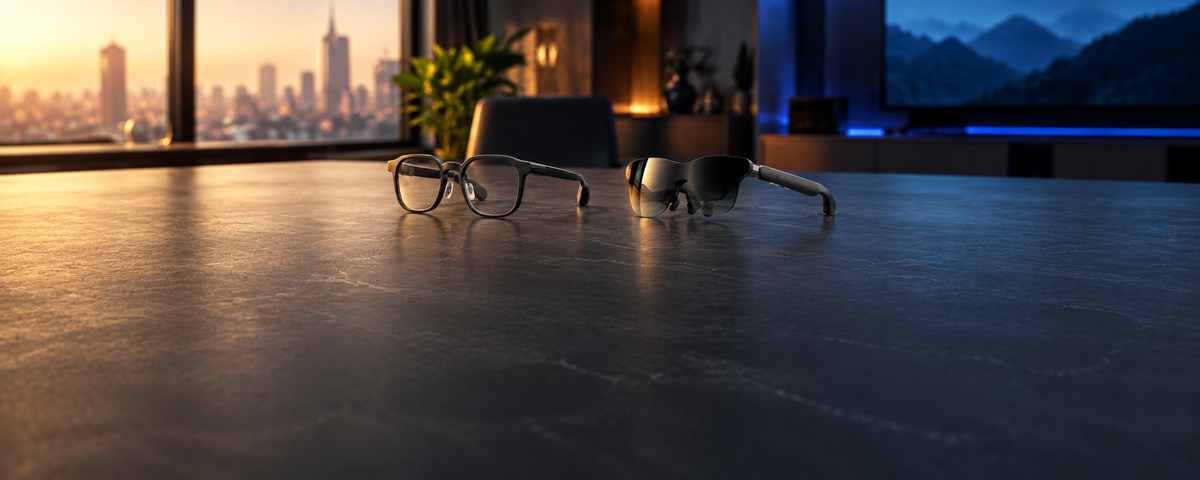
AI glasses are built to be an information layer you can wear from morning to night, while AR display glasses are built to put a large private screen in front of you whenever you plug in. Nearly every other difference, from weight and power to privacy and controls, follows from that one choice.
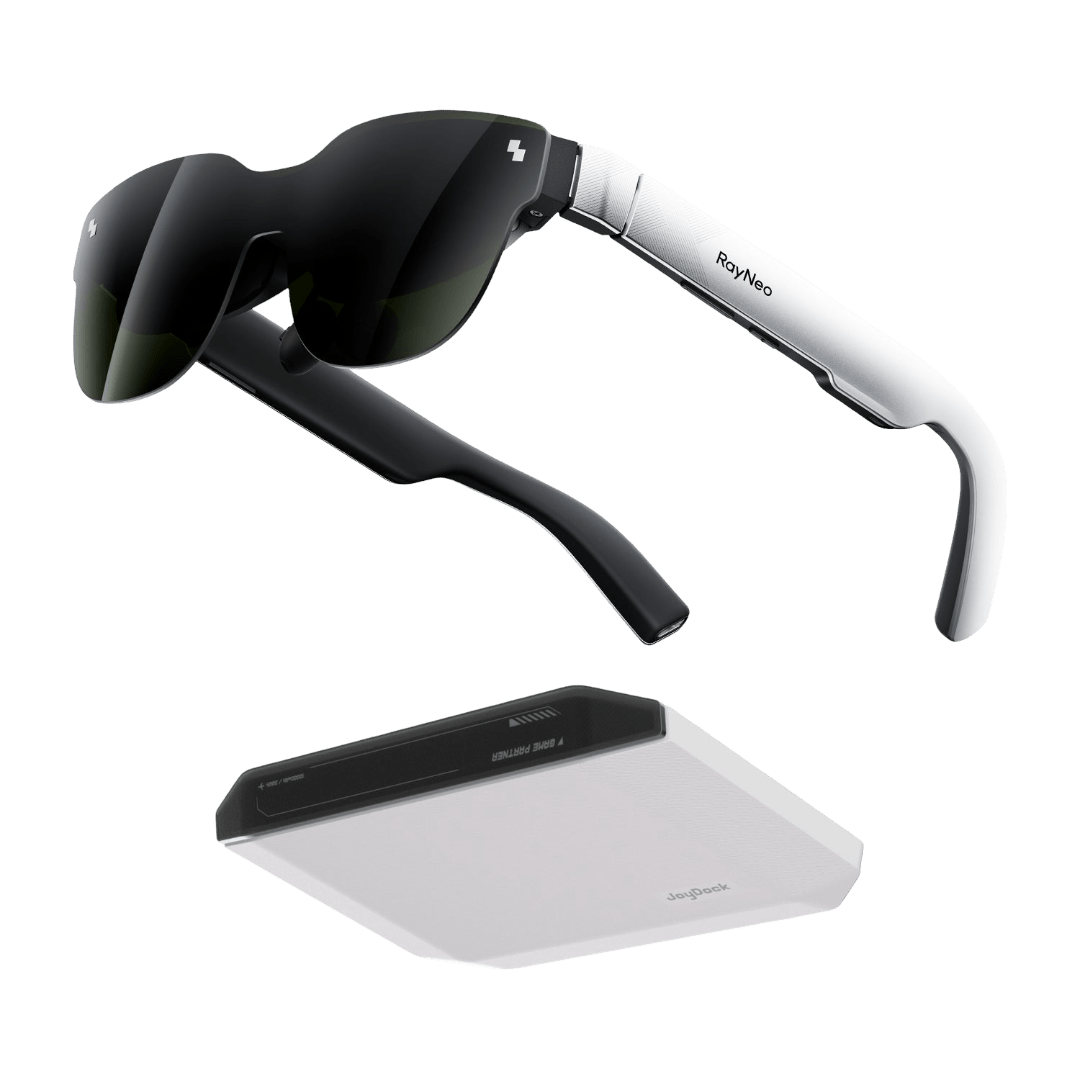
Two RayNeo models show the split clearly. RayNeo iO is a 33g pair of AI glasses whose transparent display carries captions, notes, and AI answers. RayNeo GT Max is a 78g pair of AR glasses that turns a phone, laptop, or handheld console into a 227, 267, or 307-inch cinema display, with consoles such as PS5 and Xbox joining through the RayNeo HDMI Adapter. For a model-by-model spec lineup, see our RayNeo smart glasses comparison.
| Trade-off | AI glasses: RayNeo iO | AR display glasses: RayNeo GT Max |
|---|---|---|
| Time on your face | 33g, built for all-day wear | 78g, built for movies, gaming, and long viewing sessions |
| Power routine | 240mAh battery in the frame, up to 2 days of everyday use | No battery; the connected device powers it over USB-C |
| Starting up | Unfold the temples and it reconnects to your phone | Plug in the cable and it turns on |
| What fills your view | Green text on a 97% transparent display, 23.5° field of view | A full-color 1920×1080 screen, 59° field of view |
| Controls | Smart Crown, voice, and head gestures | Three buttons on the frame, plus the source device |
| Privacy around others | Camera-free, with a status light when the microphone is active | A screen only the wearer sees |
Each row is a trade rather than a winner.
At 33 grams, iO is designed for all-day wear. The Crown Panto frame uses over 80% metal construction, silicone temple tips, and a nose pad kit with bridges in multiple sizes, and it carries an IP54 rating for everyday dust and splashes. It is built to stay on through a commute, a run of meetings, and dinner.
GT Max is built for a different kind of time. Its 78g streamlined unibody is designed for movies, gaming, and long viewing sessions, and its native 3DoF tracking keeps the screen steady as your head moves, which makes a full film or a long gaming stretch more comfortable. You put it on for something specific, then take it off and put it back in its carrying case.
The trade is presence against immersion. iO becomes part of your face for the day; GT Max becomes your screen for the evening.

iO has its own 240mAh battery and is rated for up to two days of everyday use, with 63 hours of standby while worn and 250 hours folded. Topping up works the way it does on a watch: the included charging clip attaches to the nose bridge and charges over USB-C. The optional RayNeo iO Eyewear Charging Case holds a 2000mAh battery that delivers up to five full charges, which keeps iO going through a long day away from an outlet.
GT Max skips the battery entirely and never needs charging. The connected phone, laptop, or console powers the glasses and sends the video through the included USB-C cable. The glasses turn on automatically when they detect a compatible power supply and video signal, and they turn off when the cable comes out.
In daily terms, iO travels with its charging clip or case, and GT Max travels with its cable.

Walking down a corridor or sitting across a table from someone, iO keeps your view almost entirely on the real world. The lens reads as clear glass, and a line of green text appears when you call it up: the next meeting on your calendar, a caption of what the other person just said, the answer to a question you asked RayNeo AI. The people in front of you see an ordinary pair of glasses, and your attention stays with them.
Sitting down changes the job. With GT Max, a full-color picture opens in front of you at a size you choose, from 227 to 307 inches, and the room fades into the background while a film or game plays. Its spatial modes let the screen stay centered, move gently with you on a train or plane, or stay fixed in place like a cinema wall. The optional Lens Shade for GT Max darkens the surroundings further in a bright cabin.
GT Max is designed for the moments you are seated, whether on a sofa, a plane, or a train, and iO for the moments you are on your feet and talking to people.
iO keeps its controls on the frame and in your voice. The Smart Crown on the right temple rotates to browse, clicks to select, and presses and holds to return to the Dashboard. Saying "Hey, RayNeo" opens the voice assistant, which can adjust brightness, turn on Focus Mode, start Live Captions, or open the teleprompter. When a notification arrives, a nod accepts it and a shake of the head dismisses it.
GT Max keeps its controls few and tactile, because the source device does most of the work. Three buttons sit on the frame. The Menu button opens the on-glasses menu, and a short press of the Spatial Mode button cycles through Steady, Pinned, and Follow, and holding it in Pinned mode recenters the screen. The volume rocker adjusts sound, and holding it switches between Standard, Whisper, and Spatial Surround audio. Pressing the volume and Spatial Mode buttons together flips between 2D and 3D. Everything else, from the film you pick to the game you play, runs on the phone, controller, or laptop you already know.
A pair worn into a client meeting, a classroom, or an office has to sit easily with everyone in the room. iO is built for exactly those rooms: it carries no camera at all, so colleagues never wonder whether they are being photographed. When Voice Memo is recording meeting notes, a white status light on the temple tip shows it, and system data is anonymized on the glasses before it leaves them. Recording follows local law, with consent from other participants where it is required.
GT Max approaches privacy from the opposite direction. Whatever plays on its screen is visible only to the wearer, so a spreadsheet on a crowded flight or a film in a shared living room stays your own.
Is owning both pairs redundant?
Can one phone run both pairs?
Which one should go on a business trip?
Pick by the hours you need covered: RayNeo iO for an information layer that lasts all day, and RayNeo GT Max for a private big screen whenever you plug in.




Share:
What Backup Controls Keep a Smart-Glasses Teleprompter on Pace?
Do Monocular and Binocular Smart-Glasses Displays Cause Different Eye Strain?