

Sale price$399.00
Regular priceReg. $429.00
Save $30.00


A long train ride is perfect for catching up on a movie until glare hits the screen, the tray table feels cramped, or every curve in the track makes a handheld display harder to follow.
Train entertainment AR glasses offer a different setup by putting a large virtual screen in your view without taking over your seat space. For longer journeys, though, screen size is only part of the decision. Stabilization, weight, fit, brightness control, and device compatibility all affect how practical the glasses feel once the train is moving.
So, which features actually make a difference on rail trips, and which AR glasses are worth considering? We’ll break down both below.

Trains are a surprisingly good use case for AR glasses. You often have enough time to watch a full movie, but not much room for a large screen, and the changing light and constant movement can make phones, tablets, and laptops less comfortable to use.
A virtual screen gives you more viewing scale without opening a laptop or balancing a tablet in a tight seat. That can be especially useful when the tray table is needed for food, a drink, or simply more elbow room. Because the display stays in your view, you can also sit back instead of leaning toward a small physical screen.
Train lighting changes quickly as you move between bright stations, direct sun, shaded sections, and tunnels. AR glasses reduce the need to fight reflections on a glossy tablet or laptop screen, while adjustable display brightness lets you respond to the carriage rather than keeping one setting for the entire trip.
The virtual image is primarily positioned for the wearer rather than everyone sitting nearby, which can make movies and subtitles feel less exposed than a bright laptop screen.
The best pair for rail travel is not necessarily the one with the largest advertised virtual screen. For commuting AR glasses, focus on the features that affect comfort and stability after an hour in a moving carriage.
Look for spatial tracking that offers a genuinely stabilized viewing mode, not only a screen that follows your head. A fixed or pinned mode works well when you are sitting still, while a follow mode is useful when you turn your head frequently.
If you are comparing Steady mode AR glasses, check that the stabilized mode is designed to filter small external bumps and vibration rather than simply locking the screen in place.
When choosing portable cinema glasses, around 70-80g or lighter is a useful starting benchmark for longer wear, but balance matters just as much as the number. Check nose-pad pressure, temple shape, and whether the frame stays stable when you lean back against the seat.
Also look at IPD support and prescription-lens options so the image remains clear without constant readjustment.
A field of view around 40-50° already creates a large cinema-style image, while roughly 55-60° feels more enveloping. Wider is not automatically sharper, so compare PPD as well.
Around the high-30s can work well for video, while mid-40s and above becomes more useful for subtitles, menus, and small text. In simple terms: wider FOV favors immersion; higher PPD favors fine detail.
Bright daytime carriages and dark tunnels demand very different settings. A strong peak-brightness figure can help in brighter conditions, but for a long trip you also want several usable brightness levels and a comfortable low setting.
High-frequency dimming or other flicker-control technologies can support more comfortable extended viewing, but they should not be treated as proof that unlimited screen time will be strain-free.
Open speakers are convenient because you do not need earbuds for every trip, but sound leakage matters on public transport. Directional speakers, a low-leakage or whisper mode, and easy volume control are useful when the carriage is quiet.
If privacy matters more than convenience, make sure the source device can also route audio to your own wired or wireless headphones.
A USB-C connector does not automatically support video. For direct use, check for DisplayPort over USB-C, DP Alt Mode, Thunderbolt, or another stated video-output standard. Some HDMI devices need an adapter.
Most tethered travel cinema glasses also draw power from the source device, so test the full setup before departure and check whether pass-through charging is available for longer journeys.
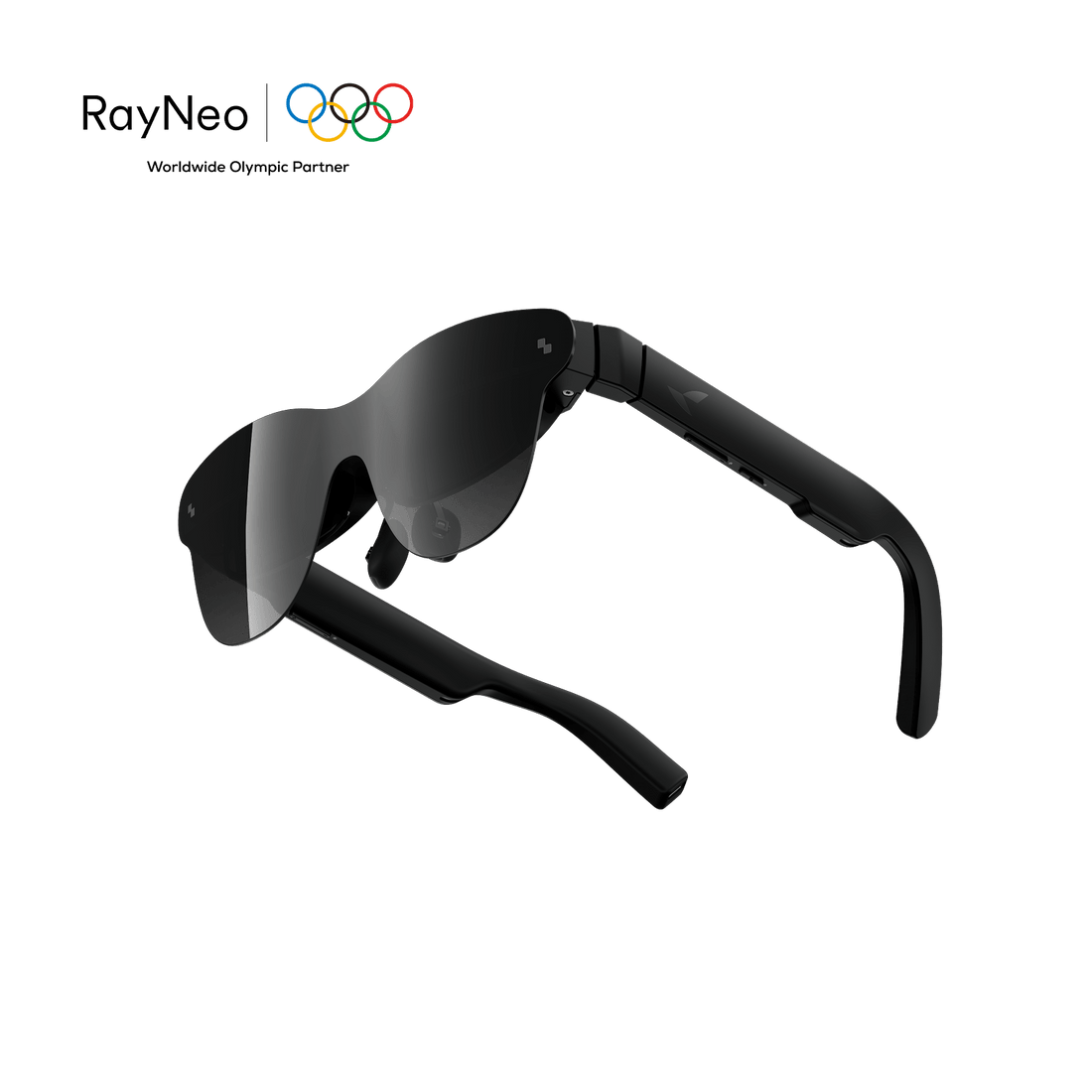
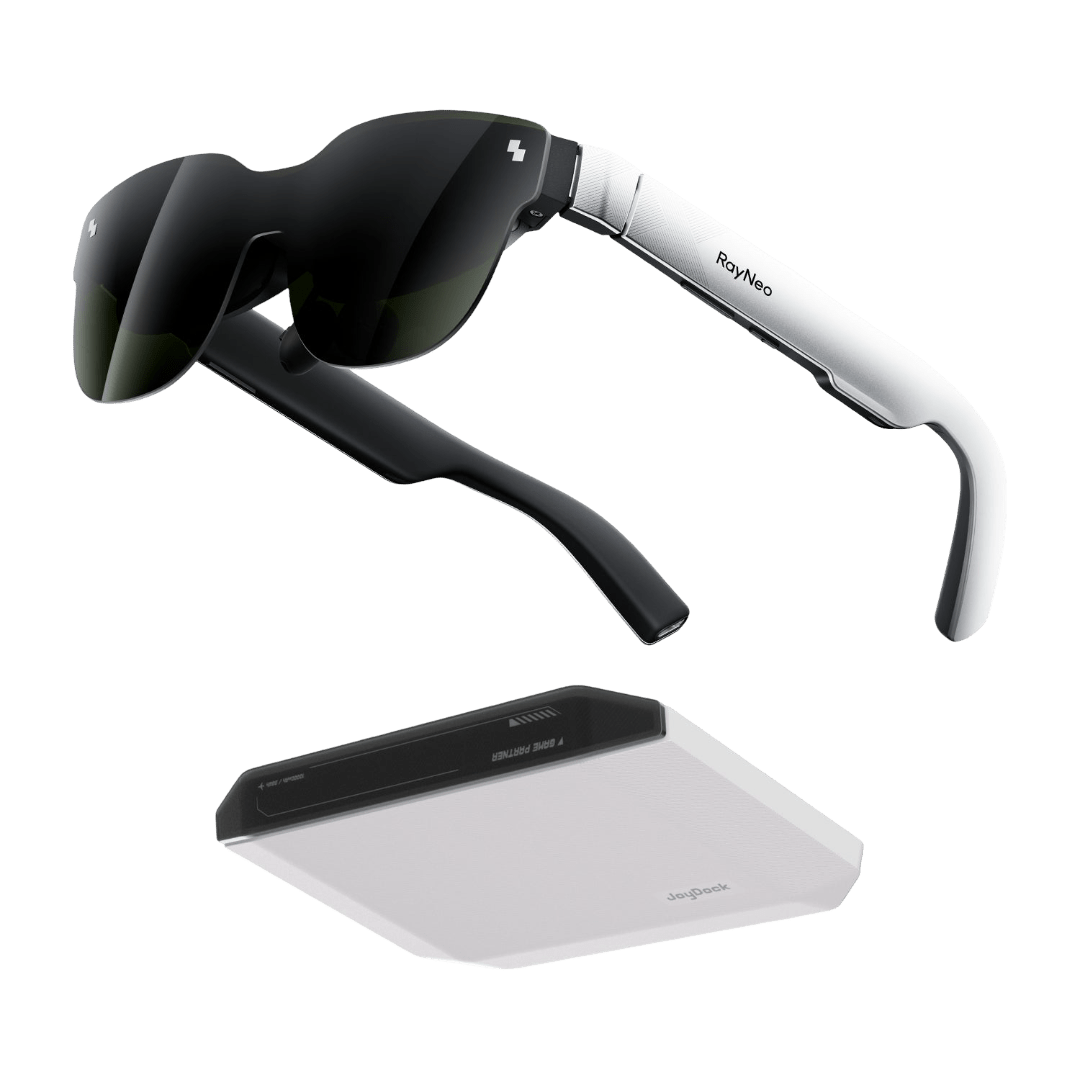
For rail travel, RayNeo AR Glasses are built around large-screen viewing in a compact form factor. The GT Series offers native 3DoF spatial tracking, adjustable virtual displays, Micro-OLED visuals, and B&O-tuned audio, with each model aimed at a slightly different travel experience.
The RayNeo GT Max AR Glasses is built around a more immersive cinema experience. Its 59° field of view and 267-inch default virtual display give movies a broad sense of scale, while the screen can also be adjusted to 227 or 307 inches when you want a more contained or expansive view.
For train travel, the bigger advantage is how the display adapts to movement. The Zone 360 3DoF Chip supports Steady, Pinned, and Follow modes, and GT Max is available in three physical IPD sizes so you can choose a closer optical fit before a long trip.

Best for: Long rail journeys and movie-focused travelers who want a wide, immersive view and flexible physical IPD sizing.
The RayNeo GT AR Glasses is designed for travel and everyday viewing, with a 68g frame that is easy to pack for regular commutes or longer trips. Its 201-inch default virtual display uses a 46° FOV, while 49 PPD helps keep subtitles and smaller interface details clear.
GT also includes native 3DoF spatial tracking, so you can use Steady mode when the carriage is moving, Pinned mode when you want a fixed cinema-style screen, or Follow mode when you prefer the image to stay centered as you move your head.

Best for: Frequent commuters and travelers who prioritize a lightweight frame, clear subtitles, and stable everyday viewing.
A little preparation can make the difference between a smooth trip and spending the first 20 minutes fixing the setup.
The best train entertainment AR glasses balance stable viewing, comfortable fit, clear detail, and simple device compatibility rather than relying on screen size alone. For frequent rail travel, pay particular attention to spatial stabilization, weight, brightness control, audio leakage, and power needs.
The RayNeo GT Series brings those priorities together in two travel-friendly cinema options, with GT Max focused on immersive viewing and GT designed around lightweight everyday use.
Not necessarily. If you do not need vision correction, you can usually wear display glasses as designed. If you are nearsighted or have astigmatism, check whether the model supports prescription inserts and what prescription range is available. Dedicated inserts are generally more practical than trying to wear full-size eyeglasses underneath. Also confirm that your IPD and the optical fit keep the virtual image clear across your view.
Yes, if your AR glasses are connected to a compatible device that can run Netflix and output video to the glasses. You can stream from a supported phone, tablet, laptop, or dedicated media player, or watch downloaded content when mobile service is unreliable. RayNeo Pocket TV Pro, for example, runs Google TV and provides direct access to Netflix and other streaming apps when paired with compatible GT Series glasses.
They can, depending on the model and setup. Most display-focused AR glasses need an external source for video and power, but that source does not have to be a smartphone. You may be able to connect a compatible laptop, tablet, handheld console, or portable media player instead. Before traveling, check the required video-output standard, cable or adapter, and how the glasses will be powered during longer sessions.





Share:
Best Airplane Entertainment AR Glasses 2026: Bring Your Own Big Screen in the Air
Best Steam Deck AR Glasses: 2026’s Picks for Giant-Screen Gaming