

$429.00

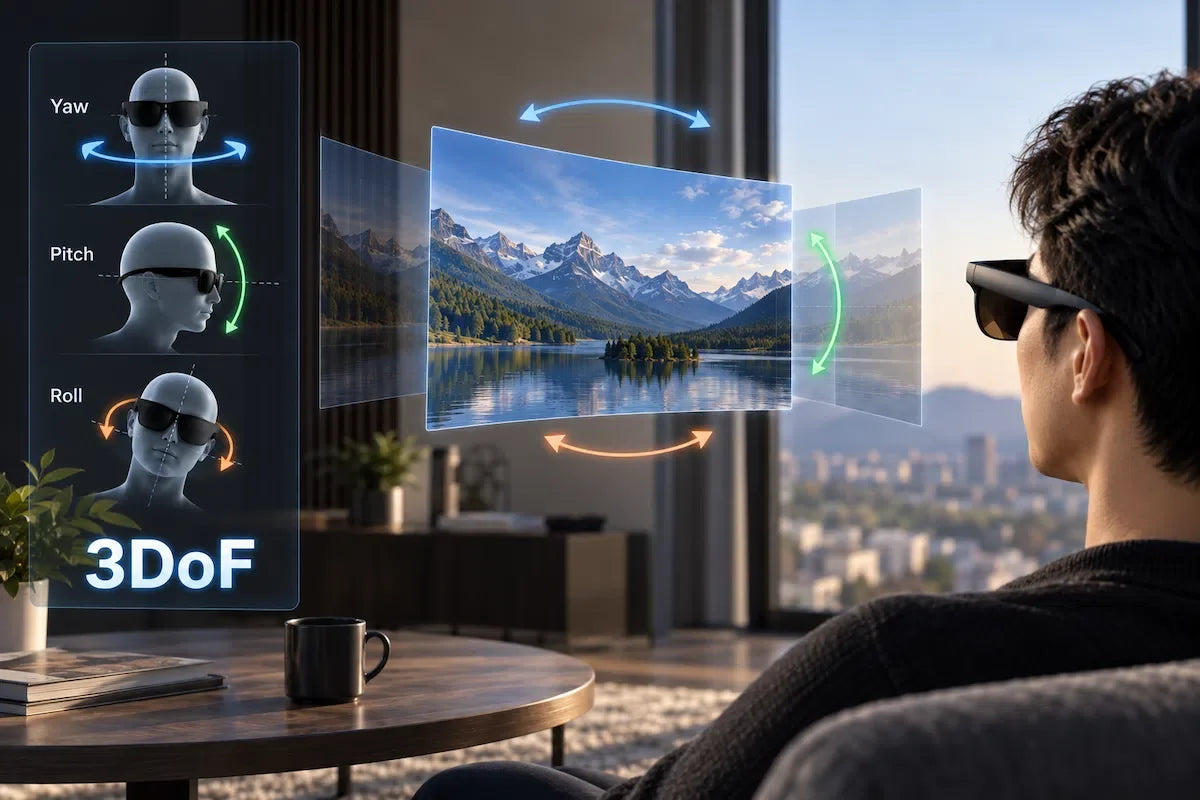
AR glasses can give you a large virtual screen almost anywhere, but screen size is only one part of the experience. How that display responds when you turn or tilt your head can make a big difference to how stable and natural it feels.
That is where 3DoF head tracking comes in. It tracks rotational head movements, so compatible AR glasses can adjust how the virtual screen behaves as your viewing direction changes.
The RayNeo GT Series brings native 3DoF to RayNeo AR glasses for the first time, with Steady, Pinned, and Follow modes designed for different viewing needs. This guide explains how 3DoF works, how it differs from 6DoF, and how the GT Series uses it to create a more stable and flexible viewing experience.

3DoF, or three degrees of freedom, tracks rotational movement around three axes: pitch, yaw, and roll. In practical terms, it can tell which direction your head is facing, but it does not track your exact position in physical space.
That means a 3DoF system can detect when you look up or down, turn left or right, or tilt your head. It cannot by itself tell that you have stepped sideways, leaned forward, or moved up and down.
In AR glasses, this orientation data can be used to control how a virtual screen responds to head movement, which is especially useful for seated, screen-based activities such as movies, gaming, and travel.
The name sounds technical, but the idea is straightforward. 3DoF is about head orientation, not eye gaze or full-body position. The glasses track how your head rotates and can use that information to update the virtual display in real time.
For display-focused AR glasses, that is often the movement that matters most. You may spend most of a movie or gaming session sitting in one place, but you still turn your head naturally, glance away, and change your viewing angle. 3DoF gives the glasses a way to respond to those movements without requiring full room-scale tracking.
Together, these three axes describe the rotational direction of your head. Tracking all three helps a virtual display respond consistently whether you turn, look up, or tilt slightly during use.
3DoF systems commonly rely on motion sensors grouped in an inertial measurement unit (IMU). A gyroscope measures rotational movement around the device’s axes, while accelerometer data can help the system understand motion and orientation. Software combines those readings to estimate how the glasses are rotating from moment to moment.
The important part for the wearer is what happens next. As your head turns or tilts, the glasses keep receiving updated orientation data. A compatible spatial mode can then use that data to decide whether the screen should stay in a chosen direction, remain steady through small movements, or continue following your view.
Both terms describe how much movement a tracking system can understand. 3DoF tracks rotation only. 6DoF adds three kinds of positional movement: forward and backward, left and right, and up and down.
| Tracking | 3DoF | 6DoF |
|---|---|---|
| Pitch, yaw, and roll | Yes | Yes |
| Forward/backward movement | No | Yes |
| Side-to-side movement | No | Yes |
| Up/down positional movement | No | Yes |
| Typical strength | Seated viewing and virtual displays | Room-scale movement and spatial interaction |
For example, if you turn your head to the left, both 3DoF and 6DoF can detect the rotation. If you keep looking forward but physically lean closer to a virtual object, 6DoF can also detect that change in position.
That does not make 3DoF a poor fit for AR glasses. When the main job is presenting a large virtual screen, the user is often seated, and the more important requirement is controlling how the display responds to head rotation.
Full positional tracking becomes more valuable when an experience expects you to move around a space or interact with virtual objects from different positions.
The benefit of 3DoF becomes easier to understand in everyday situations. By tracking how your head turns and tilts, compatible AR glasses can use that information to control whether a virtual screen stays steadier, remains fixed in one place, or stays centered in your view.
Watching a virtual screen on a train or plane can be distracting when every small movement seems to affect the image. When 3DoF is paired with a stabilization mode, the glasses can use head-rotation data to reduce unwanted screen movement while still allowing natural head motion.
That can make a movie or game easier to follow when the train vibrates, the plane encounters light turbulence, or you simply turn your head slightly during a long journey.
Sometimes you do not want the display to follow every head turn. When 3DoF is used to anchor a screen in a fixed virtual position, the experience becomes closer to looking at a TV, cinema screen, or monitor placed in front of you.
For example, while watching a movie on the sofa, you can briefly turn away and then look back to the same screen position. At a desk, you can glance down at your keyboard or toward another monitor without having the virtual display chase your gaze.
There are also times when keeping the screen fixed is less convenient. You might recline on the sofa, adjust your head on a pillow, or turn to the side while watching something casually.
3DoF can instead be used to keep the virtual screen centered as your head orientation changes. Rather than having to look back toward a fixed point, the display stays in front of your view. This makes the experience more flexible when you are changing viewing angles frequently rather than settling into one fixed position.
With the RayNeo GT Series, we bring native 3DoF to our AR glasses for the first time. Instead of treating the virtual screen as something that always follows the same movement pattern, the RayNeo GT and GT Max AR glasses let you choose how the display responds as you turn or tilt your head.
Both models use a dedicated Zone 360 3DoF Chip for spatial tracking alongside the Vision 4000 Display Chip for image processing. This dual-chip design gives spatial tracking its own dedicated processing, while the display chip handles the visual experience.
The result is three native 3DoF viewing modes—Steady, Pinned, and Follow—each designed for a different way of watching, playing, or working.
Steady Mode keeps the screen stable while allowing subtle natural movement. It is useful on flights, trains, and daily commutes, where small movements can otherwise make a virtual display harder to follow.
Pinned Mode fixes the virtual screen in one position instead of having it follow every head turn. It works well for movies, gaming, or focused viewing when you want the display to feel more like a TV or monitor placed in front of you.
Follow Mode keeps the display centered as you turn your head. It is a simple option for casual viewing when you are changing posture or viewing direction and want the screen to stay with you.
Together, the three modes let you choose between a steadier moving view, a fixed virtual screen, or a display that follows your viewing direction.

The GT Max and GT AR glasses share the same core native 3DoF experience, including Steady, Pinned, and Follow modes. The main differences are how large and wide the virtual screen feels, how the optics fit your IPD, and how much weight you want on the frame.
| Feature | RayNeo GT Max | RayNeo GT |
|---|---|---|
| Field of view | 59° | 46° |
| Virtual display sizes | 227 / 267 / 307 in | 136 / 201 / 231 in |
| Pixel density | 38 PPD | 49 PPD |
| Weight | 78g | 68g |
| IPD fit | S (<64mm), M (64-67mm), L (>67mm) | Fixed 64mm |
| 2D refresh rate | Up to 120Hz | Up to 120Hz |
| Spatial modes | Steady / Pinned / Follow | Steady / Pinned / Follow |
The RayNeo GT Max AR Glasses are built for viewers who want a more expansive virtual screen. A 59° field of view creates a 267-inch default display, with 227-inch and 307-inch options available, giving movies and big-screen games a more cinema-like sense of scale.
GT Max also offers more flexibility in optical fit, with three IPD sizes: S for under 64mm, M for 64–67mm, and L for over 67mm. At 78g with 38 PPD, it prioritizes screen size and immersion over an ultra-light frame or higher pixel density.
If a larger view and more adaptable IPD fit matter most, the GT Max is the more immersive choice.

The RayNeo GT AR Glasses take a lighter approach at 68g, making them well suited to commuting, travel, and longer everyday viewing. Their 46° field of view creates a 201-inch default virtual display, while 49 PPD helps keep text, subtitles, and fine image details crisp.
GT also supports up to 120Hz in 2D and includes the GT Series’ native Steady, Pinned, and Follow modes, so you still get control over how the virtual screen responds as you move your head.
The main fit consideration is the fixed 64mm IPD. For users who prioritize a lighter frame and higher image density over the widest possible field of view, GT offers a more portable way to experience 3DoF.

3DoF is fundamentally about orientation: it tracks pitch, yaw, and roll so AR glasses can understand how your head is turning without tracking your full position in space. For virtual displays, that can be enough to make screen behavior feel more deliberate and better suited to movies, gaming, and travel.
The GT Series brings native 3DoF to RayNeo AR glasses for the first time through Steady, Pinned, and Follow modes. The GT Max pairs those controls with a wider 59° field of view and more flexible IPD sizing, while GT offers the same core spatial modes in a lighter 68g design with 49 PPD. The better fit comes down to how much you value immersion, portability, and optical fit.
3DoF stands for three degrees of freedom. It means a device can track three types of rotational head movement: pitch (looking up or down), yaw (turning left or right), and roll (tilting your head side to side). In AR glasses, 3DoF tracking helps the virtual display respond to your head orientation, making the screen feel more stable and natural during viewing.
3DoF tracks rotational movement - pitch, yaw, and roll - while 6DoF also tracks physical position. With 6DoF, a system can tell when you move forward, backward, sideways, up, or down as well as when you turn your head. 3DoF is often sufficient for seated virtual-screen viewing, while 6DoF is more important for room-scale movement and spatial interaction.
Not full positional body movement. 3DoF can detect how your head rotates, but it does not independently track whether you step sideways, lean forward, crouch, or move vertically through a room. Tracking those changes in physical position requires additional positional tracking, as used in a 6DoF system.





Share:
RayNeo Pocket TV Pro: Build a Dolby Vision AR Cinema Anywhere
RayNeo Glasses Buying Guide: Which Smart Glasses Fit You?