Astigmatism can show up clearly in text: the horizontal bar of a letter may look crisp while the vertical strokes beside it go soft, or the reverse. Among display glasses, RayNeo GT Max and RayNeo GT take custom prescription lenses that correct astigmatism up to -2.00D, in the same insert that carries a nearsighted prescription.
The cylinder value on a prescription sets how much astigmatism correction the lens carries, and the axis sets which way that correction points. An insert does its job when both values reach the lens maker and the finished lens sits turned to that angle in front of the eye. RayNeo Air 4 Pro and RayNeo X3 Pro also take custom prescription lenses made by our optical partner Lensology.
Astigmatism on a virtual screen: blur along one direction
An eye with astigmatism does not focus every direction at the same distance. Lines running one way can look sharper than lines running at right angles to them, so the blur has a direction to it rather than being an even haze.
That directional quality is why astigmatism tends to be noticeable on a display. A film scene full of soft shapes may look acceptable, while a spreadsheet grid, a code editor or a subtitle line can look off, because thin lines run in exactly the orientations the eye handles unevenly. Vertical gridlines may look softer than horizontal ones, or the other way around.
Unlike simple nearsightedness, which mainly softens distant objects, astigmatism can blur detail at any viewing distance. It affects a book held close and a screen across the room alike, and a virtual screen is no exception.
Each eye can also have its own amount of astigmatism and its own direction, which is why a prescription lists cylinder and axis separately for the right and left eye.
A virtual screen is still seen through the wearer's own eyes, so the astigmatism correction belongs in a lens in front of them. The fix sits in the lens, which is why the prescription insert carries so much weight for this group of wearers.
The astigmatism range for GT Max and GT inserts
For RayNeo GT Max and GT, prescription lenses can be customized for astigmatism up to -2.00D. On a prescription slip that figure is read against the cylinder value, commonly written with a minus sign in quarter-diopter steps, so a cylinder of -0.75D or -1.75D sits within the range. A slip from a clinic that uses plus-cylinder notation describes the same eye in different arithmetic, with the sphere, cylinder and axis all rewritten, and any optician can convert it to minus form to read it against this range.
The range applies to each eye's lens on its own terms. A slip with -0.75D of cylinder in the right eye and -1.50D in the left becomes two lenses with two different corrections, each turned to its own axis, and both cylinder values sit within the GT series range.
Small cylinder values belong in the order too. A -0.50D or -0.75D cylinder can go unnoticed in daily life, and an insert made to the full prescription includes it rather than leaving it out.
The same lens can carry nearsightedness as well, since GT Max and GT lenses can be customized for myopia from 0 to -10.00D. A slip with both a sphere and a cylinder is normally made as one lens per eye, with no second layer of correction stacked in front of it.
Both GT models share this published range, so on prescription range alone neither has the edge. GT Max is the model for the biggest picture in the series, and GT is the lighter frame; our GT and GT Max comparison sets the two side by side on the display itself.
For an astigmatic wearer who wants a large virtual screen for films, games or work, GT Max and GT are a natural fit, because one insert per eye carries cylinder, axis and myopia together.
Ordering a toric insert with the axis intact
A lens that carries a cylinder correction is often called a toric lens. Its two principal directions carry different powers, and the axis value on the slip tells the lens maker how to orient the lens so its strong and weak directions line up with the eye's.
Three details keep the axis intact through an order:
- Each eye's cylinder and axis travel as a pair. The two eyes can have different values, and an axis entered against the wrong eye produces a lens that corrects the wrong direction.
- A recent full prescription is the right starting point. Cylinder and axis can shift over the years even when the sphere stays the same, and a lens is made to whatever values are on the order.
- The axis is copied digit for digit. Axes are commonly written from 1 to 180 degrees, often as three digits such as 005 or 175. Rounding 175 to 180 looks harmless on paper, yet it turns the correction five degrees away from where the eye needs it.
For GT Max and GT, the lens maker can be Lensology or a local optical store working with the prescription lens sample frame from the box, and the order carries the same values either way. Our guide to astigmatism and high myopia in AR glasses covers how the other numbers on a slip feed into an insert order.
Why the axis has to stay where it was set
A cylinder correction works fully only while it stays at the angle it was made for. Turn the lens away from that angle and part of the astigmatism comes back, at a direction the eye is not used to. The effect grows quickly: with the right cylinder power and only the angle off by 10 degrees, about one third of the astigmatism the lens was meant to correct is left over, pointing in a new direction.
That is why careful orientation is part of standard spectacle work. In everyday glasses, the optician marks the lens's axis and lines it up with the frame's horizontal reference before the lens is cut to shape, so the correction points where the prescription says.
A prescription insert brings the same care to display glasses. GT Max and GT ship with a prescription lens sample frame for fitting at a local optical store, and Lensology makes custom lenses for each GT model. Opticians also routinely check finished lenses on a lensmeter, an instrument that reads back the power and axis actually built into each lens, before handing them over.
Wearing the glasses level matters for the same reason. An axis is measured relative to the face, so a frame that sits tilted on the nose turns any lens it holds by the same angle.
Other RayNeo frames for an astigmatic wearer
The rest of the RayNeo lineup takes a prescription in its own way, matched to what each pair is built for.
The current Air model, RayNeo Air 4 Pro, is the entry-level choice in our AR entertainment lineup for movies and gaming, and it supports prescription lens inserts ordered through Lensology.
For a wearer who wants AI assistance, translation and a camera rather than a cinema screen, RayNeo X3 Pro supports custom prescription lenses from Lensology as well.
RayNeo iO, our everyday AI glasses with a transparent display, takes a different approach from an insert: it builds the prescription into the glasses themselves, and its order form takes the CYL and AXIS values alongside the sphere so the astigmatism correction is made in from the start.
Astigmatism-insert FAQ
Does the insert need the axis value as well as the cylinder?
Any cylinder other than zero comes with an axis, and a cylinder lens is made from the two values together. On many slips the pair is written as one entry, for example -1.25 x 170, where the number after the "x" is the axis in degrees. An axis of 180 and an axis of 0 describe the same horizontal direction, and slips commonly write 180.
Can one insert correct both nearsightedness and astigmatism?
A single lens can carry both corrections at once: the sphere handles the nearsightedness and the cylinder handles the astigmatism, so each eye gets one lens rather than two stacked layers. For GT Max and GT, the sphere is read against the series' myopia range and the cylinder against its astigmatism range.
Can the optician who made everyday glasses also make a GT Max or GT insert?
A local optical store can fit GT Max or GT lenses using the prescription lens sample frame from the box, which suits a wearer who already trusts a particular optician with an astigmatic prescription. Whichever store makes the lenses, each eye's cylinder and axis go into the order exactly as prescribed.


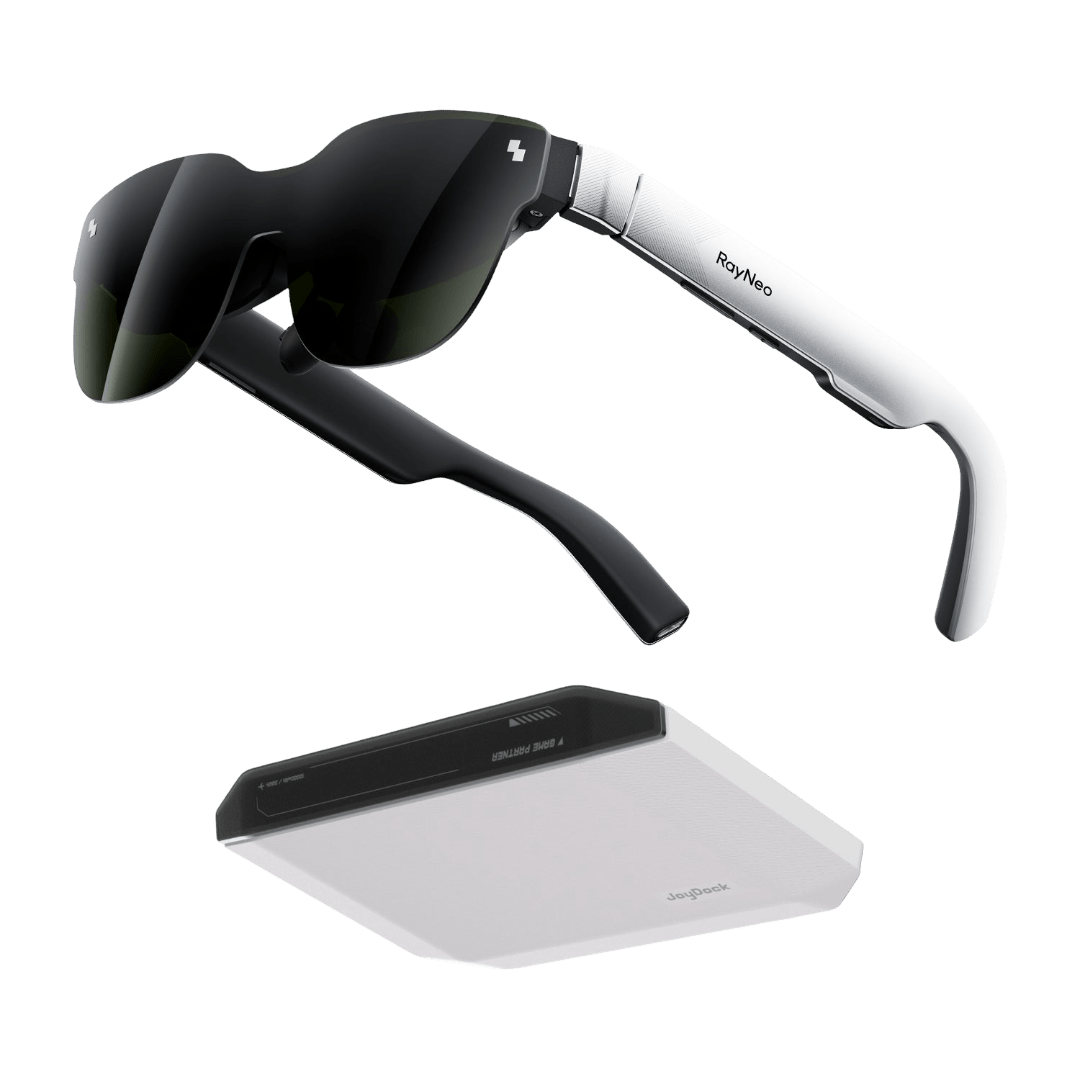


Astigmatism can show up clearly in text: the horizontal bar of a letter may look crisp while the vertical strokes beside it go soft, or the reverse. Among display glasses, RayNeo GT Max and RayNeo GT take custom prescription lenses that correct astigmatism up to -2.00D, in the same insert that carries a nearsighted prescription.
The cylinder value on a prescription sets how much astigmatism correction the lens carries, and the axis sets which way that correction points. An insert does its job when both values reach the lens maker and the finished lens sits turned to that angle in front of the eye. RayNeo Air 4 Pro and RayNeo X3 Pro also take custom prescription lenses made by our optical partner Lensology.
Astigmatism on a virtual screen: blur along one direction
An eye with astigmatism does not focus every direction at the same distance. Lines running one way can look sharper than lines running at right angles to them, so the blur has a direction to it rather than being an even haze.
That directional quality is why astigmatism tends to be noticeable on a display. A film scene full of soft shapes may look acceptable, while a spreadsheet grid, a code editor or a subtitle line can look off, because thin lines run in exactly the orientations the eye handles unevenly. Vertical gridlines may look softer than horizontal ones, or the other way around.
Unlike simple nearsightedness, which mainly softens distant objects, astigmatism can blur detail at any viewing distance. It affects a book held close and a screen across the room alike, and a virtual screen is no exception.
Each eye can also have its own amount of astigmatism and its own direction, which is why a prescription lists cylinder and axis separately for the right and left eye.
A virtual screen is still seen through the wearer's own eyes, so the astigmatism correction belongs in a lens in front of them. The fix sits in the lens, which is why the prescription insert carries so much weight for this group of wearers.
The astigmatism range for GT Max and GT inserts
For RayNeo GT Max and GT, prescription lenses can be customized for astigmatism up to -2.00D. On a prescription slip that figure is read against the cylinder value, commonly written with a minus sign in quarter-diopter steps, so a cylinder of -0.75D or -1.75D sits within the range. A slip from a clinic that uses plus-cylinder notation describes the same eye in different arithmetic, with the sphere, cylinder and axis all rewritten, and any optician can convert it to minus form to read it against this range.
The range applies to each eye's lens on its own terms. A slip with -0.75D of cylinder in the right eye and -1.50D in the left becomes two lenses with two different corrections, each turned to its own axis, and both cylinder values sit within the GT series range.
Small cylinder values belong in the order too. A -0.50D or -0.75D cylinder can go unnoticed in daily life, and an insert made to the full prescription includes it rather than leaving it out.
The same lens can carry nearsightedness as well, since GT Max and GT lenses can be customized for myopia from 0 to -10.00D. A slip with both a sphere and a cylinder is normally made as one lens per eye, with no second layer of correction stacked in front of it.
Both GT models share this published range, so on prescription range alone neither has the edge. GT Max is the model for the biggest picture in the series, and GT is the lighter frame; our GT and GT Max comparison sets the two side by side on the display itself.
For an astigmatic wearer who wants a large virtual screen for films, games or work, GT Max and GT are a natural fit, because one insert per eye carries cylinder, axis and myopia together.
Ordering a toric insert with the axis intact
A lens that carries a cylinder correction is often called a toric lens. Its two principal directions carry different powers, and the axis value on the slip tells the lens maker how to orient the lens so its strong and weak directions line up with the eye's.
Three details keep the axis intact through an order:
For GT Max and GT, the lens maker can be Lensology or a local optical store working with the prescription lens sample frame from the box, and the order carries the same values either way. Our guide to astigmatism and high myopia in AR glasses covers how the other numbers on a slip feed into an insert order.
Why the axis has to stay where it was set
A cylinder correction works fully only while it stays at the angle it was made for. Turn the lens away from that angle and part of the astigmatism comes back, at a direction the eye is not used to. The effect grows quickly: with the right cylinder power and only the angle off by 10 degrees, about one third of the astigmatism the lens was meant to correct is left over, pointing in a new direction.
That is why careful orientation is part of standard spectacle work. In everyday glasses, the optician marks the lens's axis and lines it up with the frame's horizontal reference before the lens is cut to shape, so the correction points where the prescription says.
A prescription insert brings the same care to display glasses. GT Max and GT ship with a prescription lens sample frame for fitting at a local optical store, and Lensology makes custom lenses for each GT model. Opticians also routinely check finished lenses on a lensmeter, an instrument that reads back the power and axis actually built into each lens, before handing them over.
Wearing the glasses level matters for the same reason. An axis is measured relative to the face, so a frame that sits tilted on the nose turns any lens it holds by the same angle.
Other RayNeo frames for an astigmatic wearer
The rest of the RayNeo lineup takes a prescription in its own way, matched to what each pair is built for.
The current Air model, RayNeo Air 4 Pro, is the entry-level choice in our AR entertainment lineup for movies and gaming, and it supports prescription lens inserts ordered through Lensology.
For a wearer who wants AI assistance, translation and a camera rather than a cinema screen, RayNeo X3 Pro supports custom prescription lenses from Lensology as well.
RayNeo iO, our everyday AI glasses with a transparent display, takes a different approach from an insert: it builds the prescription into the glasses themselves, and its order form takes the CYL and AXIS values alongside the sphere so the astigmatism correction is made in from the start.
Astigmatism-insert FAQ
Does the insert need the axis value as well as the cylinder?
Can one insert correct both nearsightedness and astigmatism?
Can the optician who made everyday glasses also make a GT Max or GT insert?
Share:
Leave a Comment
We'd love to hear your thoughts. Comments are reviewed before publication.