

$429.00

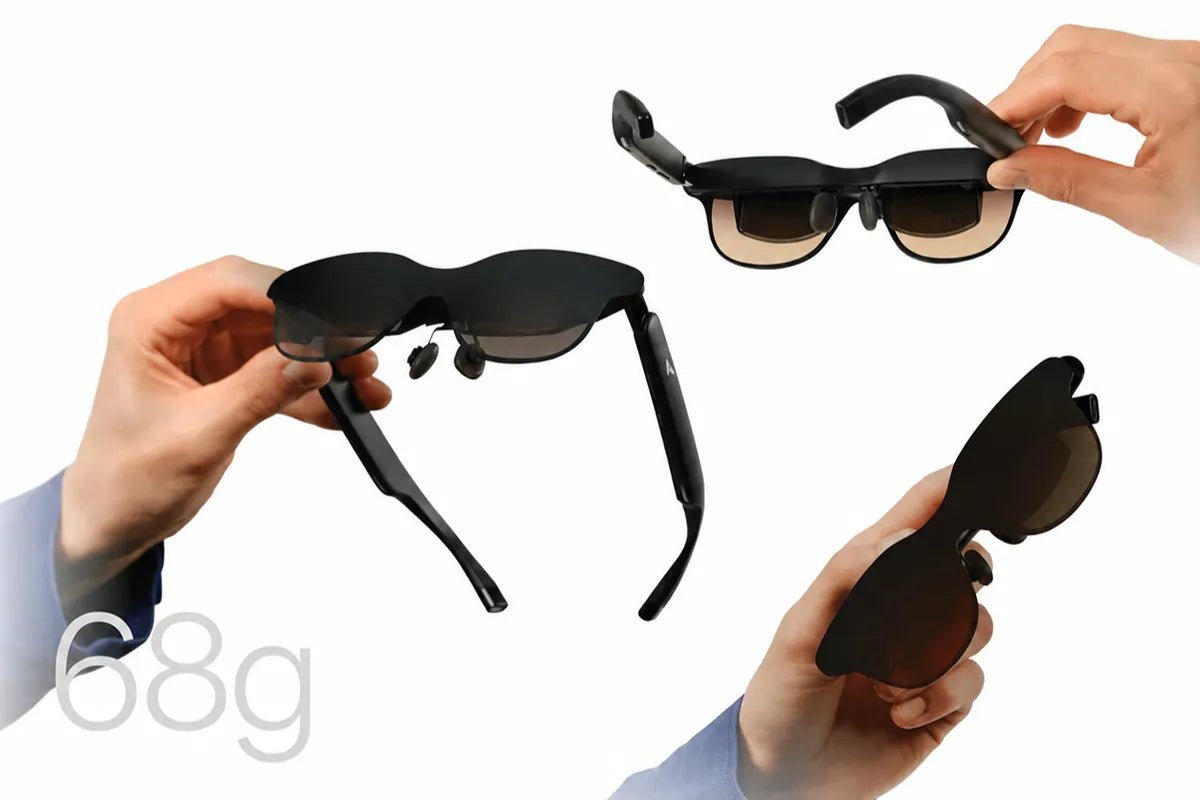
RayNeo GT and GT Max share the same display panel, the same chip, the same refresh rate, and the same audio hardware. The main differences come down to price, weight, field of view, virtual screen size, pixels per degree, and how each one is sized to your eyes.
GT Max is listed at $429 with a current launch-offer checkout price of $399 (per the product page on October 2, 2026), weighs 78g, and uses a 59-degree field of view to project a virtual screen that scales up to 307 inches. GT is listed at $329 with a current launch-offer checkout price of $299, weighs 68g, and uses a 46-degree field of view topping out at 231 inches. GT Max also offers three IPD (interpupillary distance) size options chosen at purchase, while GT uses one fixed 64mm optical design.
The numbers below are current as of early October 2026. RayNeo’s GT Max product page and GT product page are the source for every figure in this article, and both list current pricing, so it’s worth a quick check there before you buy.
| Spec | RayNeo GT | RayNeo GT Max |
|---|---|---|
| Price | $329 list; $299 shown as the current launch-offer checkout price on Oct 2, 2026 | $429 list; $399 shown as the current launch-offer checkout price on Oct 2, 2026 |
| Weight | 68g | 78g |
| Field of view (FOV) | 46° | 59° |
| Virtual screen sizes | 136” / 201” / 231” (default 201”) | 227” / 267” / 307” (default 267”) |
| Pixels per degree (PPD) | 49 (per RayNeo’s product page) | 38 (per RayNeo’s product page) |
| IPD sizing | Fixed 64mm optical design, aligned via adjustable nose pads | Three IPD size options selected at purchase: S (under 64mm) / M (64–67mm) / L (over 67mm); nose pads adjust fit independently |
| Optical engine | Peacock Optical Engine 3.0 | Peacock Optical Engine 3.0 Max |
| Display panel | 0.6” SeeYa Micro-OLED, 1920x1080 | 0.6” SeeYa Micro-OLED, 1920x1080 |
| Refresh rate | 120Hz (2D) / 60Hz (3D) | 120Hz (2D) / 60Hz (3D) |
| Brightness | 336 nits (Pinned mode) / 1,200 nits (non-Pinned) | 336 nits (Pinned mode) / 1,200 nits (non-Pinned) |
| Contrast / color | 200,000:1, 98% DCI-P3, 145% sRGB, ΔE<2 | 200,000:1, 98% DCI-P3, 145% sRGB, ΔE<2 |
| Chip | Vision 4000 + Zone 360 3DoF (onboard) | Vision 4000 + Zone 360 3DoF (onboard) |
| Display modes | Standard / Movie / Eye Protection / Office | Standard / Movie / Eye Protection / Office |
| Spatial modes | Steady / Pinned / Follow | Steady / Pinned / Follow |
| Audio | B&O-tuned quad speakers, Whisper Mode 2.0 | B&O-tuned quad speakers, Whisper Mode 2.0 |
| Eye care | OptiCare 3840Hz PWM dimming, TÜV SÜD certified | OptiCare 3840Hz PWM dimming, TÜV SÜD certified |
| 3D support | Native 3D plus AI 2D-to-3D video conversion supported under RayNeo’s current conditions (iPhone 15/16/17 series over direct USB-C, or Android phones from 2022 or later with DisplayPort output and a Snapdragon 8 Gen 2/3/Elite/Elite Gen 5 or a newer supported Snapdragon flagship chip, via the RayNeo XR app; non-Snapdragon phones currently unsupported; confirm on RayNeo’s support page) | Same support conditions as GT |
| Dolby Vision | Requires Pocket TV Pro (optional accessory) | Requires Pocket TV Pro (optional accessory) |
| Prescription lenses | Supported via Lensology | Supported via Lensology |
| Optional accessories | Sound Tube ($19), Lens Shade ($19, stock varies) | Sound Tube ($19), Lens Shade ($19) |
| Warranty / returns | 30-day returns, 1-year warranty, 12% trade-in credit | 30-day returns, 1-year warranty, 12% trade-in credit |
The $100 gap between GT and GT Max isn’t a markup on an otherwise identical product. It pays for:
If none of those four things matter for how you’ll use the glasses, GT gives you the same panel, chip, and audio for $100 less at the current launch-offer checkout price.
Ten grams by itself isn’t much, about the weight of two US quarters. But that comparison undersells it, because this weight isn’t added to something you hold in your hand. It’s added to a device sitting on your nose and ears for the length of a movie or a gaming session.
Both GT (68g) and GT Max (78g) already weigh roughly two to three times what a typical pair of prescription glasses weighs (usually in the 20 to 30g range), and nearly all of that weight concentrates on the same two pressure points: the nose bridge and the backs of your ears. Weight sitting on those points tends to register sooner than the same weight spread across a backpack strap or a phone in your pocket.
GT Max is 10g heavier than GT, roughly a 15% increase over GT’s 68g weight. GT is the lower-weight option; GT Max offers the wider field of view. Neither specification predicts a comfortable session length on its own, so consider nose-pad fit, pressure at the temples, and how the glasses feel during your intended use.


GT Max’s 59-degree FOV is the reason its virtual screen can scale up to 307 inches, versus GT’s 231-inch ceiling at 46 degrees. In practice, this means GT Max’s screen fills more of your peripheral vision, so a movie or a game feels closer to sitting in the front rows of a theater instead of watching from the back.
Both glasses offer three fixed screen-size presets rather than a continuous zoom. GT Max steps through 227”, 267”, and 307” (defaulting to 267”); GT steps through 136”, 201”, and 231” (defaulting to 201”). You switch between presets rather than dialing in an arbitrary size, so think of each tier as a fixed “seat” in a virtual theater rather than a slider.


This is the one spec where the cheaper model has a numerical edge. Both glasses use the identical 1920x1080 panel, and RayNeo publishes 49 PPD for GT against 38 PPD for GT Max. The difference tracks each model’s own field of view: GT’s narrower 46-degree FOV packs the same panel into less angular space, while GT Max’s wider 59-degree FOV spreads it further.

Higher PPD means sharper per-pixel detail, which matters most for reading dense text or working with fine UI elements. Lower PPD with a wider FOV trades some of that pixel density for a larger, more immersive screen. If you mostly read documents, spreadsheets, or long articles, GT’s tighter pixel density can look crisper. If you mostly watch video or play games where screen size and immersion matter more than text sharpness, GT Max’s wider FOV is the better trade.
GT uses a single fixed 64mm IPD, a figure commonly cited as close to the average adult interpupillary distance, and relies on adjustable nose pads for fit rather than any change to the optics. If your IPD is noticeably smaller or larger than 64mm, the image can feel slightly off-center or harder to focus on.
GT’s fixed 64mm optical design does not come with a published IPD tolerance range. GT Max’s S/M/L bands apply to GT Max only; they cannot establish which IPDs will be comfortable on GT. Measure your IPD and assess fit separately rather than borrowing another model’s size boundaries.
GT Max solves this with three hardware variants chosen at purchase:
You select the size when you buy, based on your measured IPD, not after the fact. The optics are built into each variant rather than mechanically adjustable, so “selected at purchase” is the accurate shorthand for the sizing, not “adjustable after you own it.” Nose pad fit remains separately adjustable on both models, and that’s independent of IPD sizing.
RayNeo’s IPD measurement tool provides a starting point before choosing a size. An optician’s measurement can also help. IPD is one part of fit: nose-pad position, prescription needs, and whether the full image is clearly visible matter too, so a measurement alone does not guarantee comfort.

Outside of the differences above, GT and GT Max share many of the same subsystems. Specifically, they share:
Both models also have their own Lens Shade accessory ($19 each), a clip-on shade meant to block peripheral light for better contrast in bright rooms. The GT and GT Max versions are model-specific and not interchangeable, and as of this writing, RayNeo’s official GT Lens Shade listing shows as out of stock (“notify me when it’s available”), so it’s worth confirming current stock before you count on it as part of your purchase.
The Sound Tube accessory ($19) is available for both models. Its own product page, separate from the main GT and GT Max listings, describes it as guiding sound closer to your ears to cut down on leakage. It’s worth considering if the open quad speakers’ limited privacy range matters in your setting: RayNeo’s spec sheet describes the sound as audible to people within roughly 1.5 meters, harder to make out beyond that distance.
If your priority is the biggest possible screen and you’ve confirmed your IPD isn’t a comfortable match for a fixed 64mm design, GT Max is the more deliberate choice. It’s also the better fit if you watch a lot of video or play games where a wider field of view adds more to the experience than pixel-level sharpness does.
If you mainly want a lighter, less expensive pair that still runs the same chip, panel, and audio, GT covers that without the extra $100 or the extra 10 grams. Its narrower FOV even gives you a sharper per-pixel image for text-heavy use. The trade-off is a fixed IPD and a smaller screen ceiling, both of which are worth checking against your own needs (and your measured IPD) before deciding.
Is GT Max simply a better version of GT?
Can I buy GT and upgrade to GT Max’s screen size later?
Do GT and GT Max need the same accessories to get Dolby Vision?
Is the refresh rate or brightness different between the two models?
Can I only use AI 2D-to-3D conversion on an iPhone?
GT and GT Max are built around the same display panel, chip, refresh rate, and audio system, so the decision mostly comes down to how much screen size and field of view you want, and whether your IPD calls for GT Max’s size-at-purchase options. Check your IPD at ipd.rayneo.com before choosing, then compare current pricing and stock on the RayNeo GT and RayNeo GT Max product pages.





Share:
RayNeo GT Max Full Spec Sheet Explained: FOV, Virtual Screen Sizes, and Brightness Modes
RayNeo GT and GT Max IPD Options Explained: Fixed 64mm vs. S/M/L Size Options