“AI smart glasses” gets slapped on almost any camera or display glasses on the market, but the real test is narrower: does the device run a voice assistant, usually a cloud AI model like Gemini, GPT, or Claude, that can answer a question or react to what its camera sees, hands-free? A screen or a camera alone doesn’t make a device AI glasses; the assistant does. RayNeo’s X3 Pro pairs that assistant with a display and camera; RayNeo’s iO drops the camera for a lighter, all-day frame.
AI, AR, and Smart Glasses: Three Overlapping Labels
“Smart glasses” is the umbrella term. It covers any pair of glasses with embedded electronics, audio, camera, display, AI assistant, or some combination, so nearly every product in this category technically qualifies. That makes it the least useful term for narrowing down what you actually want.
“AR glasses” (augmented reality glasses) refers specifically to having a display that projects digital content into your field of view, whether that’s a navigation arrow, a notification, or a full virtual screen for watching video. A pair of AR glasses doesn’t need an AI assistant, a microphone, or even a camera to qualify; the display is the defining feature.
“AI glasses” refers to the assistant layer: a microphone, a connection to a cloud AI model, and the ability to answer an open-ended question or hold part of a conversation. A pair of AI glasses doesn’t need a display at all; some models on the market handle voice queries and camera-based questions through a companion app with no on-lens screen.
| Term |
What it actually requires |
Does it require a display? |
Does it require an AI assistant? |
| Smart glasses |
Any embedded electronics (audio, camera, display, or assistant) |
No |
No |
| AR glasses |
A display that overlays digital content on your view |
Yes |
No |
| AI glasses |
A microphone connected to a cloud AI model for conversation or queries |
No |
Yes |
A single device can be all three at once. RayNeo’s X3 Pro is a working example: it has a display (so it’s AR glasses), a Google Gemini assistant (so it’s AI glasses), and a camera, combined in one frame. RayNeo’s Air series, by contrast, is AR glasses without being AI glasses at all, since it has a display but no microphone or assistant of any kind.
The Four Hardware Configurations Behind “AI Glasses” Today
Once you set aside the marketing language, the AI and AR glasses market currently splits into four practical hardware types. These four categories get mixed together constantly, which is why buyers sometimes end up with a pair of “AI glasses” that doesn’t do what they expected.
-
Camera-first audio glasses: a camera, microphones, and speakers, but no display. Some models in this category route photos or footage through a companion app for AI-based questions (“what’s in this photo?”), others don’t include any AI layer at all. This configuration isn’t currently part of RayNeo’s lineup.
-
Display-only AR glasses: a screen for watching video, gaming, or mirroring a laptop or console, with no camera and no built-in microphone or assistant. RayNeo’s Air series (Air 2s, Air 3s Pro, Air 4 Pro) fits here, as does the newly announced GT and GT Max, a cinema-focused pair of AR glasses RayNeo unveiled on August 21, 2026 alongside iO, with retail availability starting September 4, 2026. RayNeo’s own launch announcement describes GT Max’s display running at up to a 59-degree field of view, 1,200 nits of brightness, a 120Hz refresh rate, and a 307-inch equivalent virtual screen size. Dolby Vision playback is also part of the announcement, but only when GT Max is paired with RayNeo’s separate Pocket TV Pro device; on its own, without that companion hardware, GT Max isn’t described as supporting Dolby Vision. RayNeo hasn’t published pricing for GT or GT Max yet; that’s expected to firm up at the September 4 launch.
-
AI assistant + display, no camera: a microphone, a display, and a cloud AI backend, without a built-in camera. RayNeo’s newly announced iO fits this category, positioned around reducing how often you reach for your phone during the day rather than around photo or video capture.
-
Integrated AI + AR + camera: a camera, a display, and a voice assistant, all combined in one device. RayNeo’s X3 Pro is built this way, and its discontinued predecessor, the X2, was an earlier example of the same combined approach.
Which AI Glasses Are Most Useful? It Depends on Which Job You Need Done
There’s no single “most useful” pair of AI glasses across the board, because the four hardware types above are built to solve different problems. The more useful question is which category matches what you’re actually trying to do:
-
You want an assistant that can see what’s in front of you, translate a live conversation, and capture a quick photo or clip, all in one device. That’s the integrated AI + AR + camera category. Within RayNeo’s lineup, the X3 Pro is built for this.
-
You want an AI assistant with you all day, for dictation, meeting transcription, or quick questions, but don’t care about a built-in camera and want something as light as possible. That’s the AI assistant + display, no camera category. RayNeo’s iO, launching September 4, 2026, is built for this.
-
You want a bigger virtual screen for watching video, gaming, or mirroring a laptop, and have no interest in a voice assistant or camera at all. That’s the display-only AR category. RayNeo’s Air series (and the newly announced GT/GT Max) is built for this.
-
You want hands-free photo or video capture without any display or AI assistant getting in the way. That’s the camera-first audio glasses category, a segment of the market built purely around capture rather than an assistant or a screen. It’s not a configuration in RayNeo’s current lineup, which instead pairs that assistant layer with a display (X3 Pro) or trims down to the lightest possible all-day frame (iO).
RayNeo X3 Pro: An AI Assistant, a Display, and a Camera in One Frame

The RayNeo X3 Pro combines a voice assistant, a color AR display, and a camera in one frame.
-
Assistant: Always-on Google Gemini, triggered hands-free with a “Hey RayNeo” wake word
-
Microphones: 3-microphone beamforming array
-
Chipset: Qualcomm Snapdragon AR1
-
Display: 640x480 full-color MicroLED, roughly 30-degree diagonal field of view
-
Main camera: 12MP Sony IMX681 sensor
-
Secondary camera: Monochrome, used for spatial tracking rather than photography
-
Translation languages: About 14, including Chinese, English, Cantonese, German, French, Spanish, Italian, Japanese, Korean, Russian, Thai, Vietnamese, Indonesian, and Malay
-
Weight: 76 grams
-
Price: Promotional $1,099, down from a $1,299 list price (as of this writing)
The beamforming array is designed to pick your voice out from background noise on a street or in a café, rather than needing you to speak directly into a phone mic. Once triggered, you can ask a question, get a live translation, or trigger a Meeting Notes recording, all by voice. The display itself is sized for glanceable overlays, a translated subtitle, a navigation arrow, a notification, rather than for watching a wide-frame video.
That weight is noticeably heavier than a typical pair of everyday glasses (usually around 20 to 30 grams), since the frame carries a processor, battery, display, and dual cameras that ordinary glasses don’t. How long it lasts depends heavily on what’s actually running: RayNeo’s own materials describe roughly 30 to 36 minutes of continuous video recording, about 1 to 2 hours of active AR display and camera use together, about 3 hours of continuous music playback, and up to about 5 hours of recording, such as Meeting Notes audio capture, on a full charge. In practice, that means a translated conversation, a quick round of directions, or a day of intermittent meeting recording fits comfortably in a charge, while continuous video recording draws down the battery much faster than the other functions. Check the current product page for the live price, since promotions run for a limited time.
RayNeo iO: An AI Assistant Without the Camera, Built to Be Worn All Day
RayNeo iO was announced August 21, 2026, with retail availability beginning September 4, 2026. Where the X3 Pro pairs its assistant with a camera and a color display, iO drops the camera entirely and uses what RayNeo describes as an “invisible” display: a monochrome green MicroLED panel visible to the wearer but not to anyone looking at them, aimed at people who want an AI assistant on hand without a screen advertising itself to everyone nearby.
The assistant layer is broader than a single AI model:
-
AI models: Choice of Gemini, ChatGPT, Claude, or DeepSeek, selected in RayNeo’s companion app over Bluetooth (some of these options sit behind an optional paid membership tier, with full pricing set to be announced at the September 4 launch)
-
Voice-capture modes: Wide Spectrum, for meetings and multi-person conversations, and Voice Isolation, for interviews and one-on-one conversations
-
Live captioning: Live Captions & Translation, which displays translated or transcribed text directly in your field of view as someone speaks to you
-
Weight: About 33 grams, closer to the weight of an ordinary pair of glasses than to the X3 Pro’s 76 grams
-
Battery: 240mAh, rated for up to 18 hours of continuous recording, well beyond the X3 Pro’s audio-recording figure
-
Price: RayNeo’s iO page currently shows an early-bird price with a promotional code rather than a fixed retail price; launch coverage of the announcement cites $479 for the standard version and roughly $529 for a charging-case bundle
iO’s Live Captions & Translation feature, powered by the Timekettle BabelOS 3.0 translation engine, covers a wide range of spoken languages, cited between 40 and 55 depending on the page, with the higher figure also covering 109 regional accents. Voice Memo transcription, a separate mode built for capturing and transcribing recordings rather than translating a live conversation, supports 100+ languages.
These specifications reflect RayNeo’s pre-launch materials for iO ahead of its September 4, 2026 retail launch.
RayNeo Air Series: A Big Display Without an AI Assistant at All
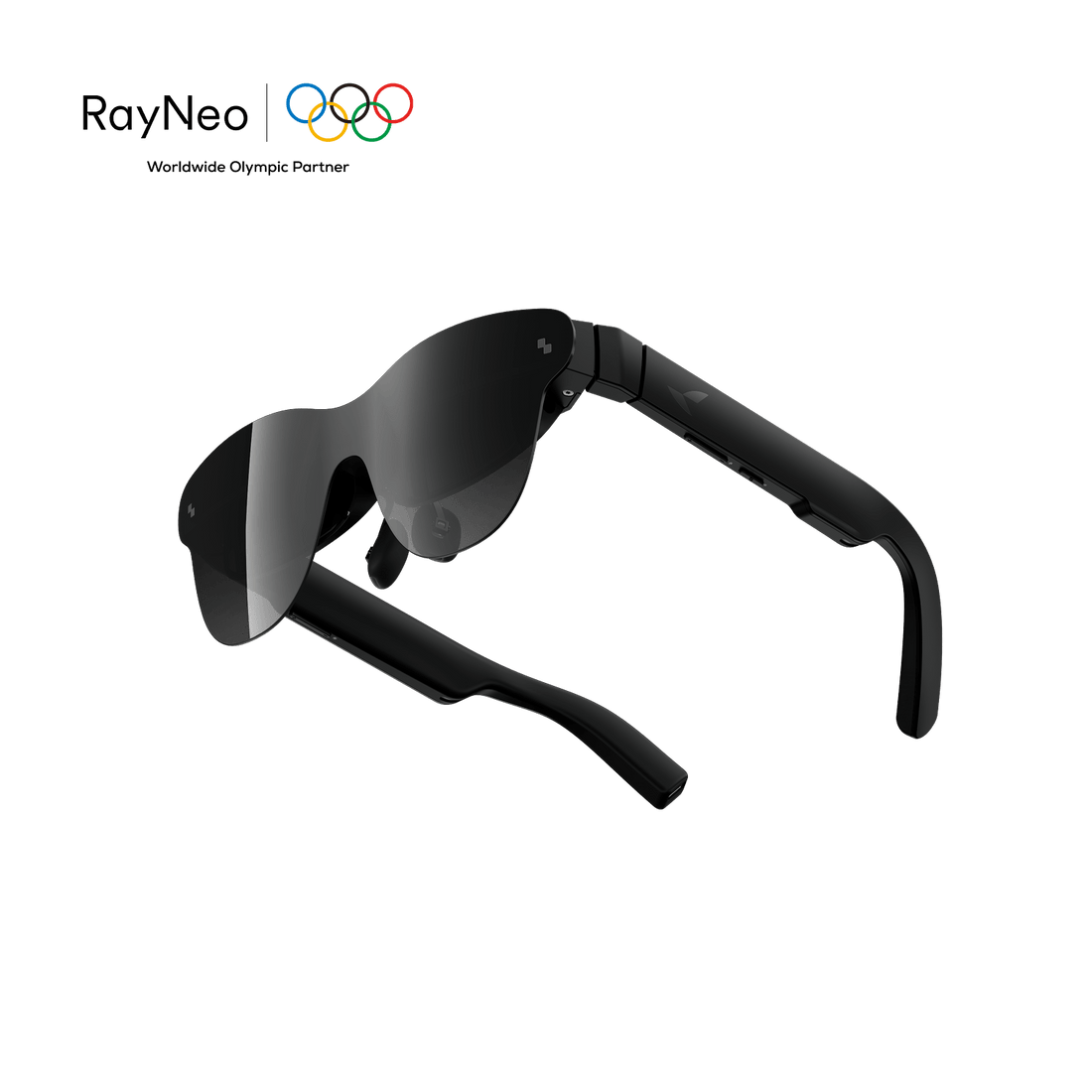
RayNeo’s Air series, Air 2s, Air 3s Pro, and Air 4 Pro, sits at the opposite end of the definition from an AI assistant. None of the three have a built-in microphone or camera on their official spec pages, so none of them can hear a wake word, answer a spoken question, or translate a conversation. What they’re built for instead is a bigger, more immersive picture: a virtual screen for watching a movie, gaming, or mirroring a laptop or console.
That picture travels over a single USB-C cable, and the source device needs to support DisplayPort Alt Mode for the connection to carry video, not just power or file transfer. That’s worth checking before you buy: a USB-C port alone doesn’t guarantee that support. Most recent Android phones, Windows laptops, and Macs with USB-C support it. iPhones with a USB-C port (iPhone 15 and later) can mirror video over USB-C too, but through Apple’s own proprietary signaling rather than the standard DisplayPort Alt Mode protocol, so a direct cable connection to Air series glasses isn’t guaranteed to behave the same way; RayNeo’s own compatibility information is the reliable source to check for iPhone specifically. Game consoles are the biggest gap: PlayStation, Xbox, and Nintendo Switch all output video over HDMI rather than USB-C, so mirroring one of these to Air series glasses typically needs a separate HDMI-to-USB-C adapter that itself supports DisplayPort Alt Mode, and that isn’t guaranteed to work out of the box. The reliable way to check any specific device before buying: search its model name plus “DisplayPort Alt Mode” or “USB-C video output.”
Each model in the Air line handles fit and comfort a little differently:
-
Weight (all models): Roughly 76 grams
-
Air 3s Pro fit: 46.7% front / 53.3% rear weight balance, 9 levels of temple adjustment, 3 nose pad sizes
-
Air 3s Pro certification: TÜV Rheinland/SÜD certified for low blue light and flicker-free display performance
-
Air 2s fit: Separate 9-point FlexiFit adjustment system
These adjustments serve a specific scenario: a two-hour-plus movie or gaming session where the frame has to stay balanced and stationary on your face rather than slide down while you sit still, which is a different fit problem than X3 Pro’s design solves for, since that model is built around quick, on-the-move photo and video capture rather than sitting still for a long stretch.
As of this writing, RayNeo’s Air series runs roughly in the $159 to $299 range across Air 2s, Air 3s Pro, and Air 4 Pro, with promotional pricing that shifts periodically. Check the live product pages for the current price on each model before buying. If watching video or gaming on a large virtual screen is the goal, and an AI assistant isn’t part of what you’re looking for, this is the category to focus on, not the X3 Pro or iO.
What AI Glasses Still Can’t Do, Regardless of Which Type You Pick
A few limits apply across the category, not just to any one brand or model:
-
None of the current mainstream models work as a full phone replacement. Voice assistant queries and real-time translation route through a cloud AI model, which in nearly every case means a live internet connection, usually through a paired phone’s data connection rather than the glasses’ own cellular radio.
-
Cameras built into a glasses frame share the same physical limits: a fixed lens, automatic exposure only, and digital rather than optical zoom, since there simply isn’t room in a glasses frame for interchangeable optics or a zoom lens.
-
Battery life scales down fast the more the display or camera is actively working. A number like “up to 5 hours” almost always describes light, intermittent use; continuous video recording or nonstop display use typically cuts that down to a fraction of the headline figure.
-
Display-only AR glasses require a physical connection to a source device that supports video output over USB-C. None of RayNeo’s Air series glasses run untethered, and as covered above, not every phone, laptop, or console can supply that video signal even with the right cable.
Frequently Asked Questions
Is the RayNeo Air series considered “AI glasses”?
Not in the sense this article defines the term, since none of the three Air models (Air 2s, Air 3s Pro, Air 4 Pro) have a built-in microphone or AI assistant on their official spec pages. What the Air series does deliver is a large virtual display for watching video, gaming, or mirroring a laptop, which is a real and confirmed capability, just not the assistant-driven use case that “AI glasses” usually refers to. If an AI assistant is what you actually want, RayNeo’s X3 Pro (with a camera) or the newly announced iO (without one) are the models built around that instead.
Do AI glasses need to be connected to a phone to work?
For the features that make them “AI” glasses specifically, yes, in nearly every case on the market today. A voice assistant’s cloud-based reasoning and real-time translation need an active internet connection, which for RayNeo’s X3 Pro and iO routes through the paired phone’s data connection or the glasses’ own Wi-Fi. Basic functions like the camera or a simple on-device display can work without a connection, but the AI layer itself can’t.
What’s the difference between RayNeo’s X3 Pro and the newly announced iO?
The core difference is the camera. X3 Pro combines a Google Gemini assistant, a color AR display, and a dual-camera setup in one 76-gram frame. iO drops the camera and the color display in favor of a lighter, roughly 33-gram frame with a monochrome “invisible” display, a choice of AI model (Gemini, ChatGPT, Claude, or DeepSeek), and a battery rated for far longer continuous audio recording. X3 Pro is available now; iO launches September 4, 2026.
Can AI glasses translate a conversation without an internet connection?
Not with any current mainstream model, RayNeo’s included. Real-time translation depends on cloud processing to convert speech to text and translate it quickly enough to show or speak back in near real time. If the connection drops, whether that’s the glasses’ own Wi-Fi or a paired phone’s signal, translation stops working even though the glasses stay powered on.
Are AR glasses and AI glasses the same thing?
No, though a single device can be both at once. AR glasses are defined by having a display; AI glasses are defined by having a voice assistant. RayNeo’s X3 Pro qualifies as both. RayNeo’s Air series is AR glasses without being AI glasses, since it has a display but no assistant. Some AI glasses on the market skip the display entirely and handle assistant queries through a companion app instead, which makes them AI glasses without being AR glasses.
Which RayNeo AI glasses are best for meetings and note-taking?
Both the X3 Pro and the newly announced iO include a dedicated meeting-recording feature, but they’re built for slightly different priorities. X3 Pro’s Meeting Notes feature is available today and comes bundled with a camera and color display for everything else you might use the glasses for. iO’s Voice Memo feature, once it ships on September 4, is built more specifically around capturing spoken conversations, with named modes for meetings versus one-on-one interviews and a battery rated for far longer continuous recording than X3 Pro’s audio figure.
Picking the Type That Fits Your Job
The fastest way through this category is to stop asking “which AI glasses are best” and start asking which of the four hardware types matches what you want the glasses to do. An assistant that can see what’s around you and answer questions hands-free, a big virtual screen for video and gaming, or hands-free photo and video capture are three different jobs, and no single device currently does all three equally well.
Within RayNeo’s own lineup, that breaks down cleanly: the X3 Pro covers an AI assistant, a glanceable display, and a camera together; the newly announced RayNeo iO covers an AI assistant and a lighter, camera-free frame built for all-day wear; and the Air series, including the Air 4 Pro, covers a larger display for video and gaming without any AI assistant at all. The job you need the glasses to do, not the marketing label on the box, is what separates these three from each other.




Share:
How Does Smart Glasses Technology Work? Displays, Cameras, Sensors, and AI Explained
Best AI Glasses with Cameras for Hands-Free Photos, Video, and Visual AI