

$429.00


Smart glasses with in-lens display can look surprisingly close to ordinary eyewear until a caption, reminder, route cue, or AI response appears in front of your eyes.
But not every in-lens display is designed for the same job. Some prioritize lightweight, glanceable text for everyday wear, while others use full-color binocular displays for navigation, apps, and spatial AR content.
Understanding that difference matters more than simply comparing brightness or resolution. In this guide, we explain how in-lens displays work, which specifications affect real-world use, and what to consider before choosing the right display style for your routine.

Smart glasses with an in-lens display can show digital information within your field of view while still allowing you to see the real world around you. Instead of looking down at a phone, you may be able to glance at navigation directions, notifications, translations, captions, prompts, or AI-generated information directly through the glasses.
Despite the name, this usually does not mean a conventional screen is embedded inside the lens. Many designs use a tiny optical engine in the frame together with a transparent waveguide in the lens. The optical engine creates the image, while the waveguide guides that light towards the eye, making the content appear over the wearer’s normal view.
This is what separates display-equipped smart glasses from audio-only smart glasses, which may have microphones, speakers, AI features or cameras but cannot visually show information. Current in-lens displays also vary considerably: some are monochrome and designed mainly for text, while more advanced models can provide full-color graphics and visual overlays.
In-lens smart glasses display technology works by generating a small digital image inside the glasses and using optical components to direct that image toward your eye. The lens or optical combiner remains transparent, allowing you to see the real world while digital information appears within your field of view.
In many smart glasses, this process involves three main components: a microdisplay or projector, an optical system, and a transparent waveguide or combiner.
The process starts with a compact display module built into the frame of the glasses. Depending on the design, it may use MicroLED, Micro-OLED, LCoS, or another near-eye display technology. These display types are commonly used as light engines in AR and other near-eye systems.
This small display generates the text, icons, directions, captions, images, or other visual content you are meant to see. Because the display itself is not positioned directly in front of your eye, the glasses need an optical system to deliver that image into your view.
Next, the image light is directed into the optical system.
Many slim, see-through smart glasses use a waveguide, a thin transparent optical element built into or positioned alongside the lens. An in-coupler directs the image light into the waveguide rather than placing a conventional screen directly in front of your eye.
This approach helps keep the display system relatively compact while preserving a clear view of the surrounding environment.
Once inside the waveguide, the image light travels through the transparent optical element, commonly using total internal reflection. An out-coupler then redirects the light toward your eye. Modern waveguide systems may use gratings, mirrors, or other optical structures to control this process and enlarge the usable viewing area.
The result is a virtual image that appears within your view rather than as something physically printed or displayed on the surface of the lens.
At the same time, light from your surroundings continues to pass through the transparent optics. This allows you to see digital content and the real world together.
The digital image does not normally cover everything you can see. Instead, it occupies a defined field of view (FOV), which describes the angular area available for displayed content.
Depending on the glasses and their intended use, that display may show:
A larger FOV can accommodate more visual information, while a smaller display area may be sufficient for short captions, prompts, or notifications.
Not every pair of smart glasses with visual display is designed to show the same type of content. One of the most useful distinctions is between full-color displays, which can present richer visual interfaces, and monochrome displays, which focus more on readable text and simple graphics.
| Comparison point | Full-color display | Monochrome text display |
|---|---|---|
| Typical content | Maps, icons, images, app interfaces, and spatial graphics | Captions, notifications, prompts, AI responses, and status information |
| Visual output | Multiple colors and more detailed graphical content | Usually one display color with simpler text and symbols |
| Best suited to | Navigation, visual AI, interactive AR, and richer interfaces | Live captions, teleprompter text, notifications, and glanceable information |
| Typical experience | More visually rich and suited to spatial interaction | More focused and discreet for everyday information access |
A monochrome display is not simply a “lower-end” version of a full-color display. It can be the more appropriate design when the main goal is to show a few lines of readable information without filling the wearer’s view with graphics. Current lightweight monochrome smart-glasses platforms are commonly positioned around notifications, navigation prompts, task guidance, and AI-assisted information.
Full-color displays become more useful when color itself carries information or when the interface includes maps, images, app elements, and spatial graphics. Producing full-color output can also require a more complex display and optical architecture—for example, some AR systems generate separate red, green, and blue image information before combining it through the optical system.
If you’re researching what smart glasses have a display, don’t just look at whether a screen is included—compare how well that display performs in real-world conditions. Here’s what to look for:
For lightweight glasses designed around captions, navigation and notifications, a roughly 20–30° FOV can already provide useful viewing space. Wider displays can accommodate larger interfaces and richer AR content, but often require more complex optics and may add weight or power consumption.
Resolution matters most when you need to read small text. Check not only the pixel count but also whether reviews report sharp edges, readable small fonts and consistent clarity across the display.
Also consider whether you actually need color. Monochrome displays can be efficient and perfectly suitable for text-based information, while full-color displays make more sense for maps, images and richer interfaces.
A higher nit figure can help, but brightness alone does not guarantee sunlight readability. Waveguide efficiency, contrast, lens transparency and ambient light all affect what reaches your eye.
For regular outdoor use, prioritize:
For glasses intended for extended wear, around 50 g or less is a useful lightweight target. Once frames move towards 60–70 g or more, fit and weight distribution become increasingly important.
Also check nose-pad adjustment, temple pressure and whether the display remains correctly aligned when the glasses move. A lighter frame is not necessarily more comfortable if the weight is poorly distributed.
Battery claims are particularly difficult to compare. A low-power information display may advertise up to two days of typical intermittent use, while glasses running more power-hungry displays, cameras and processors may be rated for only several hours per charge.
Instead of looking only at “all-day battery”, check how long the smart glasses with LED display last during the feature you actually need, such as:
A charging case can also make a major difference if you intend to wear the glasses throughout the day.
Check how you interact with the display, and which functions require another device. Controls may include voice, touch, physical dials, or head gestures.
Also distinguish between standalone operation and phone-assisted operation. Even glasses with their own processor and battery may still need a phone for setup, internet access, notifications, software updates, or certain AI services.
If you need corrective lenses, check the actual supported prescription range, not simply whether the glasses are described as prescription-compatible.
Also confirm whether they support:
Integrated prescription support generally provides a more glasses-like experience, while inserts may add extra weight or affect the viewing position.
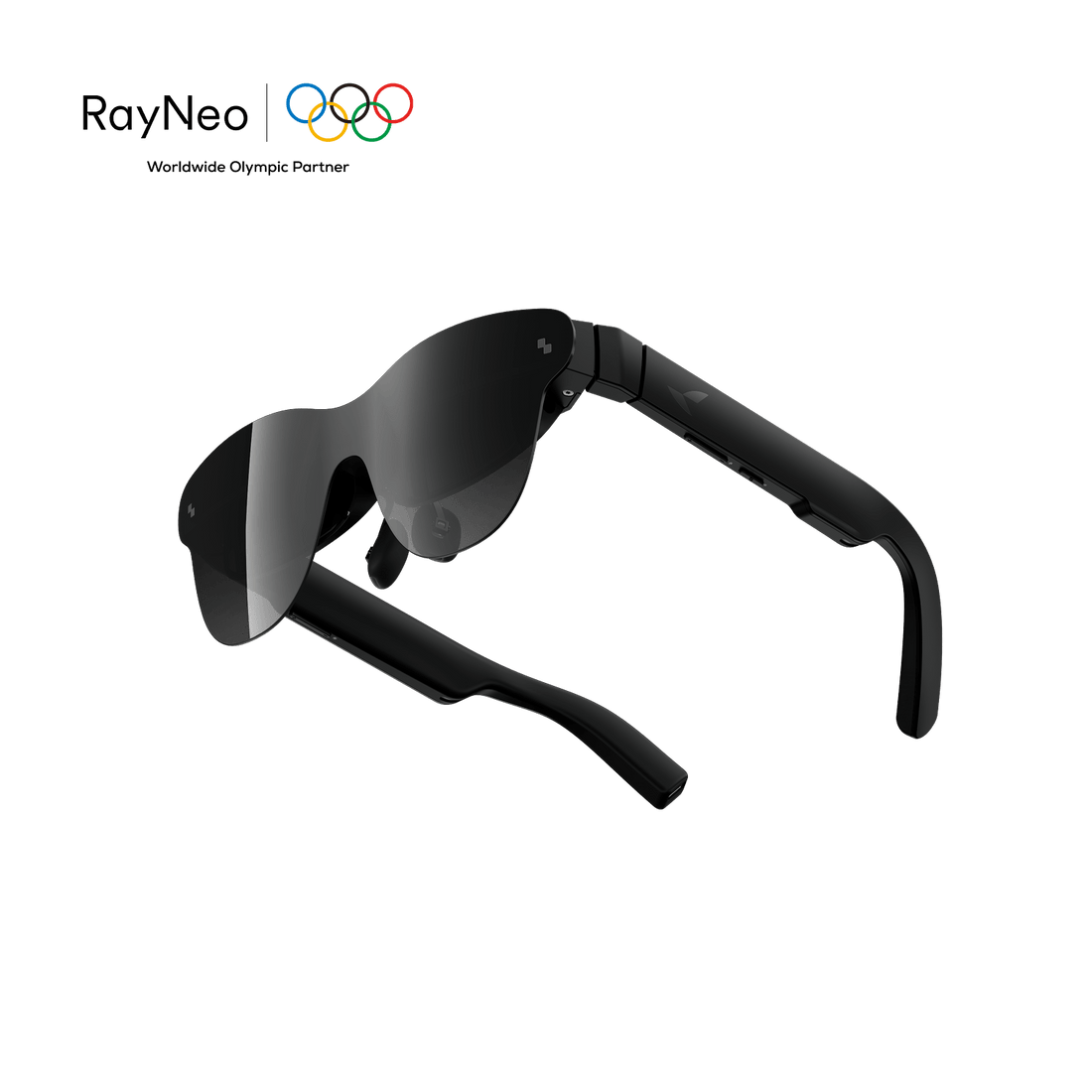
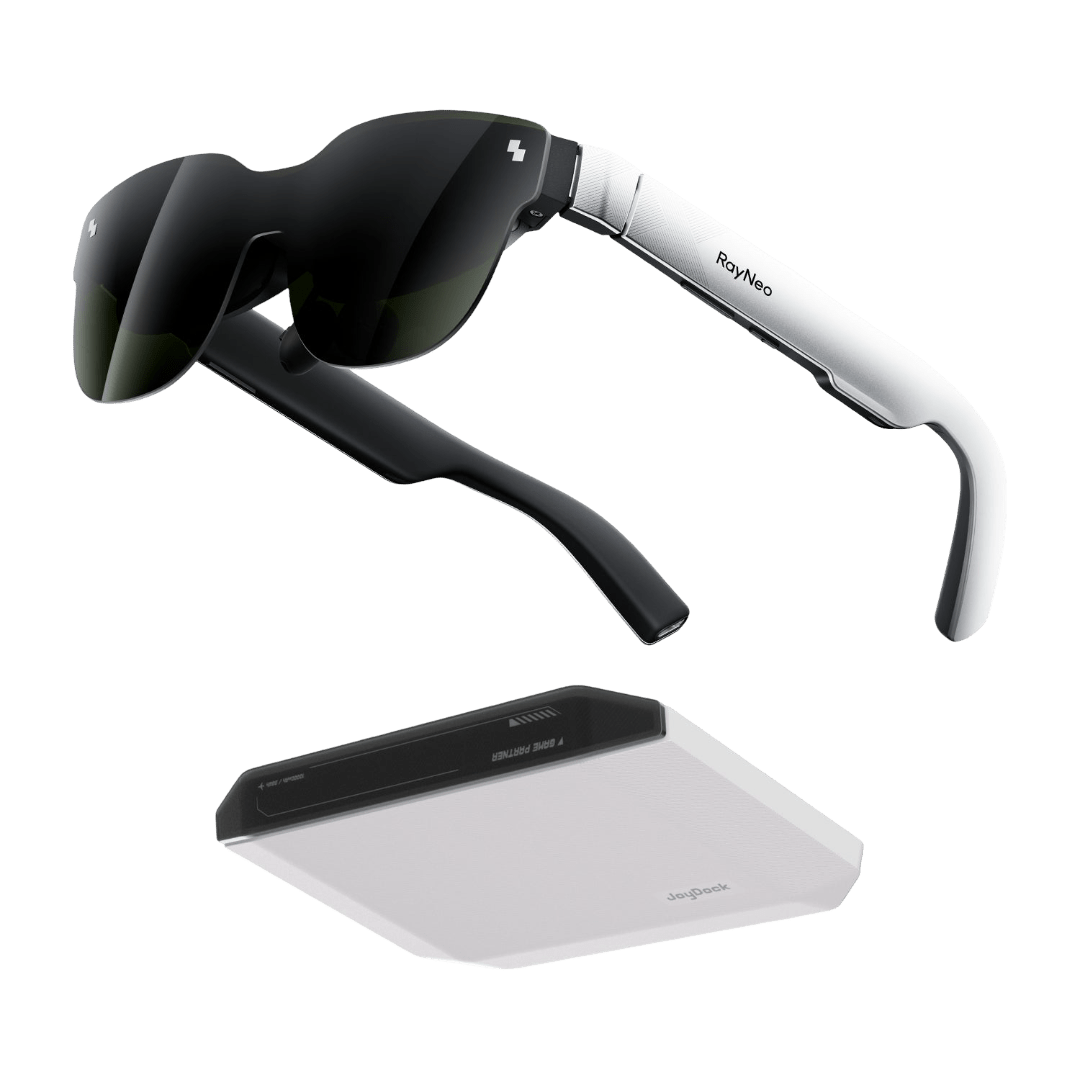
Once you know what type of in-lens display suits your needs, it becomes easier to narrow down the right smart glasses. Below are two RayNeo models that take different approaches to in-lens display technology and suit different every day and AR use cases.
The RayNeo iO AI Glasses are designed for people who want AI assistance and useful information in view while keeping the look and feel of everyday eyewear. Their monochrome green display uses an ultra-transparent waveguide, so captions, notifications, prompts, and AI information can appear in front of you without turning the glasses into a bulky headset.
Best for: Everyday AI assistance, meetings, presentations, travel, and people who want glanceable information without constantly checking a phone.

The RayNeo X3 Pro AI+AR Smart Glasses are designed for people who want a richer, full-color in-lens experience rather than mainly text-based prompts.
Their binocular MicroLED display works with RayNeo AIOS, Gemini-powered assistance, navigation, apps, translation, and spatial AR tools, so useful information can appear directly within your field of view.
Best for: Full-color AR, navigation, visual AI, spatial applications, travel, and people who want more interactive visual content directly on the glasses.

Different in-lens display designs lend themselves to different tasks. Depending on the display type and features, these glasses can support everything from captions and presentations to navigation, field work, and everyday organization.
Choosing smart glasses with in-lens display starts with deciding what you actually want to see. Monochrome displays suit captions, prompts, and quick AI information, while full-color binocular systems are better for maps, apps, and spatial AR.
From there, compare FOV, fit, battery behavior, prescription support, and device connectivity. The right display should make useful information easier to access without demanding more attention than the task itself.
Yes. Many display-equipped smart glasses support prescription vision through direct replacement lenses or clip-in inserts. Availability depends on the model, supported prescription range, astigmatism correction, and approved lens partner. Before ordering, check pupillary-distance requirements and confirm that the display remains aligned after fitting. Stronger prescriptions, progressive lenses, and other complex corrections may have limited support.
Usually not. The optical system directs light toward the wearer’s eye, so nearby people generally see ordinary or lightly tinted lenses instead of the displayed text or graphics. However, visibility can vary with the viewing angle, display brightness, lens transparency, and surrounding light. Someone standing very close may notice a faint glow or reflection when the display is particularly bright.
It depends on the design. Some glasses rely on a connected phone, computer, or other source device for power, apps, processing, or internet access. Others include their own processor, battery, storage, Wi-Fi, and operating system. Even standalone models may still use a smartphone for initial setup, hotspot access, software updates, account management, or companion features, so “standalone” should not automatically be interpreted as completely phone-independent.





Share:
Can You Use AR Glasses to Replace Monitor Setups?
Smart Glasses with Screen: 2026’s Best Picks & Buying Guide