

$429.00


RayNeo currently sells five smart glasses models in stock and ready to order, plus three more officially announced: the RayNeo iO, RayNeo GT, and RayNeo GT Max, all confirmed for retail sale on September 4, 2026. The five current models include one camera-and-AR headset, the X3 Pro, and four display-only AR glasses, Air 2s through Air 4 Pro. Buy now if a camera is the deciding factor; wait a few weeks and the September 4 lineup adds a camera-free AI glasses option and a bigger-screen display choice.
As of this writing, RayNeo’s official store lists five models as in stock and purchasable.
| Model | Category | Price (as listed) | Camera |
|---|---|---|---|
| RayNeo X3 Pro | AI + AR + camera glasses | $1,099 (on sale from $1,299) | Yes, 12MP |
| RayNeo Air 4 Pro | Display-only AR glasses | $254.15 (on sale from $299) | No |
| RayNeo Air 3s Pro | Display-only AR glasses | From $279 (on sale from $299) | No |
| RayNeo Air 3s | Display-only AR glasses | $269 | No |
| RayNeo Air 2s | Display-only AR glasses | $159 (on sale from $299) | No |
The RayNeo X3 Pro is the only current model that combines a camera with a display. It runs dual full-color MicroLED displays, a 12MP camera, and Google Gemini for real-time translation and hands-free AI queries. Its 245mAh battery is the tradeoff for packing in a camera and two displays: continuous camera use drains it in around 30 minutes, while light, intermittent use (short notification glances, occasional AI queries) stretches closer to 3.5 to 5 hours.
X3 Pro connects to a phone over Bluetooth 5.3 and Wi-Fi 6, so it runs untethered day to day. Setup, software updates, and pulling saved photos or video off the glasses go through RayNeo’s companion AR app, which is available for both iOS and Android; check the current version requirements on the App Store or Google Play listing before buying, since those can change.

The Air series (Air 2s, Air 3s, Air 3s Pro, Air 4 Pro) skips the camera entirely and focuses on the display. These are built for watching video, gaming, or using a larger virtual monitor, not for hands-free recording. Air 4 Pro is the current flagship of that line, with HDR10 support that RayNeo markets as a first for AR glasses in this price range.
The Air series connects differently from the X3 Pro: each model plugs into a phone, laptop, or console over a single USB-C cable using DisplayPort Alt Mode, and there’s no companion app required just to use the display. RayNeo’s Air 4 Pro product page lists confirmed compatibility with iPhone, Android, PC, Nintendo Switch, and PS5; Air 3s Pro and Air 4 Pro also support an optional RayNeo HDMI adapter for devices without USB-C video output. Not every USB-C port supports DisplayPort Alt Mode even when it looks identical to one that does, so it’s worth confirming that on your specific phone or laptop before buying.
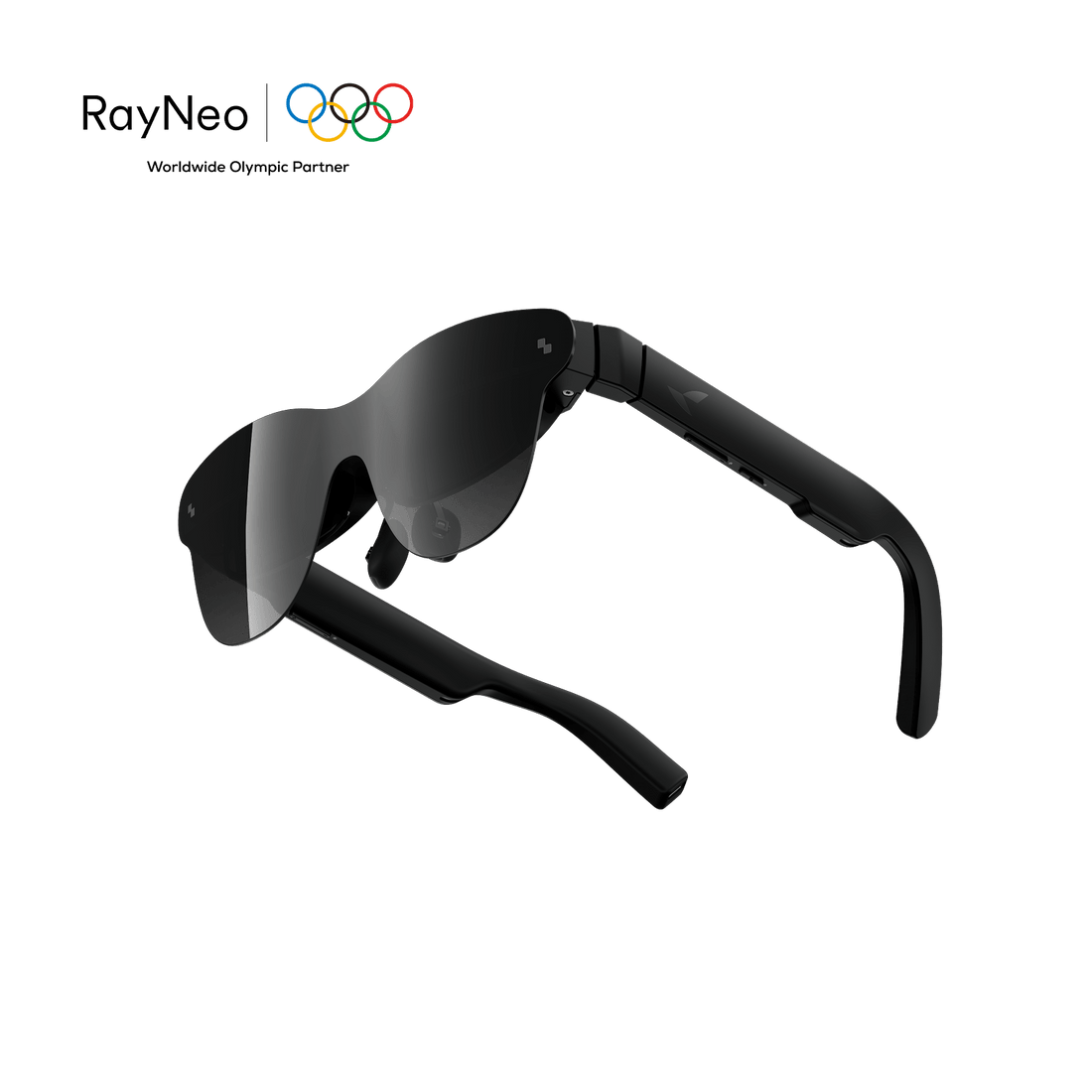
Two earlier models, RayNeo X2 (the previous camera-equipped generation) and RayNeo Air 2 (an earlier display model), are currently listed as sold out on RayNeo’s US store as the lineup has moved on to newer releases like the X3 Pro and Air 4 Pro. They’re mentioned here only so readers researching earlier RayNeo models can tell them apart from what’s currently available.
RayNeo introduced three new models on August 21, 2026: the RayNeo iO, RayNeo GT, and RayNeo GT Max. September 4, 2026 is the confirmed retail launch date for all three, through RayNeo’s official website and its Amazon store, alongside an in-person demo at IFA 2026 in Berlin (Hall 21A, September 4 to 8).
Pricing for all three models hasn’t been published yet. RayNeo’s product pages currently show a “notify me” early-access signup instead of a listed retail price, with full pricing expected at launch.
RayNeo iO is positioned as an all-day pair of glasses built around an AI assistant rather than a camera or an immersive display. Its announced hardware specs are:
In practice, that display size and format mean iO is meant for glanceable text, not video or photos: things like live captions, a teleprompter line of text during a presentation, or a translated phrase, not a movie screen floating in front of your eyes.
RayNeo positions iO as built for “all-day heads-up productivity and high-fidelity mobile entertainment.” Given the monochrome, single-line display and bone-conduction audio rather than open-ear speakers, it’s worth setting expectations around what that “entertainment” means here: this is a device for audio-centered listening, a podcast, an audiobook, spoken content, translated conversation, rather than for watching video or photos on the lens itself. Knowing that going in helps line up what iO is for with what you’ll actually use it for day to day.
It runs on RayNeo’s own AI software paired with Google’s Gemini 3.1 Flash Lite. iO supports live translation across 55 languages and 109 accents, with a narrower set of 40 languages specifically optimized for its on-lens Live Captions feature, the broader translation figure and the more focused captioning figure covering two different parts of the experience rather than conflicting with each other. Audio is picked up by a four-microphone array. iO doesn’t include a camera, which sets it apart from the X3 Pro’s camera-first design.
Battery is rated at 240mAh for up to two days of typical, light use, and the frame carries an IP54 rating for dust and light water resistance. It ships in two colorways, Polar Night (dark grey) and Dune (gold).
The GT series targets a different use case: a large virtual screen for watching video, working on a bigger display, or gaming, in a lighter package than a traditional headset. Neither GT model includes a camera.
Here’s how the two models compare on the specs RayNeo has announced so far:
GT Max also supports native Dolby Vision playback when paired with RayNeo’s separate Pocket TV Pro accessory; RayNeo describes that combination as the world’s first AR glasses system to support native Dolby Vision this way, so the Dolby Vision claim applies to the GT Max plus Pocket TV Pro pairing, not to the glasses running on their own.
GT Max is available in three IPD (interpupillary distance) sizes, and both GT models support custom prescription lens inserts. Battery life for GT and GT Max, along with full connectivity details beyond the Pocket TV Pro requirement for Dolby Vision, hasn’t been published yet; full specs are expected to land closer to the September 4, 2026 launch.
None of the three upcoming models replace the X3 Pro’s camera-and-AR combination. RayNeo iO fills a different gap: an everyday, camera-free AI glasses lighter and less display-heavy than the Air series, aimed at people who want an assistant and live translation without carrying a phone-replacement device on their face. GT and GT Max extend the Air series’ display-only concept toward bigger, cinema-style virtual screens with better color and audio, rather than a bigger camera or a stronger AI assistant.
If capturing photos or video is the priority, the X3 Pro remains the only current or announced RayNeo model built around a camera. If a larger, higher-fidelity virtual screen for video and gaming is the priority, GT Max is the more display-focused option once it ships. If the goal is a lightweight, all-day pair of glasses for notifications, translation, and an AI assistant without a screen full of media, iO is closer to that use case, though full details on its day-to-day comfort and battery performance will land closer to the September 4 launch.
Is RayNeo iO available to buy right now?
Does the RayNeo iO have a camera?
What’s the difference between RayNeo GT and GT Max?
How much will the new RayNeo glasses cost?
Is the RayNeo X3 Pro still worth buying with new models coming?
If a camera is part of what you need today, the RayNeo X3 Pro is the current option, and nothing announced for the September 2026 lineup changes that. If a display-only, wallet-friendlier AR experience is the goal, the Air series (Air 2s through Air 4 Pro) is already shipping and doesn’t require waiting on anything.
If you can wait a few weeks, RayNeo iO adds a lighter, camera-free everyday AI glasses option, and GT Max pushes the display-only concept toward a bigger, higher-fidelity virtual screen. Pricing for all three isn’t set yet, and neither is battery life for GT and GT Max; RayNeo’s product pages currently list early-access signups rather than a checkout price, with full specs expected to land closer to the launch.
September 4, 2026 is the date that resolves the open questions here: pricing, final specs, and retail availability for iO, GT, and GT Max all go live at once, alongside the in-person demo at IFA Berlin. Anyone weighing whether to buy from the current lineup now or hold out for one of the three new models has that answer in a matter of weeks, not months.




Share:
Best AI Translation Glasses in 2026: How Accurate Is Real-Time Translation?
Which Smart Glasses Support Prescription Lenses, and Which Feel Most Comfortable?