

$429.00


A single pair of XR glasses can cover gaming, movies, and a private external monitor, but only if the display hardware underneath is built to do all three at once. That means a panel sharp and fast enough for games, a screen size and audio setup good enough for movies, and a display mode stable enough to read text at a desk for hours. The RayNeo GT Max ($399) is built around exactly that combination, and the lighter RayNeo GT ($299) covers the same three jobs at $100 less with a narrower field of view.
This guide walks through what each job actually requires, how GT Max handles gaming, movies, and monitor use separately, and where GT makes sense instead.
Gaming, movie watching, and monitor replacement don’t ask for the same thing from a display, which is why most AR glasses only do one of them well. Doing all three requires a specific combination of hardware.
A sharp Full HD panel. GT Max uses a 0.6-inch SeeYa Micro-OLED panel at 1920×1080 (Full HD). That resolution matters most for the monitor use case, where you’re reading small text rather than watching motion, and for games with fine detail like UI elements or distant enemies.
A fast refresh rate. GT Max runs at 120Hz in 2D and 60Hz in 3D. In practice, 120Hz is what keeps a first-person shooter or a fast-scrolling desktop window from feeling smeary, while the 3D mode trades refresh rate for depth when you’re watching native 3D or converted content.
A wide field of view. GT Max’s optical engine covers 59 degrees, and its virtual screen is built around a 267-inch cinema display (227-inch and 307-inch sizes are also available), which is what makes it feel like an actual home theater screen rather than a small floating window. GT covers a narrower 46 degrees, with a default screen RayNeo describes as equivalent to viewing a 201-inch display from six meters away (136-inch and 231-inch sizes also available), still usable but noticeably smaller in your peripheral vision.
3DoF spatial modes. GT Max and GT both track head rotation across three axes, what RayNeo calls 3DoF, or three degrees of freedom, and use that tracking to run three spatial display modes: Follow, Steady, and Pinned. Follow keeps the screen centered in your view as you turn your head, which fits gaming and watching while lying down. Steady adds a damping layer that smooths out constant small motion, built for travel and commuting. Pinned locks the screen to one fixed position in the space around you, closer to a mounted display, which fits a desk setup or focused, cinema-style movie watching. Which one fits best depends on the job, covered mode by mode below.
Audio that doesn’t need a headset. GT Max and GT both use a Bang & Olufsen-tuned four-speaker array with Immersive Spatial Sound and Head-Tracked Spatial Audio, shifting sound with your head movement without adding headphones on top of the glasses.
A fit matched to your eyes. GT Max ships in three IPD-specific builds, S, M, and L, chosen at checkout based on your interpupillary distance. GT uses a single fixed 64mm IPD adjusted through the nose pads. RayNeo frames getting this size right as key to a clearer, more comfortable image during long gaming or work sessions, rather than something to sort out after the fact.
Low enough weight to keep wearing it. GT Max weighs 78g and GT weighs 68g. Neither is as light as glasses with no display hardware inside, but both are built to stay on your face through a two-hour movie or a gaming session, not just a quick glance.
GT Max checks every one of these boxes at the higher end (wider FOV, a choice of three IPD sizes), and GT checks the same boxes at a lower price and lighter weight with a fixed IPD and narrower view.

GT Max connects to a gaming source over a wired USB-C cable using DisplayPort Alt Mode, the same USB-C specification that lets some of a cable’s data lanes carry video instead of just data and charging. That’s a direct connection: iPhone 15, 16, and 17 series phones (not the 16e, 17e, or Air models, which fall outside this direct-connection support), Android phones with USB-C DisplayPort video output such as Samsung Galaxy S8 through S25, iPad 10th generation and newer, MacBook 2015 and later, and USB-C handhelds that carry DisplayPort video output over their own port all connect with the included USB-C cable and no adapter.
For console gaming, PS4, PS5, and Xbox connect through the RayNeo HDMI Adapter ($64), since those systems output HDMI rather than USB-C DisplayPort Alt Mode. Any USB-C handheld docked and outputting over HDMI instead of its own USB-C port needs the same adapter; check the device’s own port before assuming it connects directly. The HDMI Adapter needs its own power too: RayNeo’s FAQ notes that when using an adapter, you should make sure it’s connected correctly and sufficiently powered, so plan on a separate USB-C power source alongside the video cable rather than a single two-cable setup.
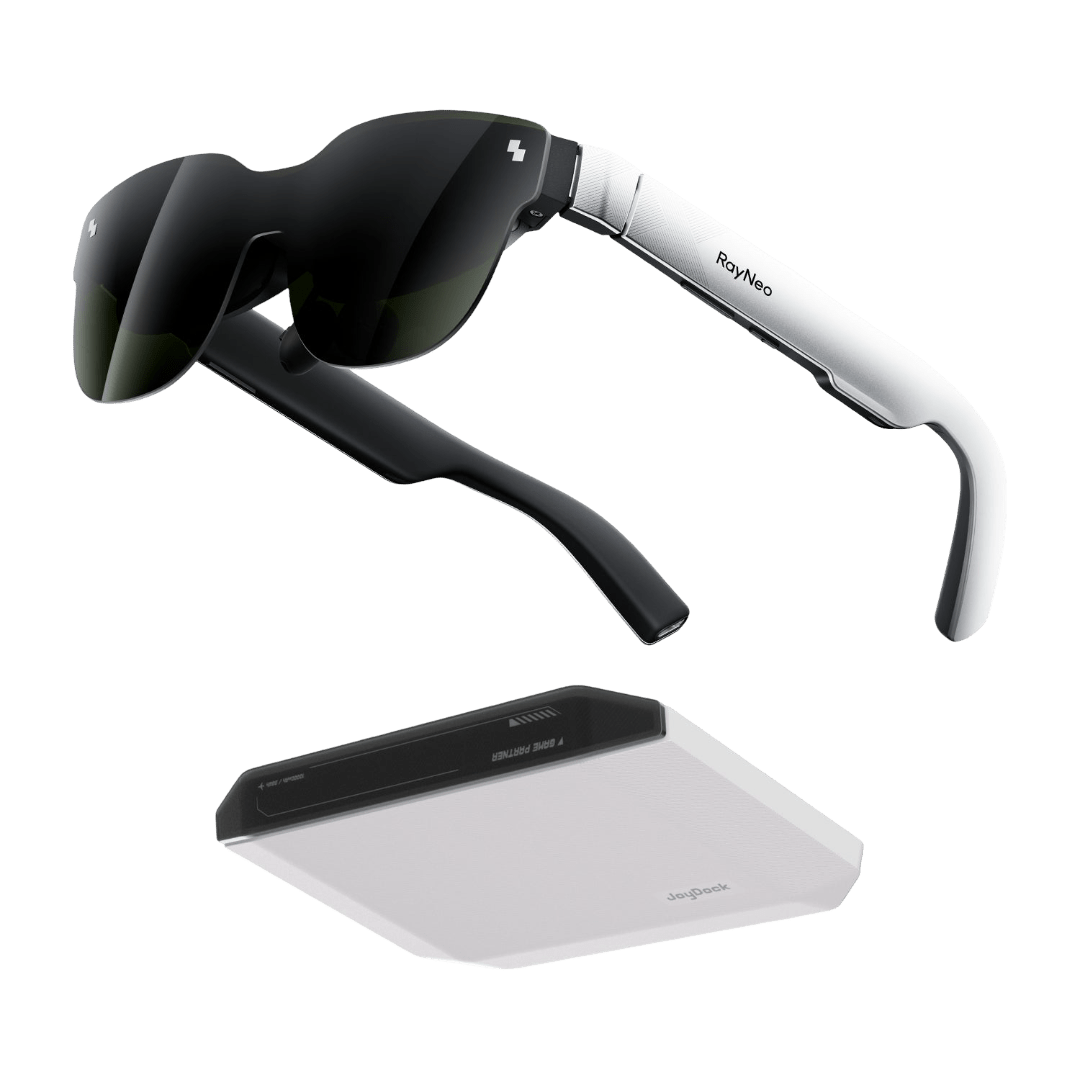
Nintendo Switch shows up in two places in RayNeo’s compatibility list: grouped with HDMI-connected devices like PS4, PS5, and Xbox, and under its own Nintendo Switch category, which calls for a JoyDock ($89) plus a Back Clip, with support listed for both Switch (1st generation) and Switch 2. A Switch 2 Bracket ($15) is listed as an additional accessory; RayNeo’s page doesn’t spell out exactly how it’s used alongside the Back Clip, so check the current accessory listing before ordering for a Switch 2 setup.
For direct USB-C connections like a phone, laptop, or handheld’s own port, the glasses draw power from that same cable, so expect the source device to warm up slightly and drain faster during longer sessions. RayNeo builds in two settings that dim the connected phone’s own screen to help with that: Eco Mode, switched on from the XR Space video player, and Auto-Dim Brightness, switched on under Immersive Casting in the RayNeo XR App, which dims the phone’s screen after about 10 seconds without interaction.
For the display itself, 120Hz in 2D mode is the number that matters most for competitive or fast-paced games; RayNeo’s own materials describe the result as smooth, vivid visuals rather than making a specific comparison to slower panels. Follow mode, one of the three 3DoF spatial modes, keeps the screen centered in your view as you move your head, which fits active gaming sessions where you’re not sitting perfectly still staring at one fixed point in a room.
One limit worth knowing up front: the Pocket TV Pro isn’t required for gaming at all. It’s a Google TV streaming device built around apps and a movie and show library, so console and handheld gaming go through GT Max’s direct wired connections instead.
Movie watching is where GT Max’s field of view and screen size do the most work. RayNeo builds GT Max’s virtual screen around a 267-inch cinema display, with 227-inch and 307-inch sizes also available. Switching the display into Movie mode, one of four presets alongside Standard, Eye Protection, and Office, is built with film watching in mind.
Audio comes from the same Bang & Olufsen four-speaker array used for gaming, with Head-Tracked Spatial Audio shifting the soundstage as you move your head.
For a movie night on a couch or chair, Pinned mode locks the screen to one fixed position in the space around you, which RayNeo describes as ideal for focused, cinema-like viewing, closer to a hung screen than something that drifts every time you shift position. Follow mode, which keeps the screen centered as your head moves, is what RayNeo positions for casual, everyday viewing instead, worth switching to if you’d rather the picture travel with you than stay anchored in place.
Dolby Vision playback is available under one specific condition: GT Max needs to be paired with the RayNeo Pocket TV Pro ($199), and the content itself has to be mastered in Dolby Vision. RayNeo’s own product page puts it this way: “Paired with RayNeo Pocket TV Pro, GT Max delivers an immersive Dolby Vision experience. AI real-time SDR-to-HDR conversion is supported across all compatible devices.” Beyond Dolby Vision, Pocket TV Pro brings its own Google TV app library (10,000+ apps, 400,000+ titles across services like Netflix, Prime Video, and Disney+) and up to 5.5 hours of continuous viewing per charge.
For 3D content, GT Max supports native 3D playback plus AI-powered 2D-to-3D conversion. RayNeo lists the conversion feature as available on iPhone 15, 16, and 17 series phones, specifically excluding the iPhone 16e, 17e, and Air models; RayNeo’s page doesn’t spell out the same kind of device limits for native 3D playback itself.

The monitor use case leans on a different combination of the same hardware. Office mode, the fourth of GT Max’s four display presets, is named for text and productivity use rather than film watching. Pinned is the spatial mode that makes the most sense at a desk: it locks the screen to one fixed position in the space around you, so it stays put like a monitor bolted to a stand even as you turn your head to check a second window or glance away.
For anyone working from a train, plane, or car instead of a stationary desk, Steady is the better fit. It still tracks your head, but smooths out the small, constant motion of a moving vehicle instead of locking to a single point in space that’s also in motion.
Text sharpness comes down to pixel density rather than screen size, and GT Max’s optical engine delivers 38 pixels per degree (PPD), RayNeo’s own figure for the panel. Higher pixel density is generally what keeps small text in a spreadsheet or code editor readable instead of blurring together, and it’s a spec worth checking against for anyone planning to read or write for extended periods rather than just watch video.
GT actually comes out ahead on this specific number: its narrower 46-degree field of view packs the same 1920×1080 resolution into a smaller visual area, which works out to 49 PPD against GT Max’s 38. For anyone whose main job for the glasses is reading and writing rather than gaming or movies, that tighter field of view is a tradeoff that pays off in sharper text.
The same USB-C DisplayPort Alt Mode connection used for gaming works for monitor use: plug in a compatible MacBook, Windows laptop, or supported phone or tablet with the included cable, and GT Max functions as an external display. As with any DisplayPort monitor, whether the picture mirrors or extends your desktop comes down to how that device’s own operating system handles an external display, not a setting on the glasses. That means the same pair of glasses can run a coding session in Office mode in the morning and switch to Follow mode for a game in the evening, just by changing the display and spatial mode settings, no different cable or adapter required.
For anyone using GT Max as a monitor in a coffee shop, shared office, or on a plane, Whisper Mode 2.0 is the audio setting built for that. It’s one of three options accessible by long-pressing the volume rocker (Standard, Whisper, and Spatial Surround), or through RayNeo XR App > Glasses Settings > Whisper Mode, and RayNeo describes it as reducing audio leakage in quiet or public environments. The speakers are open-ear by design rather than sealed, and RayNeo’s own materials note that audio becomes difficult to hear clearly from about 1.5 meters away, though someone standing very close may still pick up some sound, worth knowing before relying on Whisper Mode for anything that needs to stay fully private.

| RayNeo GT Max | RayNeo GT | |
|---|---|---|
| Price (at the time of writing) | $399 | $299 |
| Weight | 78g | 68g |
| Field of view | 59° | 46° |
| Pixel density | 38 PPD | 49 PPD |
| Virtual screen | 267” cinema display (227”/307” also available) | 201” default (136”/231” also available) |
| IPD | S / M / L (chosen at checkout) | Fixed 64mm |
| Panel | 0.6” SeeYa Micro-OLED, 1920×1080 | Same |
| Refresh rate | 120Hz (2D) / 60Hz (3D) | Same |
| Brightness | 336 nits Pinned / 1,200 nits perceived non-Pinned | Same |
| Audio | B&O four-speaker, Spatial Audio, Whisper Mode 2.0 | Same |
| Display modes | Standard / Movie / Eye Protection / Office | Same |
| Spatial modes | Follow / Steady / Pinned | Same |
| Dolby Vision | With Pocket TV Pro, Dolby Vision content only | Same |
The two share nearly the same core display, audio, and mode set. The real difference is field of view and fit: GT Max’s wider 59-degree view and S/M/L size options cost $100 more and add 10g of weight. If your interpupillary distance sits close to 64mm and a slightly narrower view doesn’t bother you, GT delivers the same gaming, movie, and monitor functions for less. If your IPD is further from that number, or the wider field of view matters more to you than the price difference, GT Max is the better fit.
GT Max ships in three IPD-specific builds rather than one adjustable frame: S for under 64mm, M for 64 to 67mm, and L for over 67mm. RayNeo provides a measurement tool at ipd.rayneo.com to check which size matches your eyes before ordering. Getting this right matters more for GT Max than it would for glasses without a display. RayNeo describes a correctly matched IPD size as what helps align your eyes with the optical viewing area, for clearer visuals and a more comfortable viewing experience, worth getting right whether you’re settling in for a longer movie or working through a stretch of Office mode.
GT skips this decision entirely with its fixed 64mm IPD, adjusted only through the nose pads. That’s a simpler purchase if your IPD happens to sit near that number, and a real limitation if it doesn’t.

The USB-C cable needed for direct connections to phones, tablets, and laptops ships in the box with both GT Max and GT. Beyond that, what else you need depends on the source device:
None of these are required to use GT Max for its core gaming, movie, and monitor functions over a direct USB-C connection. They cover specific source devices or specific features (Dolby Vision, console HDMI output) rather than being prerequisites for the glasses to work at all. Both GT Max and GT also ship with a 30-day return window and a one-year limited warranty directly from RayNeo, so testing the fit and connection with your own setup before committing to accessories is a real option, not just a sales line.
Does GT Max need its own battery to work as a monitor or gaming display?
Does GT Max only get better HDR through Dolby Vision content, or does it improve regular video too?
For anyone who wants one pair of XR glasses to handle console or handheld gaming, movie nights, and a private external display for work, RayNeo GT Max is built around that exact combination: a 120Hz Full HD panel, a 59-degree field of view, three spatial modes and four display presets that switch between the three jobs, and a choice of three IPD sizes to keep long sessions comfortable. The RayNeo GT covers the same three use cases on the same core hardware, at $100 less, for anyone whose eye spacing sits near 64mm and who doesn’t need the wider view.





Share:
RayNeo Smart Glasses Comparison: iO vs GT vs GT Max vs X3 Pro
The Newest Smart Glasses Released in 2026: RayNeo's iO and GT Series