

$429.00

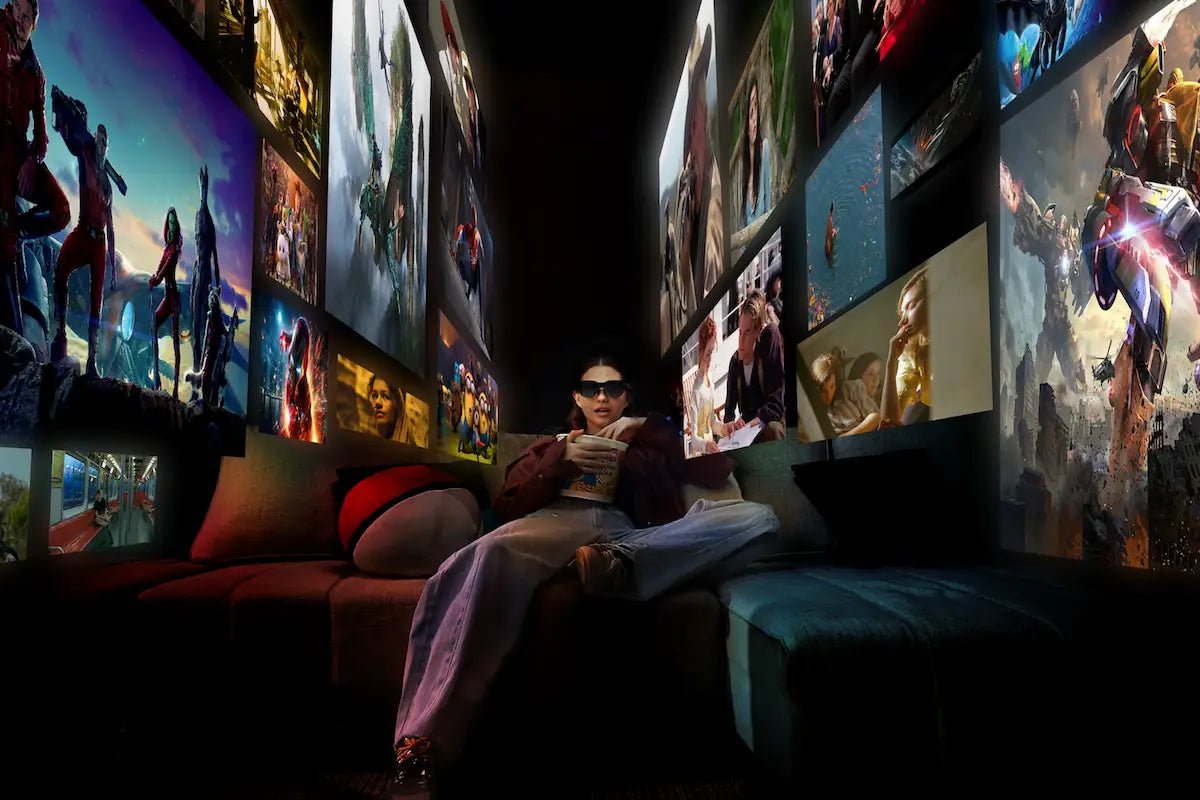
A pair of AR display glasses solves a problem regular televisions can’t: watching what you want, where you want, without needing an actual TV in the room. RayNeo GT Max projects a virtual screen, a 267-inch cinema display with 227-inch and 307-inch sizes also available, directly to your eyes from a phone, tablet, streaming box, or HDMI source. You can also adjust how the screen behaves depending on whether you’re sitting up, lounging on a couch, or lying flat in bed.
This matters for a few common situations: a household with one TV that’s usually occupied, a bedroom or guest room that never got one, wanting to watch a show late at night without waking someone up, or a living room too bright for a screen to look good on. AR glasses address all of these by making the screen personal instead of shared.
“Watching TV” here covers both senses of the phrase: streaming apps like the ones already on your phone, and video from an HDMI-connected device such as a game console. RayNeo GT Max handles both, though the setup differs depending on which one you’re using.

GT Max displays video from a compatible connected source, whether that’s a phone, a streaming box, or a device connected over HDMI. What you can watch, and how the setup works, comes down to that source rather than anything built into the glasses themselves.
Phone or tablet apps, connected directly. RayNeo GT Max connects to compatible devices over USB-C using DisplayPort Alt Mode, mirroring the supported video and apps running on that phone, laptop, or tablet screen. This is the simplest path if you already have a phone or tablet with your streaming subscriptions on it and just want the picture bigger and private.
Pocket TV Pro, a standalone streaming box. For $199 at the time of writing, this pocket-sized device runs Google TV with Google Assistant voice control, giving access to more than 10,000 apps and roughly 400,000 movies and shows across services like YouTube, Prime Video, Netflix, and Disney+. It carries its own 6,500mAh battery, rated for up to 5.5 hours of continuous viewing, plus 3GB of RAM and 64GB of storage that expands to 2TB with a microSD card.
Two USB-C ports mean it can stay plugged in and charging while it’s actively streaming, so battery life doesn’t have to be a limit during a long movie or a binge session. This is the option for anyone who wants a real smart TV experience without owning, or needing, an actual television.
Game console or other HDMI source. If your video source only outputs HDMI, connect it to GT Max through the RayNeo HDMI Adapter ($64), sold separately. RayNeo lists any HDMI-enabled device as compatible, including Xbox and PS4/PS5. The HDMI connection alone doesn’t power the glasses, so a USB-C PD charger needs to be plugged into the adapter as well; RayNeo’s own guidance is to make sure the adapter is connected correctly and sufficiently powered.
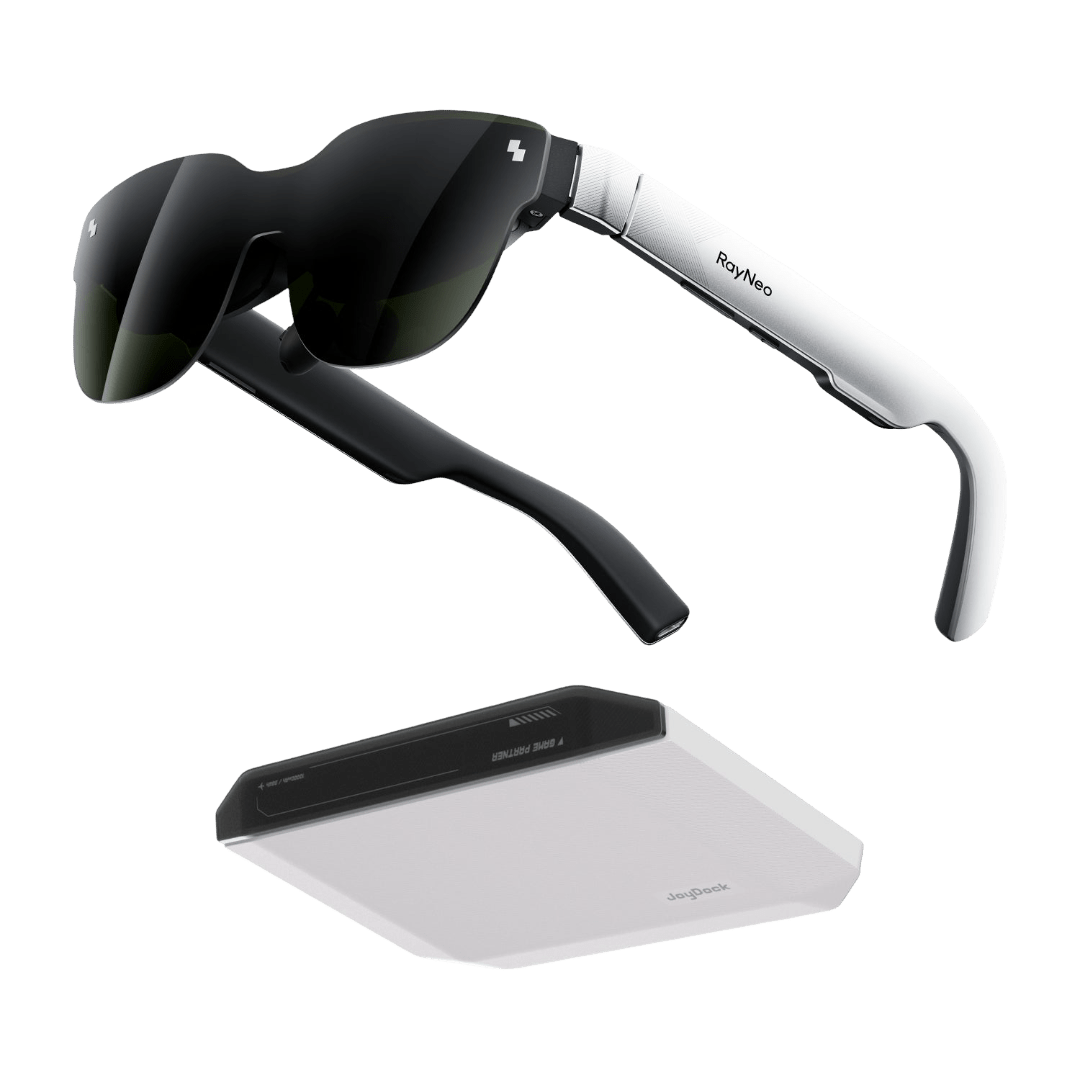
Pairing GT Max with Pocket TV Pro also unlocks something neither device does alone: RayNeo describes the pairing as “the World’s First Dolby Vision AR Glasses System with Pocket TV Pro,” delivering Dolby Vision HDR detail and color when the content itself is mastered in Dolby Vision. Pocket TV Pro isn’t required to use GT Max, but it is required specifically for that Dolby Vision playback.

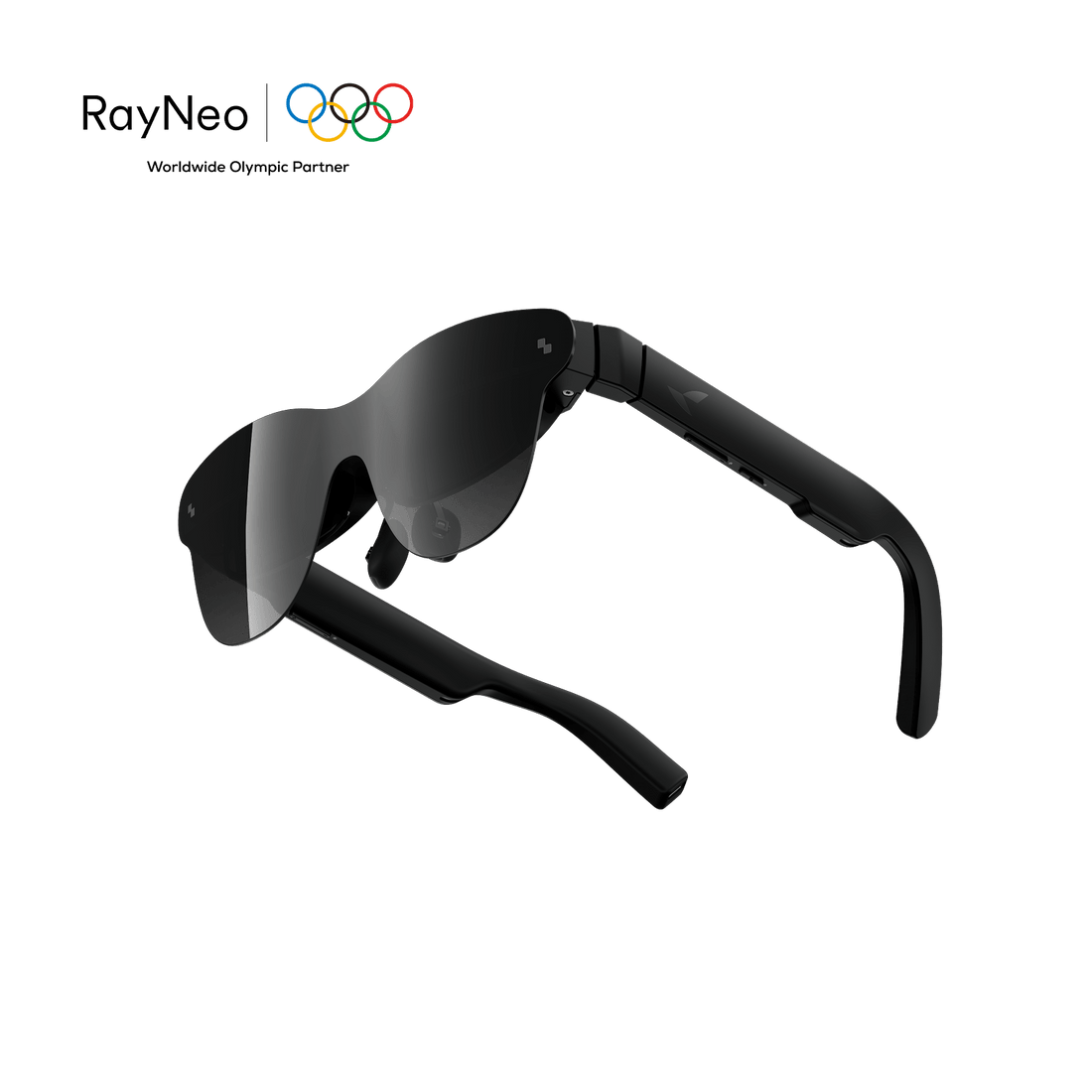
At 78 grams, GT Max is meant to be worn for full episodes or movies, not just quick glances. Interpupillary distance (IPD) is available in three sizes (S, M, and L), and RayNeo provides an online tool at ipd.rayneo.com to measure which one fits before ordering. Measuring your IPD first and matching it to the right size, rather than guessing, is what keeps the image properly aligned with the optical viewing area.
The 59-degree field of view is wide enough that the screen doesn’t feel like you’re peering through a narrow window, which matters more the longer you’re watching.
Three spatial display modes cover the postures people actually watch TV in:
Brightness works differently depending on the mode: Pinned mode runs at 336 nits, which suits a dim bedroom or a darkened room better than a bright space, while non-Pinned modes reach up to 1,200 nits of perceived brightness, RayNeo’s figure for viewing in rooms with more ambient light.
For sound, GT Max uses four open-ear speakers tuned by Bang & Olufsen with spatial audio. Because the speakers are open-ear rather than sealed, RayNeo’s own description is that sound is difficult to make out from about 1.5 meters away, though someone standing very close may still hear some sound. Whisper Mode 2.0 reduces audio leakage further in quiet or public environments, useful for late-night viewing next to someone who’s asleep, and can be turned on with a long press on the volume rocker or through RayNeo XR App > Glasses Settings > Whisper Mode. The same long press also switches between Standard, Whisper, and Spatial Surround.
For eye comfort during extended sessions, OptiCare uses 3840Hz flicker-free dimming, backed by three TÜV SÜD certifications for eye comfort, low blue light, and flicker-free performance. Four display modes are available: Standard, Movie, Eye Protection, and Office. Eye Protection is the one to try for longer sessions, and Movie is the natural pick for film and TV, much like a television’s “cinema” or “movie” picture setting.
RayNeo also sells a lighter, less expensive version in the same GT series.
| RayNeo GT Max | RayNeo GT | |
|---|---|---|
| Price (at time of writing) | $399 | $299 |
| Weight | 78g | 68g |
| Field of view | 59° | 46° |
| Virtual screen sizes | 267” cinema display (227”/307” also available) | 201” cinema display (136”/231” also available) |
| IPD | S / M / L | Fixed 64mm |
| Spatial modes | Follow, Steady, Pinned | Follow, Steady, Pinned |
| Audio | B&O 4-speaker, Whisper Mode 2.0 | B&O 4-speaker, Whisper Mode 2.0 |
| Dolby Vision (with Pocket TV Pro) | Yes | Yes |
GT uses a fixed 64mm IPD, adjusted through the nose pads rather than a size selection. If you’d rather measure your IPD and match a specific size, GT Max’s S/M/L options are the more precise fit. GT’s product page also lists around 10% light leakage, which keeps the image reasonably private from someone sitting close beside you.
Both models share the same core display, audio, and spatial mode features. The difference comes down to screen size, field of view, weight, and fit, not what kind of content each one can play.
Both GT Max and GT support prescription lens inserts through RayNeo’s partnership with Lensology, so wearing glasses day to day doesn’t rule out using either model. Each model links to its own Lensology page: GT Max’s prescription insert page and GT’s prescription insert page.

For anyone planning to stream directly from a device rather than using Pocket TV Pro, GT Max connects over USB-C using DisplayPort Alt Mode to iPhone 15, 16, and 17 series phones, Android phones such as the Galaxy S8 through S25, iPads from the 10th generation onward, and MacBooks from 2015 onward. GT Max ships with the USB-C cable needed for this connection, so there’s nothing extra to buy just for the phone or tablet path.
iPhone 16e, 17e, and iPhone Air don’t support this direct video connection. Older Lightning-based iPhones and iPads need Apple’s Digital AV Adapter to bridge the connection. The glasses draw power from whatever they’re connected to, which means your phone’s battery will drain faster during a viewing session, something worth planning around on a longer flight or a full movie night.

GT Max is built for people who want a personal, adjustable screen for TV and movies rather than a shared living room television: someone in a household where the main TV and its one connected cable box or console are usually claimed by someone else, a bedroom or guest room that never got a set installed, a side sleeper who wants to watch lying down without a laptop propped on their chest, or a frequent traveler who wants a consistent big-screen setup on a plane or in a hotel room.
For the shared-TV household in particular, GT Max just needs its own signal source, whether that’s a phone, a tablet, or a separate Pocket TV Pro, and not access to the TV or box someone else is already using. Paired with Pocket TV Pro, it also works for anyone who doesn’t want to buy or set up an actual television at all.
GT is the better starting point if the priority is lighter weight and a lower price, and the fixed IPD fits comfortably. GT Max is the better fit for anyone who wants the larger 267-inch screen, the wider 59-degree field of view, and a size-matched IPD.
Do I need Pocket TV Pro to use GT Max for watching TV?
Can I actually watch TV lying down in bed?
Will the sound wake someone sleeping next to me?
Can I connect a game console or another HDMI-only device?
What if I need glasses to see clearly?
For watching TV comfortably without depending on a shared television, RayNeo GT Max is the stronger pick: the larger screen, wider field of view, and size-matched IPD make it the more comfortable option for regular, longer viewing sessions, and Follow mode’s screen-centering behavior makes it well suited to watching lying down. Pair it with Pocket TV Pro for a full streaming setup that doesn’t require an actual TV, or connect it directly to a phone or tablet for something simpler. For anyone prioritizing a lighter frame and a lower price over screen size and a size-matched fit, RayNeo GT covers the same core display and comfort features at $299.
Both models come with a 30-day return window and a one-year limited warranty.





Share:
RayNeo Smart Glasses Comparison: iO vs GT vs GT Max vs X3 Pro
The Newest Smart Glasses Released in 2026: RayNeo's iO and GT Series