

$429.00

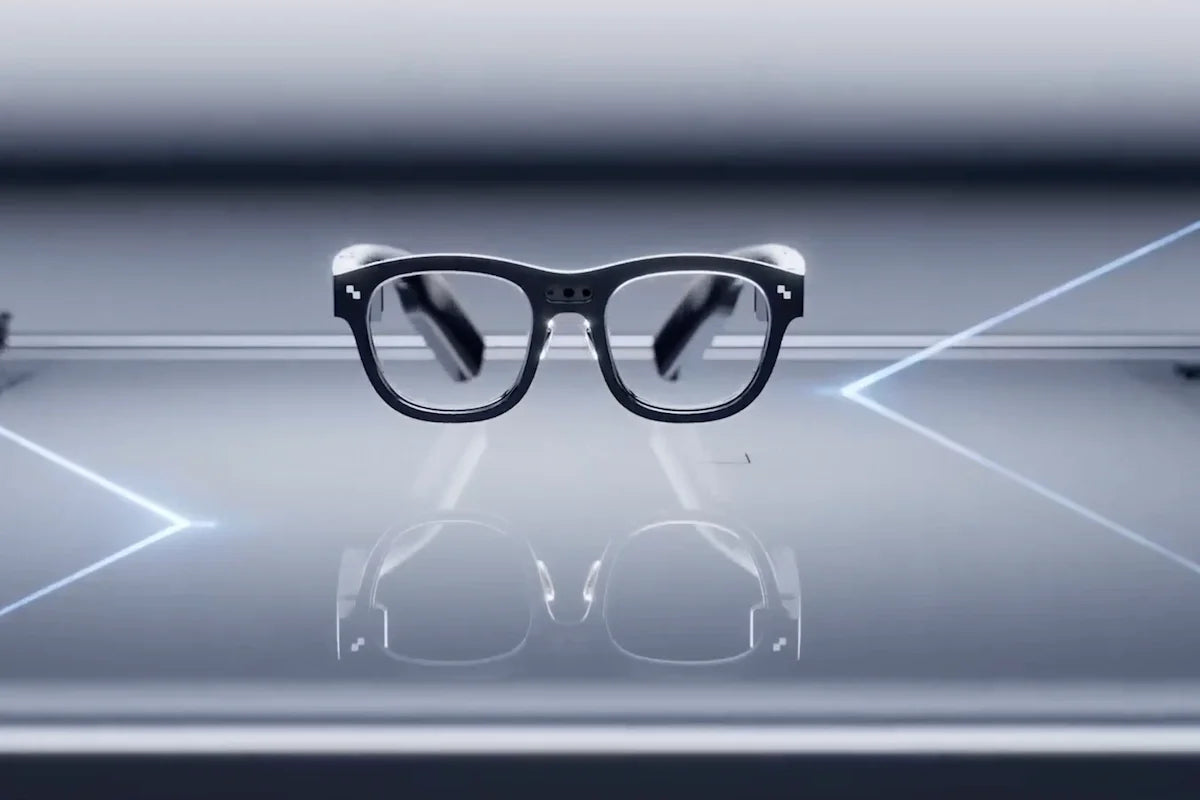
RayNeo released two new product lines on the same day this September: the RayNeo iO AI glasses at $449, and the RayNeo GT Max and RayNeo GT AR glasses at $399 and $299 (prices at the time of writing). Both were announced in a single press release on August 21, 2026, went on sale September 4, and RayNeo announced live demonstrations of both lines at IFA Berlin, running September 4 through 8.
What makes this launch worth tracking isn’t just the timing. iO and the GT series are built for two different jobs, and together they show where the smart glasses category is heading this year: one path toward all-day, camera-free AI assistance, and another toward a private, portable screen for video and gaming.
2026 has been an active year for smart glasses, with several companies shipping updated versions of camera-first glasses, translation-focused glasses, and display-based headsets. RayNeo’s approach stands out because it launched two purpose-built devices rather than one device trying to cover every use case.
RayNeo CEO Howie Li put it directly in the company’s August 21 announcement: “Rather than compromising with a single device that tries to do everything, we designed two dedicated experiences: the iO as an invisible, all-day assistant for heads-up productivity, and the GT Series as an uncompromising personal cinema for travel and entertainment.” Neither is meant to replace the other, and RayNeo doesn’t market them as interchangeable.
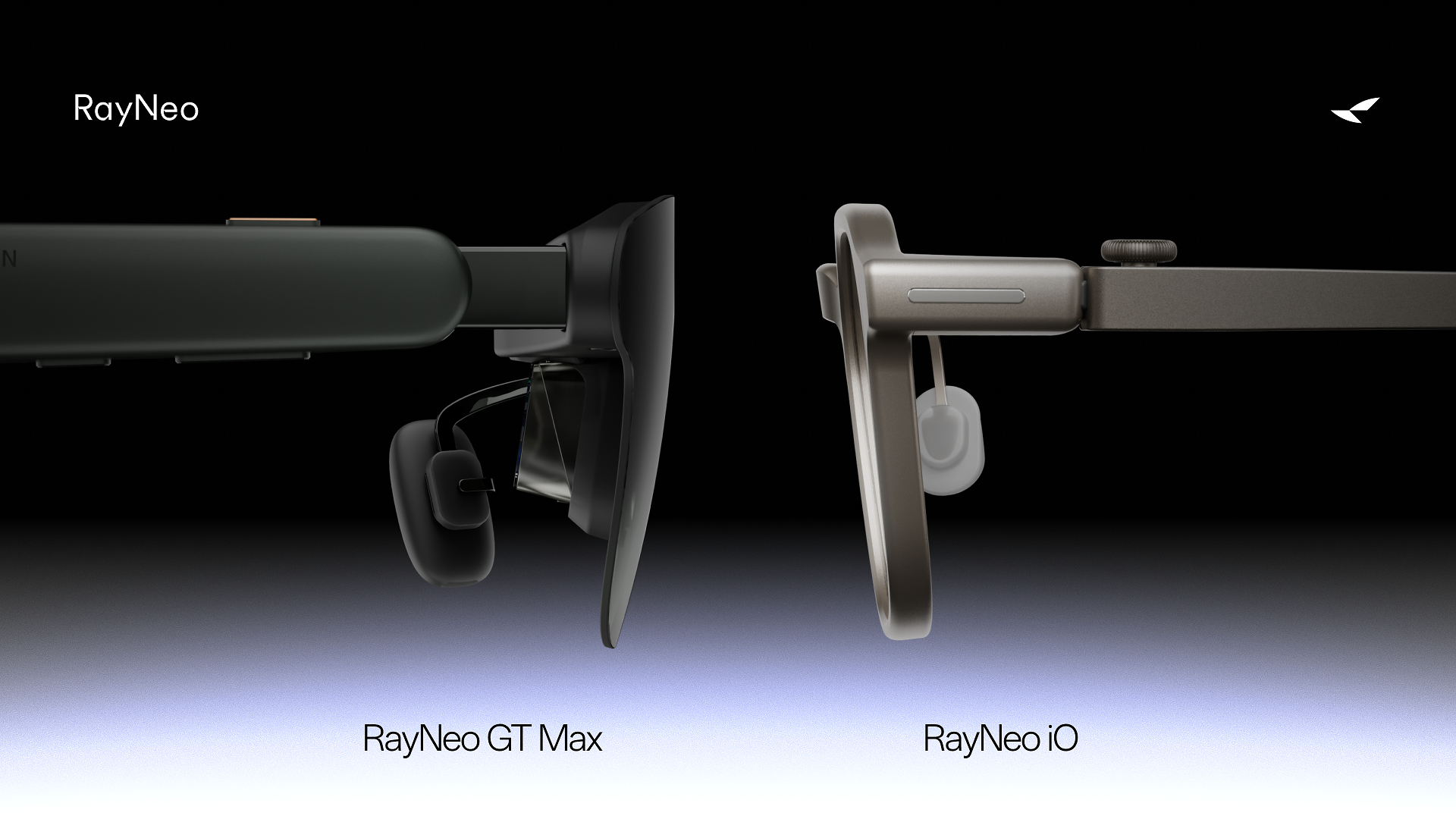
Announced: August 21, 2026. Released: September 4, 2026. Price: $449 (Standard), $499 (Charging Case Bundle), at the time of writing.
iO is built for people who want ambient, glanceable information throughout the day, translated conversations, live captions, meeting notes, without carrying anything that looks or feels like a headset. At 33 grams, it’s close to the weight of a regular pair of glasses.
Three things about iO are worth paying attention to if you’re evaluating it against other AI glasses released this year.
No camera, by design. RayNeo’s FAQ states plainly: “No. RayNeo iO is designed without a camera.” Instead of pass-through video, iO shows information through a binocular MicroLED and diffractive waveguide display, a monochrome green heads-up display roughly equivalent to viewing a 33-inch screen from two meters away. For anyone who wants an AI assistant on their face without a camera in the room, that’s the core trade-off iO is built around.
Live captions and translation at 55 languages. iO’s Live Captions & Translation feature covers 55 languages and 109 accents; RayNeo’s product materials list Timekettle as the translation partner behind it and cite roughly 1.2 seconds of latency. In practice, that means a conversation in another language can appear as live captions in your field of view fast enough to follow along in real time, not read back after the fact. Continuous translation runs for about 6.2 hours on a full charge. iO’s spec sheet lists audio input only, a 4-mic array and a bone-conduction sensor RayNeo describes as helping “isolate your voice with precision,” with no speaker.
Multi-model AI access. iO includes RayNeo AI and Gemini 3.1 Flash Lite at no extra cost. A VIP subscription at $9.99 per month unlocks access to additional models, including Claude, GPT, DeepSeek, Kimi, and Qwen, through the same interface. Beyond the AI assistant, iO also runs a Personal Dashboard for notifications and schedule, Lifelog for all-day audio capture with automatic summaries, one-tap recording with auto-generated meeting notes, and an invisible teleprompter that scrolls text as you read.
iO is rated IP54, runs Bluetooth 5.4 with MFi certification, and RayNeo states typical battery life at up to two days; RayNeo’s product materials also cite a 25-minute fast charge to 80 percent. RayNeo’s product page lists Bluetooth 5.4 and MFi certification (Apple’s accessory certification program) but doesn’t include a separate compatibility statement for Android phones. It comes in two finishes, Dune (Gold) and Polar Night (Grey), with a magnesium-aluminum front frame and titanium temples.

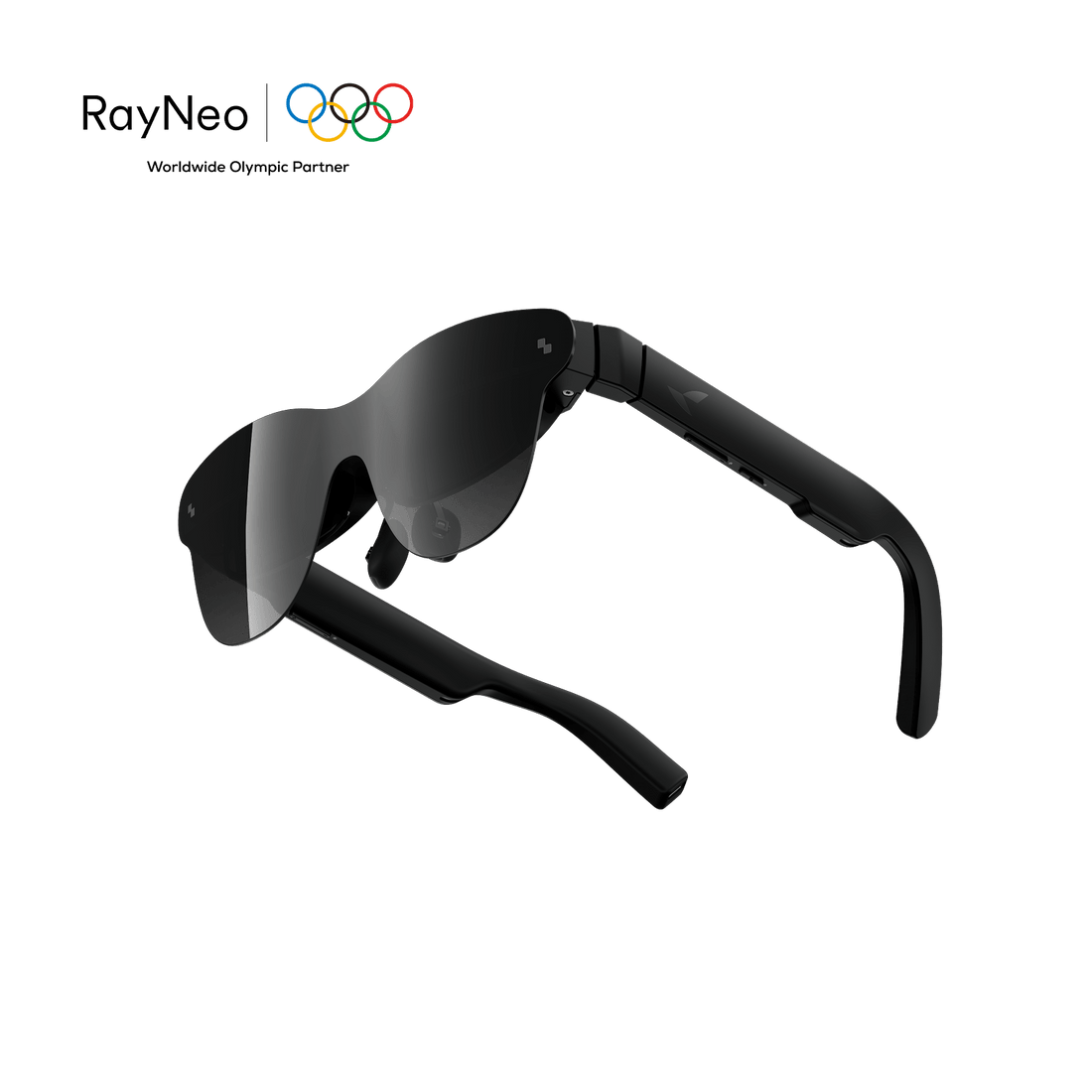
Announced: August 21, 2026. Released: September 4, 2026. Price: GT Max $399, GT $299, at the time of writing.
Where iO is built to disappear into daily life, the GT series is built to do the opposite: project a large virtual screen for watching movies, playing games, or mirroring a laptop or console, without needing a TV, a projector, or a bulky VR headset. GT Max is built around a 267-inch cinema display, with 227-inch and 307-inch sizes also available, and a 59-degree field of view. GT is built around a 201-inch cinema display, with 136-inch and 231-inch sizes also available, and a 46-degree field of view. GT Max weighs 78 grams and GT weighs 68 grams, light enough for a plane seat or a couch, not light enough to forget you’re wearing a display.
Three things stand out about the GT series compared to earlier display glasses.
Three spatial modes for how the screen behaves as you move. RayNeo’s official descriptions: Follow “keeps the screen centered as you move your head, ideal for casual and everyday viewing” (the display is head-locked, so it moves along with you). Steady offers “stable viewing with subtle natural movement, ideal for travel and commuting,” which in practice smooths out the bumps of a train, car, or plane ride. Pinned “keeps the screen fixed in one position, ideal for focused, cinema-like viewing” (the screen stays anchored in space, closer to a second monitor on a desk or a screen mounted on a wall, so turning your head moves you away from it rather than dragging it along). In practice, Follow suits walking around or repositioning frequently, Steady suits a commute or flight with some vibration, and Pinned suits sitting still at a desk or on a couch for a longer, more theater-like session.
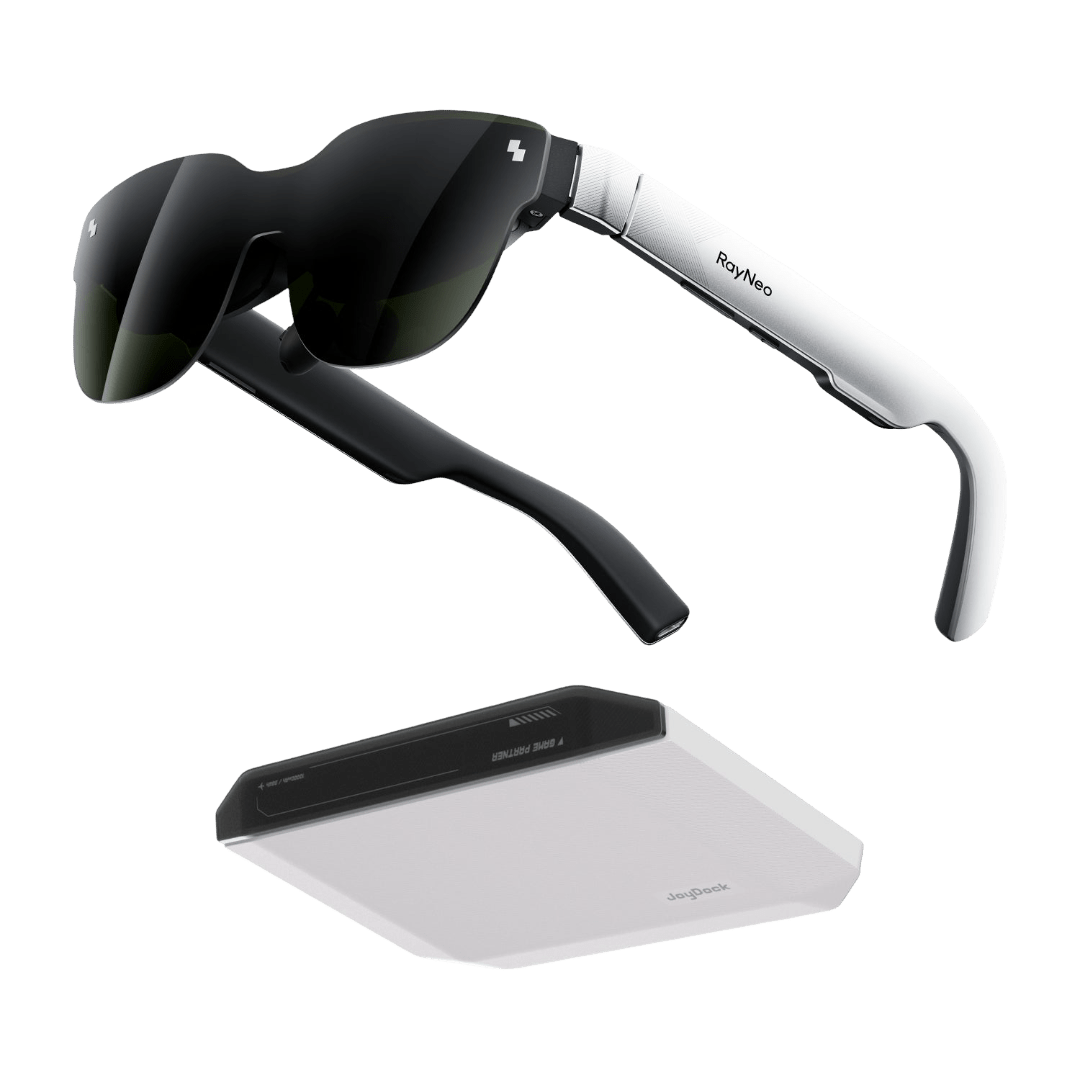
Dolby Vision, with one condition. GT and GT Max support Dolby Vision only when paired with RayNeo’s Pocket TV Pro ($199) and only when the content itself is encoded in Dolby Vision. Pocket TV Pro isn’t required to use the glasses, RayNeo’s FAQ confirms this directly, but it’s the specific combination RayNeo markets as its Dolby Vision AR system, running on Google TV with access to over 400,000 titles across services like Netflix, Prime Video, and Disney+. Without Pocket TV Pro, both models can still display standard SDR video from compatible sources. RayNeo also states, in the same part of its spec sheet that covers the Pocket TV Pro pairing, that “AI real-time SDR-to-HDR conversion is supported across all compatible devices.”
Direct connection over USB-C, no separate computer needed. Both models connect over USB-C DisplayPort Alt Mode, and RayNeo includes a USB-C cable in the box for that connection. Supported sources include:
When you connect one of these devices directly over USB-C, that source device powers the glasses and processes the video, so expect somewhat faster battery drain on your phone or handheld during longer sessions. Two settings can help offset that on the phone side: Eco Mode, which dims the phone’s screen while you’re watching video inside RayNeo’s XR Space player, and Auto-Dim Brightness, which dims the phone’s screen after about 10 seconds of inactivity while you’re screen-casting through the RayNeo XR App.
Older Lightning devices need Apple’s Digital AV Adapter (not included). Consoles and other sources that only output HDMI, such as PlayStation and Xbox, connect through RayNeo’s $64 HDMI Adapter instead. RayNeo’s FAQ for that adapter notes that you need to “make sure it is connected correctly and sufficiently powered,” since the HDMI connection itself doesn’t power the glasses, so the adapter needs its own USB-C power source plugged in. If you’re connecting a USB-C handheld through a dock’s HDMI output rather than its own USB-C port, use the HDMI Adapter the same way.
The two models share the same 0.6-inch SeeYa Micro-OLED panel at 1920x1080, 120Hz refresh in 2D and 60Hz in 3D, and native 3D playback alongside AI-driven 2D-to-3D conversion (2D-to-3D conversion is limited to iPhone 15, 16, and 17 series). That same 1920x1080 panel is spread across a narrower field of view on GT than on GT Max: RayNeo lists this as about 49 pixels per degree on GT versus about 38 on GT Max. In practice, that means GT renders text and fine on-screen detail a bit sharper, while GT Max trades some of that sharpness for a wider, more immersive field of view. The main difference beyond size and field of view is fit: GT Max ships in three IPD sizes, S for under 64mm, M for 64 to 67mm, and L for over 67mm, for a closer match to your eye spacing, while GT uses a fixed 64mm IPD adjusted with nose pads. Both include Bang & Olufsen-tuned four-speaker audio with Whisper Mode 2.0 for lower-volume private listening, and both support prescription lens inserts through RayNeo’s partnership with Lensology.

| If you mainly want… | Consider |
|---|---|
| Ambient AI assistance, live translation, and meeting notes without a camera | RayNeo iO |
| A large private screen for movies and shows while traveling or commuting | RayNeo GT |
| The biggest virtual screen, a closer IPD fit, and Dolby Vision when paired with Pocket TV Pro | RayNeo GT Max |
| First-person photo and video capture | A RayNeo model with a built-in camera, X3 Pro |
Did RayNeo really launch two separate glasses on the same day?
Can iO and the GT series be used together?
Do either of the new models have a camera?
Do you need a phone to use these glasses?
If the smart glasses you’re watching for in 2026 need to disappear into your workday, translate a conversation in real time, and take meeting notes throughout the day, RayNeo iO is the one launched this year built specifically for that job. If what you’re after is a private screen big enough for a movie on a flight or a game session on a couch, RayNeo GT Max is the fuller-featured option with the closer IPD fit, and RayNeo GT covers the same core experience at a lower price and slightly smaller field of view. Both launched together on September 4, 2026, precisely because RayNeo built them to solve different problems rather than compromise on one.





Share:
RayNeo Smart Glasses Comparison: iO vs GT vs GT Max vs X3 Pro
Smart Glasses That Work as a Windows PC External Display