

$429.00


AI glasses for executives are becoming useful for a simple reason: leadership work is full of small interruptions. A calendar check, a quick translation, a meeting note, or a short AI question can pull your attention away from the person or decision in front of you.
The right pair moves some of those interactions into your line of sight, helping you stay informed without reaching for your phone every few minutes. This guide looks at the features that matter most for executive work, including discreet displays, meeting transcription, live translation, teleprompters, notifications, controls, and more.

AI glasses bring AI assistance, voice input, and—in display-equipped models—glanceable digital information into eyewear you can use without constantly reaching for another screen.
For executives, their value is less about replacing a phone or laptop and more about making short, frequent interactions easier to handle without breaking the flow of a meeting, conversation, or workday.
A calendar check, quick AI question, translation, or reminder may take only a few seconds, but each one can pull your attention into another device.
The American Psychological Association's overview of multitasking explains that task switching carries measurable cognitive costs, and repeated switches can add up over time.
For an executive moving between decisions, conversations, and meetings, glanceable information can reduce the number of times a small task turns into a longer phone interaction.
Display-equipped AI glasses can surface short information such as a calendar event, caption, prompt, notification, or AI response in your field of view. That makes them especially useful when you need one piece of information quickly but still want to keep your attention on the person or task in front of you.
Depending on the model, AI glasses can also support transcription, meeting summaries, live captions, translation, teleprompters, and hands-free note capture. These features are most valuable when they remove small pieces of friction from an existing workflow rather than trying to move an entire laptop-style workload onto your face.
Executive AI glasses should make information easier to access without becoming another source of interruption.
For most professional workflows, the strongest features are discreet information display, quick AI access, meeting support, multilingual communication, presentation tools, and controls that still feel natural in public.
A near-eye display works best when it handles short, glanceable information rather than trying to recreate a full computer screen.
Look for readable text, adjustable positioning, and a design that keeps the optical hardware compact enough for everyday wear.
A transparent display is particularly useful for calendars, captions, prompts, and short AI responses because you can still see the room around you.
Voice access to an AI assistant can make short questions, summaries, and information lookups faster when your hands are occupied. Some systems also let you choose between different AI models, such as ChatGPT, Gemini, and Claude.
That can be useful if you prefer one model for general questions and another for writing, summarization, or other work tasks.
For meeting-heavy roles, recording and transcription can be more valuable than generic voice commands. Look for speaker recognition, structured summaries, action-item extraction, and easy access to previous transcripts. The goal is to stay involved in the discussion instead of splitting your attention between listening and manual note-taking.
For international teams and business travel, captions can keep spoken language visible in real time while translation helps bridge multilingual conversations. Check the supported language count, whether translation is one-way or two-way, and whether transcripts can be reviewed afterward.
A near-eye teleprompter can keep talking points or a script in view during a keynote, investor presentation, video recording, or internal update. Speech-following or automatic scrolling is particularly useful because it reduces the need to manually advance text while presenting.
Voice control is useful, but it should not be your only option. Physical controls, head gestures, or touch controls give you quieter ways to interact in boardrooms, shared offices, and public spaces.
Also look for a focus or do-not-disturb mode so that smart glasses help filter interruptions instead of simply moving every phone alert into your field of view.
If you already wear corrective lenses, prescription compatibility is a practical requirement rather than an optional extra.
Also consider total weight, front-to-back balance, nose-pad fit, temple pressure, and battery life. A feature-rich pair has limited value if you only want to wear it for an hour at a time.
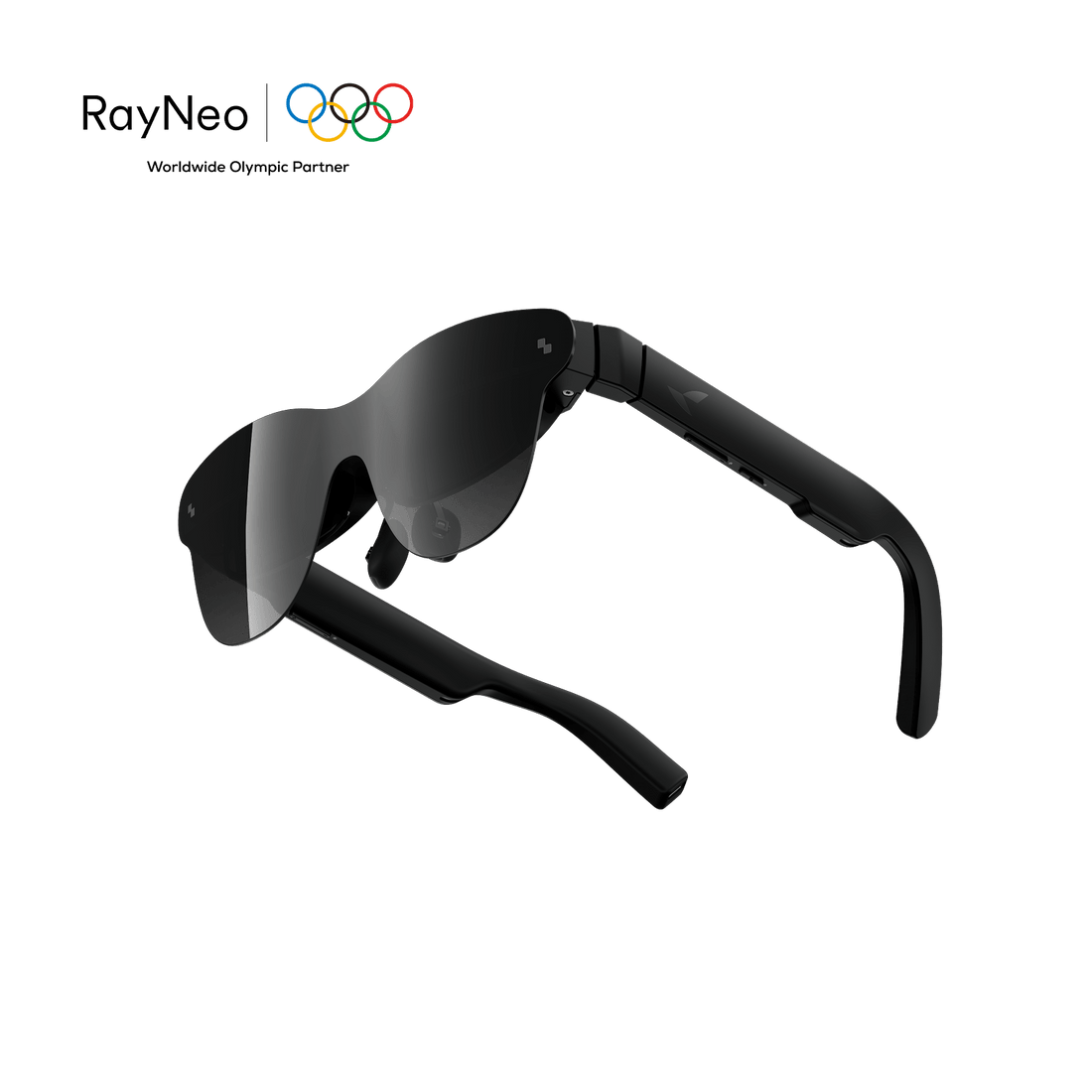
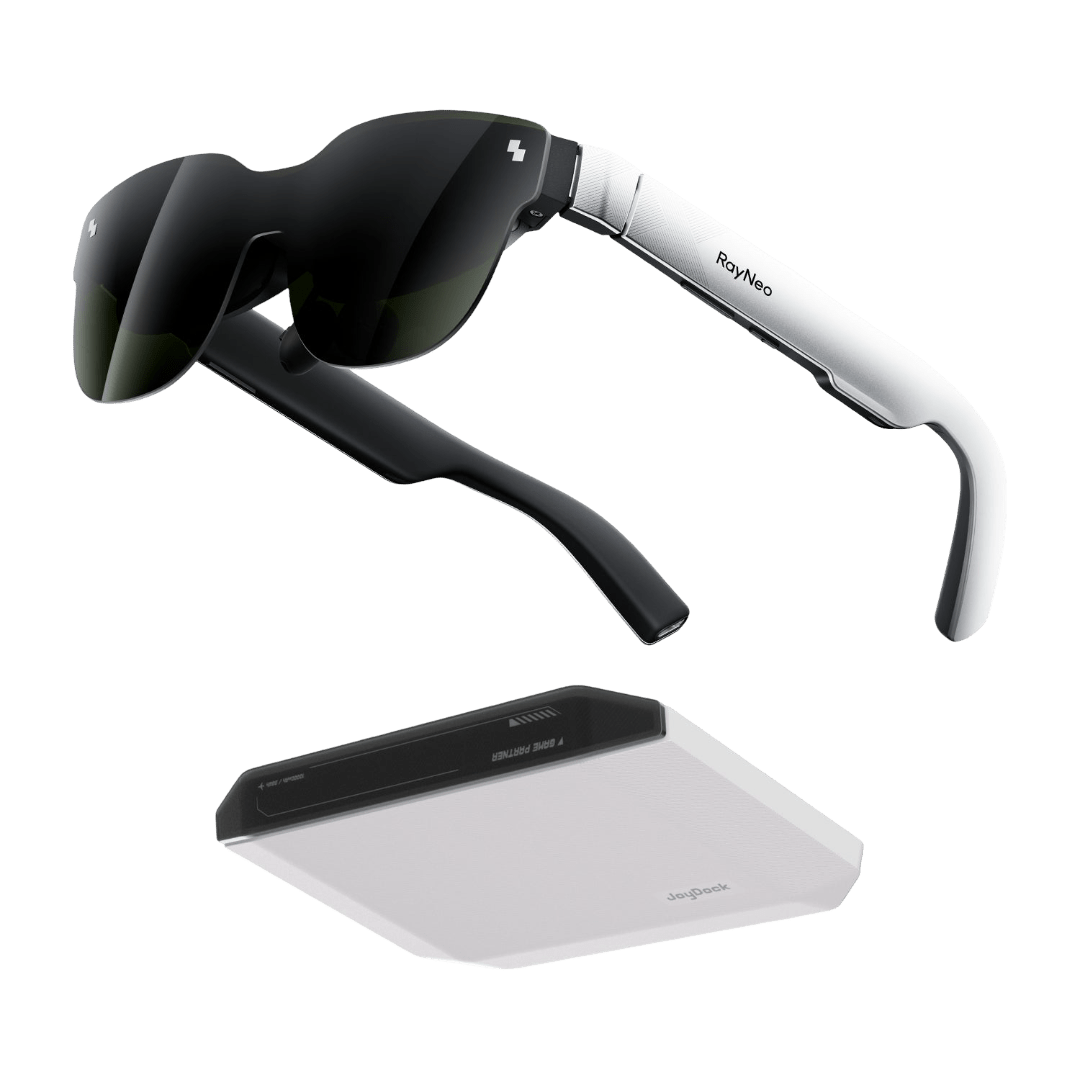
For executives who want AI assistance without a bulky headset, the RayNeo iO AI Glasses combine a 34g, camera-free and speaker-free everyday frame with an ultra-transparent display and flexible multi-model AI.
Here is what you can expect in everyday use:

AI glasses are strongest at short, glanceable interactions, while smartphones remain better for detailed input and full applications. Used together, they can reduce the number of times a simple task turns into a longer screen session.
| Executive Task | AI Glasses | Smartphone |
|---|---|---|
| Check a calendar or reminder | Quick glance with minimal interruption | Full schedule editing and planning |
| Ask a short AI question | Voice input and concise in-view answer | Better for long prompts and deeper follow-up |
| Capture a meeting | Hands-free recording, transcription, or summaries | Better for editing, organizing, and sharing afterward |
| Follow multilingual conversation | Live captions or translation in view | Full translation apps and text entry |
| Review notifications | Surface selected alerts without looking down | Full message threads and app actions |
| Work on documents or apps | Best as a supporting information layer | Better for detailed interaction and complex workflows |
The practical advantage is not replacing one device with another. It is letting AI glasses handle the small information checks that benefit from being immediate and hands-free, while your phone or laptop remains available for deeper work.
Choosing AI glasses for executives comes down to reducing friction without adding another source of distraction. The most useful features are the ones that support real work: glanceable information, AI assistance, meeting summaries, translation, presentation tools, discreet controls, and comfortable everyday wear.
The RayNeo iO brings those functions into a lightweight, camera-free design built around visual assistance, giving executives another way to stay informed while keeping more attention on the room and the conversation.
Yes. Many AI glasses support prescription lenses, but the fitting method and prescription range vary by model. Some use custom inserts, while others allow prescription lenses to be made directly for the frame. If you wear glasses every day, check supported sphere and cylinder ranges, pupillary-distance requirements, and how the lenses are ordered. This matters for comfort and display alignment, especially with near-eye or waveguide displays.
AI glasses commonly last several hours of active use, while lightweight models designed for intermittent notifications and AI assistance can last a full day or longer. Battery life drops faster with continuous recording, navigation, audio, bright displays, or frequent AI requests. The RayNeo iO, for example, uses a 240mAh battery rated for up to 48 hours of typical use, while X3 Pro supports up to 5 hours of continuous audio recording.
Usually, wearing AI glasses at work is not prohibited by a single blanket U.S. law, but company policy and recording rules can still limit how you use them. Federal law sets one-party consent as a minimum for many recordings, while some states impose stricter all-party consent requirements.
Camera-free glasses may avoid video concerns, but microphone-based recording still requires attention to workplace policy, privacy expectations, and applicable state law. See the Reporters Committee's Recording Guide for state-by-state rules.





Share:
AI Glasses for CEOs: A Hands-Free Edge for Modern Leaders
Smart Glasses Proactive Reminders: A Practical Guide