Prescription wearers can use smart glasses in two quite different ways: as a pair that stays on from morning to evening, or as a pair put on for a film, a game or a work session. How the corrective lenses go into the frame follows from that choice.
RayNeo handles the two cases in two different ways. RayNeo iO, the everyday AI glasses, is ordered with the prescription built in. The virtual-screen models, RayNeo GT Max, RayNeo GT and RayNeo Air 4 Pro, take a separate prescription insert.

Two ways a prescription goes into RayNeo glasses
The first route is a prescription made into the glasses at the time of purchase. iO's prescription elements are custom-built and fused with the display optics, so the lenses and the display come as one finished pair.
The second route is an insert. GT Max, GT and Air 4 Pro are worn over the eyes for a large virtual screen, and the prescription sits in a custom lens insert that fits inside the frame. The insert can come from RayNeo's lens partner, Lensology, or be made by a local optical store using the sample frame included in the box. Because the insert sits between the eyes and the display optics, the virtual screen is viewed through the wearer's own correction, and the insert stays with the viewing pair rather than with everyday glasses.
iO as the pair that stays on all day
iO is built to be worn through the day, with a transparent display for captions, translation, notifications and reminders. RayNeo iO with prescription lenses is ordered through Shop Prescription on the product page, where the prescription values are entered and a copy of the prescription is uploaded before checkout, with single-vision or progressive lenses available.
When the display features are powered off, iO serves as a standard pair of prescription glasses. That makes it the natural choice for someone who wants one pair on their face from the commute to the last meeting.

Inserts for GT Max, GT and Air 4 Pro
GT Max and GT offer two ways to get prescription lenses. The first is a custom insert from Lensology, made for each model (GT Max inserts, GT inserts). The second is to take the prescription-lens sample frame from the GT or GT Max box to a local optical store and have the lenses made there. For GT and GT Max, lenses can be customized for myopia from 0 to -10.00D and astigmatism up to -2.00D.
Air 4 Pro follows the same insert approach. Custom inserts are available from Lensology (Air 4 Pro inserts), and the box includes a prescription-lens frame (sample) that a local optician can fit.

Prescription numbers and the route they fit
A prescription slip uses the same few values whichever route is chosen, and each one has a clear place in a RayNeo order.
An up-to-date prescription keeps both routes simple. iO orders include an uploaded copy of the prescription, and an optician making lenses for a GT, GT Max or Air 4 Pro sample frame works from the same slip. A prescription's validity window is usually one to two years from issue, shaped by regional guidelines and by how a person's vision changes, so a recent eye exam is the natural starting point.
Taking the sample frame to a local optical store
The local-optician route suits people who already have a trusted optical store. The prescription-lens sample frame from the GT, GT Max or Air 4 Pro box goes to the store together with a current prescription, and the optician uses the frame for custom fitting of the wearer's lenses.
This route keeps the lens order close to home, with the same store that handles everyday glasses. For GT and GT Max, the optician works to the same myopia and astigmatism range as the Lensology route. Once the finished lenses are back, the prescription side of the viewing pair is ready, and the glasses connect to a compatible video source as usual.
Nose pads and fit for a viewing pair
A prescription insert works best when the frame sits in the right place on the face, and each model has its own fit hardware. GT Max includes three nose pads, with nose-pad heights in S, M and L for different pupil heights, on top of its S, M and L IPD sizes. GT includes two nose pads and uses adjustable nose pads to center the picture. Air 4 Pro combines a 9-way flexible adjustment system with 3-position nose pads.
On the GT models, moving the nose pad up or down fine-tunes the vertical position of the glasses so the display sits centered in front of the eyes.
Usage pattern, model and prescription route
Four decisions, in order
The choice between the four models can be settled with four decisions taken in sequence.
- How many hours a day the glasses will be worn. A pair meant to stay on from morning to evening points to iO, with the prescription built in. A pair put on for films, games or a work session points to GT Max, GT or Air 4 Pro with an insert.
- Where the lenses will be made. Lensology makes custom inserts for each viewing model, and the sample frame in the box lets a local optical store make them instead.
- How the frame will fit. For GT Max, the IPD size is chosen at checkout; for GT, the fixed 64mm IPD design is centered with nose pads; for Air 4 Pro, the flexible adjustment system and nose pads set the position.
- What the virtual screen will mostly show. For films and games, GT Max's wider 59° view is the draw; for wearers who put pixel density first, GT's higher pixel density is the reason to look at it.
Owning one of each
Owning both is another route. iO handles the working day: it stays on, shows captions or a teleprompter when needed, and works as ordinary prescription glasses when the display is off. A GT model or Air 4 Pro comes out in the evening, on a flight or at the desk for a game, with its own insert already fitted.
Splitting the roles this way means each pair does one job well. RayNeo's guide to prescription smart glasses and comfort looks at how the frames feel over longer wear.
Prescription-choice FAQ
Do GT and GT Max cover the same prescription range?
The two GT models share the same range: lenses can be customized for myopia from 0 to -10.00D and astigmatism up to -2.00D on both. A wearer moving between GT and GT Max can therefore compare the two on view, weight and fit, with the prescription range staying the same, and the insert is ordered for whichever model is chosen.
Does the PD on a prescription help choose a GT Max size?
PD on a prescription and IPD for GT Max both describe the distance between the centers of the pupils in millimeters, so a recent PD reading is a useful reference next to the GT Max sizes: S under 64mm, M from 64 to 67mm, L over 67mm. GT, by contrast, has a single fixed 64mm IPD design. For sizing, the RayNeo tool at ipd.rayneo.com, opened in a smartphone browser, measures IPD directly before ordering, and the GT and GT Max IPD options explainer covers the sizes in detail.
Which model suits a prescription wearer who mainly reads documents on the virtual screen?
For a prescription wearer who puts pixel density first, RayNeo GT is the model to look at: it is rated at 49 pixels per degree against 38 on GT Max, and both GT models include an Office display mode.


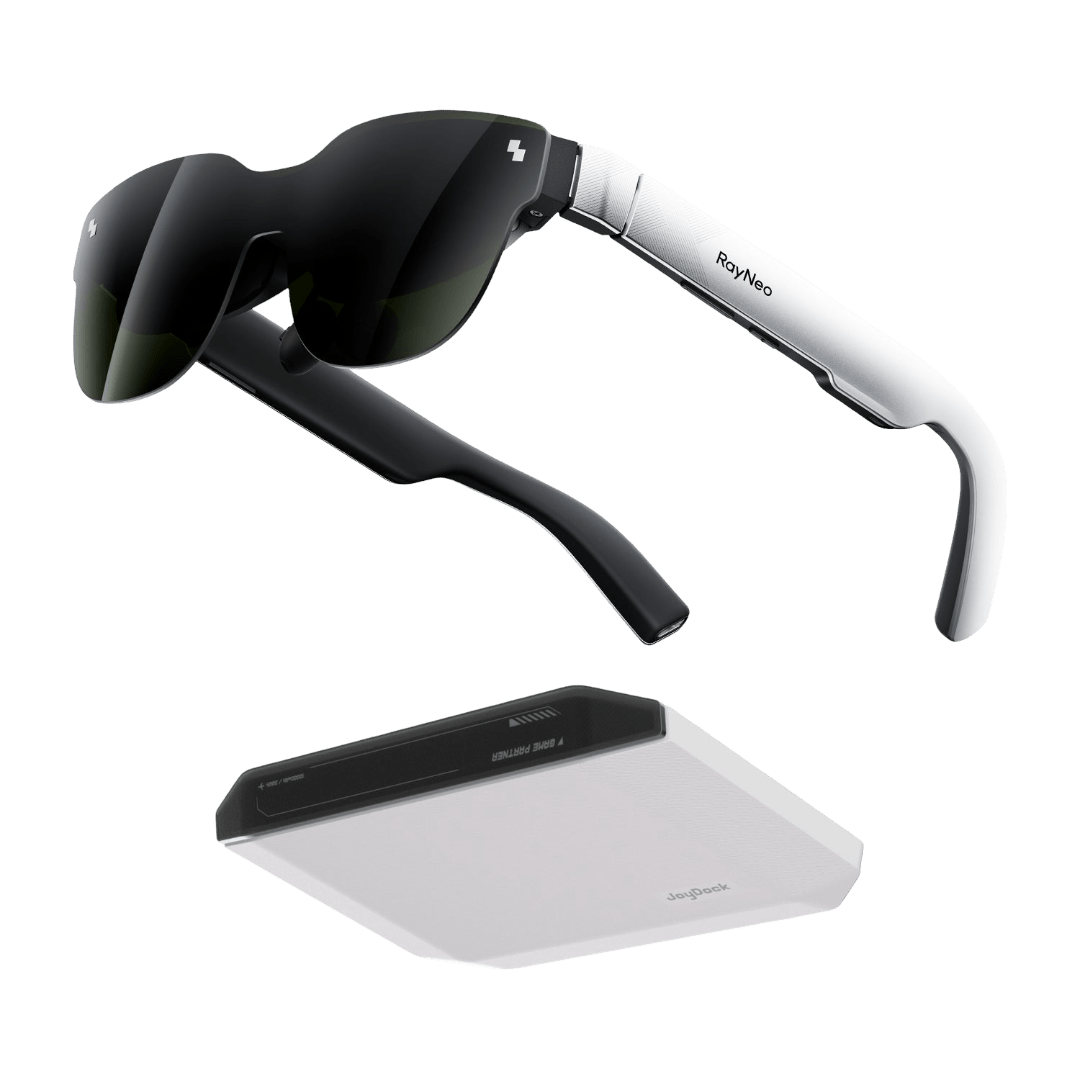


Prescription wearers can use smart glasses in two quite different ways: as a pair that stays on from morning to evening, or as a pair put on for a film, a game or a work session. How the corrective lenses go into the frame follows from that choice.
RayNeo handles the two cases in two different ways. RayNeo iO, the everyday AI glasses, is ordered with the prescription built in. The virtual-screen models, RayNeo GT Max, RayNeo GT and RayNeo Air 4 Pro, take a separate prescription insert.
Two ways a prescription goes into RayNeo glasses
The first route is a prescription made into the glasses at the time of purchase. iO's prescription elements are custom-built and fused with the display optics, so the lenses and the display come as one finished pair.
The second route is an insert. GT Max, GT and Air 4 Pro are worn over the eyes for a large virtual screen, and the prescription sits in a custom lens insert that fits inside the frame. The insert can come from RayNeo's lens partner, Lensology, or be made by a local optical store using the sample frame included in the box. Because the insert sits between the eyes and the display optics, the virtual screen is viewed through the wearer's own correction, and the insert stays with the viewing pair rather than with everyday glasses.
iO as the pair that stays on all day
iO is built to be worn through the day, with a transparent display for captions, translation, notifications and reminders. RayNeo iO with prescription lenses is ordered through Shop Prescription on the product page, where the prescription values are entered and a copy of the prescription is uploaded before checkout, with single-vision or progressive lenses available.
When the display features are powered off, iO serves as a standard pair of prescription glasses. That makes it the natural choice for someone who wants one pair on their face from the commute to the last meeting.
Inserts for GT Max, GT and Air 4 Pro
GT Max and GT offer two ways to get prescription lenses. The first is a custom insert from Lensology, made for each model (GT Max inserts, GT inserts). The second is to take the prescription-lens sample frame from the GT or GT Max box to a local optical store and have the lenses made there. For GT and GT Max, lenses can be customized for myopia from 0 to -10.00D and astigmatism up to -2.00D.
Air 4 Pro follows the same insert approach. Custom inserts are available from Lensology (Air 4 Pro inserts), and the box includes a prescription-lens frame (sample) that a local optician can fit.
Prescription numbers and the route they fit
A prescription slip uses the same few values whichever route is chosen, and each one has a clear place in a RayNeo order.
An up-to-date prescription keeps both routes simple. iO orders include an uploaded copy of the prescription, and an optician making lenses for a GT, GT Max or Air 4 Pro sample frame works from the same slip. A prescription's validity window is usually one to two years from issue, shaped by regional guidelines and by how a person's vision changes, so a recent eye exam is the natural starting point.
Taking the sample frame to a local optical store
The local-optician route suits people who already have a trusted optical store. The prescription-lens sample frame from the GT, GT Max or Air 4 Pro box goes to the store together with a current prescription, and the optician uses the frame for custom fitting of the wearer's lenses.
This route keeps the lens order close to home, with the same store that handles everyday glasses. For GT and GT Max, the optician works to the same myopia and astigmatism range as the Lensology route. Once the finished lenses are back, the prescription side of the viewing pair is ready, and the glasses connect to a compatible video source as usual.
Nose pads and fit for a viewing pair
A prescription insert works best when the frame sits in the right place on the face, and each model has its own fit hardware. GT Max includes three nose pads, with nose-pad heights in S, M and L for different pupil heights, on top of its S, M and L IPD sizes. GT includes two nose pads and uses adjustable nose pads to center the picture. Air 4 Pro combines a 9-way flexible adjustment system with 3-position nose pads.
On the GT models, moving the nose pad up or down fine-tunes the vertical position of the glasses so the display sits centered in front of the eyes.
Usage pattern, model and prescription route
Four decisions, in order
The choice between the four models can be settled with four decisions taken in sequence.
Owning one of each
Owning both is another route. iO handles the working day: it stays on, shows captions or a teleprompter when needed, and works as ordinary prescription glasses when the display is off. A GT model or Air 4 Pro comes out in the evening, on a flight or at the desk for a game, with its own insert already fitted.
Splitting the roles this way means each pair does one job well. RayNeo's guide to prescription smart glasses and comfort looks at how the frames feel over longer wear.
Prescription-choice FAQ
Do GT and GT Max cover the same prescription range?
The two GT models share the same range: lenses can be customized for myopia from 0 to -10.00D and astigmatism up to -2.00D on both. A wearer moving between GT and GT Max can therefore compare the two on view, weight and fit, with the prescription range staying the same, and the insert is ordered for whichever model is chosen.
Does the PD on a prescription help choose a GT Max size?
PD on a prescription and IPD for GT Max both describe the distance between the centers of the pupils in millimeters, so a recent PD reading is a useful reference next to the GT Max sizes: S under 64mm, M from 64 to 67mm, L over 67mm. GT, by contrast, has a single fixed 64mm IPD design. For sizing, the RayNeo tool at ipd.rayneo.com, opened in a smartphone browser, measures IPD directly before ordering, and the GT and GT Max IPD options explainer covers the sizes in detail.
Which model suits a prescription wearer who mainly reads documents on the virtual screen?
For a prescription wearer who puts pixel density first, RayNeo GT is the model to look at: it is rated at 49 pixels per degree against 38 on GT Max, and both GT models include an Office display mode.
Share:
Leave a Comment
We'd love to hear your thoughts. Comments are reviewed before publication.