

$429.00


The RayNeo GT and RayNeo GT Max connect to a compatible Nintendo Switch through a dock and RayNeo’s powered HDMI Adapter. JoyDock offers a different route, but its compatibility list names the Air series. Choose the accessory according to both your glasses and your Switch model.
Two RayNeo accessories touch Nintendo Switch: the RayNeo HDMI Adapter ($64 at the time of writing) and the RayNeo JoyDock ($89 at the time of writing). Phones that connect to the glasses over a single cable use DisplayPort Alt Mode, a standard for sending video over USB-C. The original Switch and Switch OLED don’t output video over USB-C in handheld use, and Switch 2 has its own port details (below), so getting a Switch picture onto the glasses means going through one of these accessories.
The GT and GT Max product pages list Switch alongside PS4, PS5, and Xbox under the “connects via RayNeo HDMI Adapter” category. The same pages also carry a row reading “Switch (1st generation) / Switch 2 *Back Clip Needed,” a clip-accessory note for Switch 2. Both paths are laid out below.
Which Switch you own matters:
This is the general-purpose accessory for any device that outputs HDMI instead of USB-C video. It’s the same adapter used for PS4, PS5, Xbox, and standard PCs. It merges an HDMI video signal with external USB-C power and outputs a single USB-C connection the glasses can read.
For Switch, the HDMI signal comes from the console’s dock. Going the HDMI Adapter route means you need a dock that outputs HDMI, either the official one for your Switch model or a compatible one, in addition to RayNeo’s adapter. Connect the dock’s HDMI output to the adapter, then the adapter to the glasses, and provide the adapter’s power as RayNeo’s setup guidance describes. Make sure the dock is the one that’s compatible with your console; the original Switch dock and the Switch 2 dock are different products.
On the video side of Switch 2, it has two USB-C ports. According to Nintendo representative Koichi Kawamoto, as reported by Notebookcheck and Tweaktown, only the bottom port supports video output. In the same exchange, Nintendo said it “cannot guarantee” that third-party display glasses work with Switch 2, since they aren’t official Nintendo products. That’s Nintendo’s general position on third-party glasses, not a statement naming RayNeo.
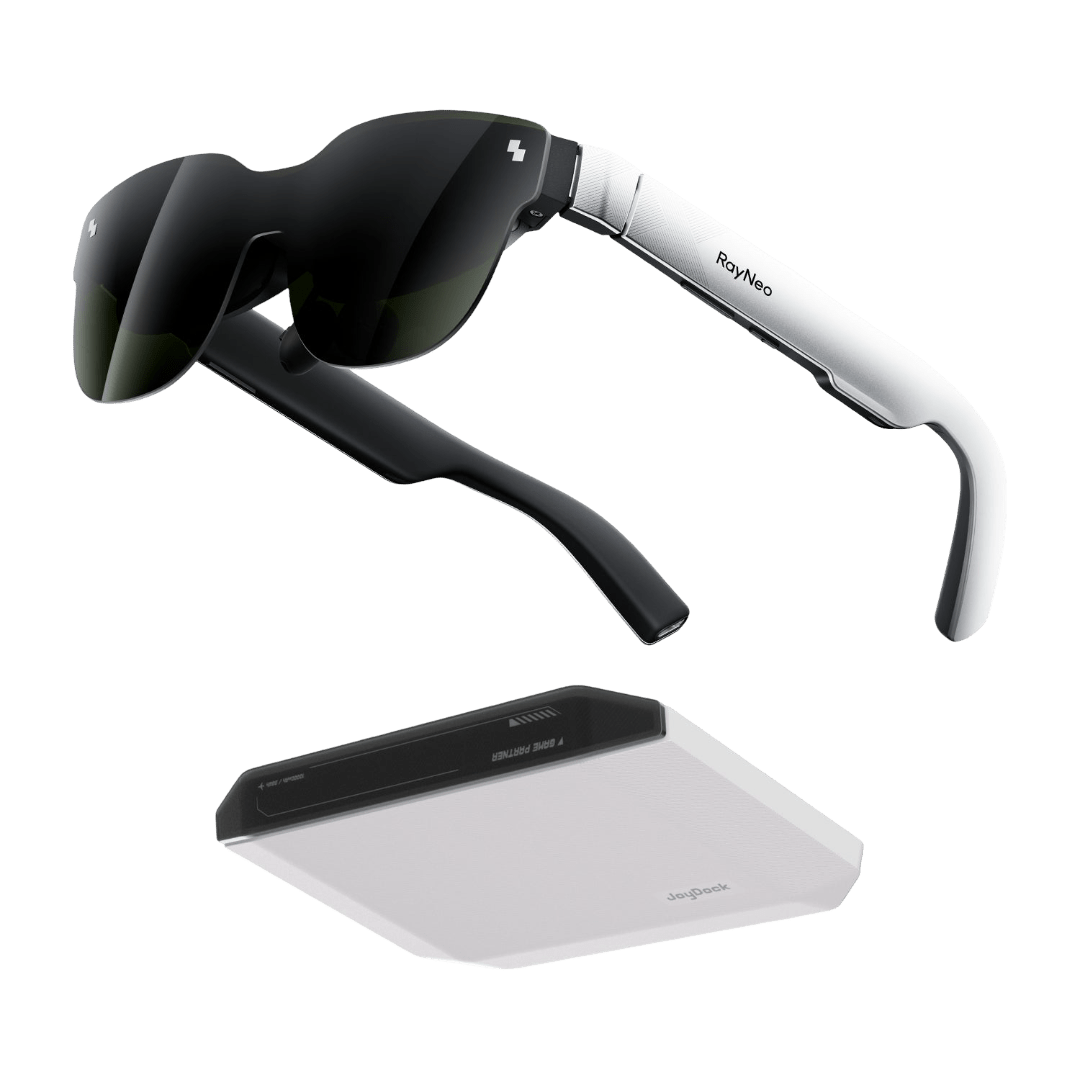
JoyDock works differently from the HDMI Adapter: instead of routing a signal through a TV dock, it attaches directly to the console. RayNeo’s product page describes it this way:
“TV mode,” the phrase JoyDock’s product page uses, refers to the Switch’s higher-resolution display output, the mode the console uses when it’s docked to a television, as opposed to the handheld screen mode. JoyDock sends that output to your glasses.

JoyDock’s compatibility list names the RayNeo Air series (Air 2, Air 3s, Air 4 Pro, and similar models) plus Nintendo Switch. GT and GT Max aren’t named on that list, even though the GT and GT Max pages reference Switch through the HDMI Adapter category and the Back Clip row.
Switch 2 needs a separate accessory with JoyDock: the JoyDock Switch 2 Bracket (sold separately, $15 at the time of writing). The bracket isn’t bundled into the JoyDock price. If you’re buying JoyDock for a Switch 2, plan to buy both pieces. The original Switch doesn’t use the bracket.
GT and GT Max have a Bang & Olufsen-tuned four-speaker array for audio delivered through the connected video source. Their up-to-120Hz 2D display rating is not a measurement of Switch input lag. The game’s output frame rate, console, and adapter setup also affect what you see; a 120Hz display does not make every Switch game run at 120 frames per second.
For a hands-on data point, a write-up from Pocket Tactics covering an Air 4 Pro connected to a Switch 2 through JoyDock described the built-in speakers as “surprisingly rich with audio” and gameplay as feeling smooth during a platforming session. That’s one reviewer’s experience on one Air-series model, not a published spec and not a test of GT or GT Max.
The GT and GT Max compatibility tables point to the HDMI Adapter for Switch, so that’s the documented route. It needs a Switch dock (yours or a compatible one) to feed HDMI into the adapter, the same way a PS5 or Xbox would connect.
JoyDock’s own compatibility list currently names only the Air series. A “RayNeo GT Max AR Glasses & JoyDock for Switch Bundle” is listed on RayNeo’s Amazon storefront, but a retail bundle listing isn’t a compatibility statement from the product page. If JoyDock with GT or GT Max is what you want, confirm first:
For Air 2, Air 3s, Air 4 Pro, and similar Air series glasses, JoyDock is the accessory listed for your hardware. Its compatibility list names these models alongside Nintendo Switch, and its description frames the experience around TV mode, so it’s positioned for a bigger-screen session. If you’re using a Switch 2, you’ll also need the bracket described above.
| RayNeo JoyDock | RayNeo HDMI Adapter | |
|---|---|---|
| Price (at time of writing) | $89 | $64 |
| Built specifically for | Nintendo Switch | Any HDMI-output device (PS4, PS5, Xbox, PC, and per the GT/GT Max pages, Switch) |
| Compatibility list names | RayNeo Air series + Nintendo Switch | GT, GT Max, and other HDMI-capable setups |
| How it connects to Switch | Clips onto the console via a back-clip and rail system; no TV or dock needed | Needs a Switch dock with HDMI output (official or compatible) |
| Switch 2 extra part | JoyDock Switch 2 Bracket (sold separately) | A Switch 2-compatible dock; check Nintendo and RayNeo for current guidance |
| Original Switch / OLED extra part | None listed | A compatible dock |
| Switch Lite | No video output; not usable | No video output; not usable |
This table reflects what each product page states at the time of writing. Accessory compatibility can change as RayNeo adds support for more glasses models, so check the product pages before buying.
Does the RayNeo GT Max work with the Nintendo Switch? Through the RayNeo HDMI Adapter, yes: GT Max’s compatibility table groups Switch alongside PS4, PS5, and Xbox under that accessory, provided you have a compatible Switch dock to supply the HDMI signal. Whether JoyDock also works with GT Max isn’t confirmed on JoyDock’s own compatibility list.
Do I need the Back Clip for every Switch? No. RayNeo’s pages call for a back clip for Switch 2 (JoyDock’s Switch 2 Bracket is sold separately); the original Switch doesn’t need the bracket.
Is JoyDock the same thing as the HDMI Adapter? No, they’re separate accessories built for different jobs. The HDMI Adapter makes sense if you already own a Switch dock or also play PS4, PS5, or Xbox, since it works for all of them. JoyDock is for people who’d rather skip the dock and use one accessory dedicated to Switch. GT and GT Max are documented for the HDMI Adapter path; JoyDock’s compatibility list currently names the Air series.
Can I use JoyDock in handheld mode instead of docked? JoyDock doesn’t need a TV or stationary dock: you hold the assembled Switch-plus-JoyDock unit while wearing the glasses as your screen. RayNeo describes the output as TV mode, the Switch’s docked output, rather than the handheld screen mode.
If you’re choosing between GT and GT Max for Switch gaming, both share a 120Hz 2D refresh rate, Bang & Olufsen tuned audio, and three 3DoF spatial display modes (Steady, Pinned, and Follow). 3DoF modes track the direction you’re facing, not your position in the room. Whether a game looks smooth also depends on the frame rate the game outputs, not only on the panel.
| RayNeo GT | RayNeo GT Max | |
|---|---|---|
| Price | See the product page | List price $429; $399 with the launch discount applied at checkout |
| Default virtual screen size | 201 inches | 267 inches |
| Weight | 68 grams | 78 grams |
| Frame sizing | Fixed 64mm IPD | Three IPD sizes (S/M/L) selected at purchase |
GT Max’s larger default screen suits a big-screen feel for docked-style Switch sessions. GT is lighter, though its fixed 64mm IPD means less room to match your eye spacing if it falls outside that measurement.
For either model, the HDMI Adapter path is the one documented on the product pages today. If you want JoyDock specifically, get a quick support confirmation first.





Share:
RayNeo Wired vs. Wireless Glasses: What the Cable Actually Means
RayNeo Air 3s Pro Display Resolution Explained: 1920x1080 (2D) and 3840x1080 (3D)