

$429.00

If you are exploring wearable displays this year, finding the right fit is all about matching the hardware to your daily routine. This guide focuses strictly on how our current RayNeo lineup breaks down to meet those needs.
Rather than building a single device that tries to do everything, we designed distinct smart glasses tailored for specific experiences. Whether you want to capture point-of-view video, enjoy a massive personal cinema, or add a discreet productivity assistant to your workday, this overview will help you identify the architecture that fits your lifestyle.
Our established flagship for immersive AR and spatial computing is the RayNeo X3 Pro, available for $1,299. Weighing 76g, we built it with a 12MP camera located in a visible cutout on the front frame. (Prices may adjust, so check the product pages for current offers).

Powered by a Snapdragon AR1 Gen 1 chip, it utilizes binocular full-color MicroLED displays to project digital information directly into your line of sight. This allows for hands-free video recording, real-world visual overlays, and live translation directly on the lenses.
You will notice a small LED near the camera that lights up during recording to indicate activity. Interaction is primarily hands-free through Google Gemini, using a "Hey RayNeo" wake word and a three-microphone array.
We designed the X3 Pro for early adopters and creators seeking the ultimate all-in-one spatial computing experience. It is not the best choice if your primary goal is high-resolution movie watching, or if you frequently work in environments where visible cameras are restricted.
If you are mainly interested in entertainment and media consumption, our newly released RayNeo GT Max ($399) and RayNeo GT ($299) provide dedicated solutions. We designed these models without a camera to focus entirely on high-resolution Micro-OLED screens.


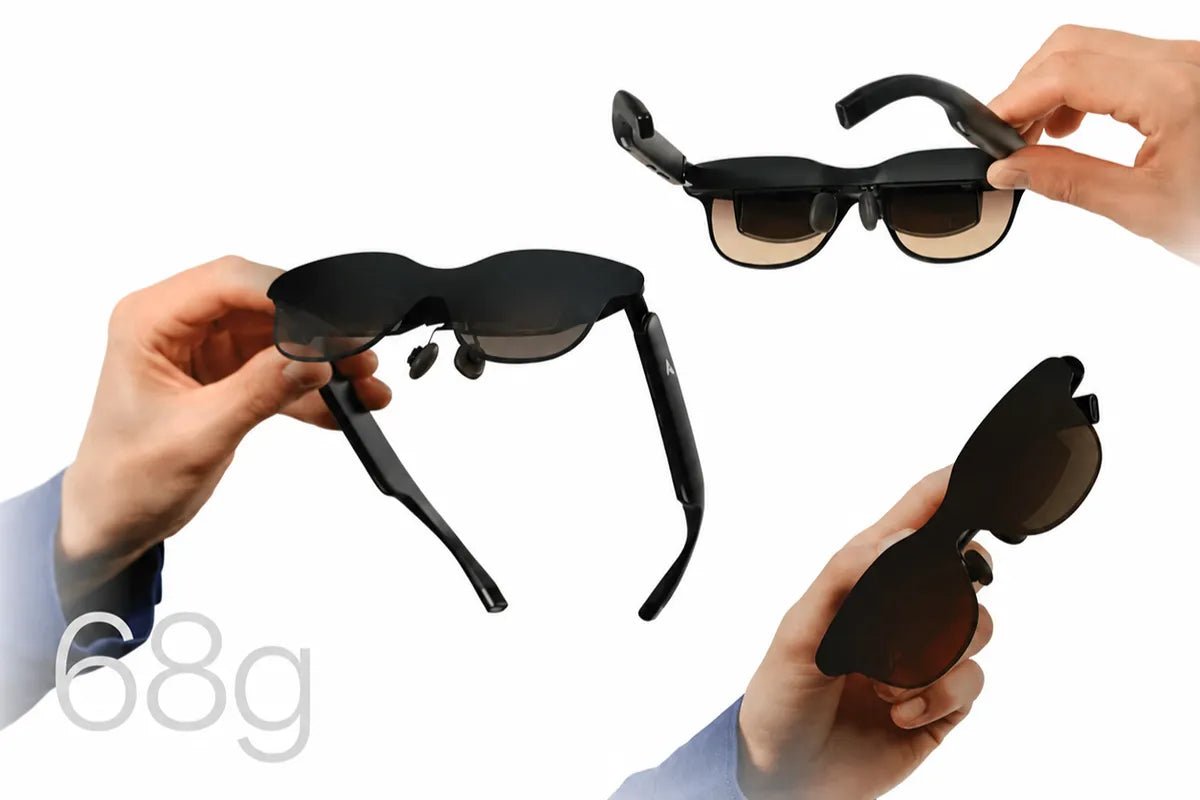
The 78g GT Max delivers a massive virtual display, defaulting to 267 inches among three adjustable size settings, and offers three IPD sizes (Small, Medium, Large) for a customized fit. The lighter 68g GT model defaults to a 201-inch screen among its three settings but comes with a fixed 64mm IPD, relying on nose pad adjustments for alignment.
Both models achieve 1200 nits of brightness in non-Pinned mode, ensuring a clear viewing experience. Audio is handled by quad-speakers tuned by Bang & Olufsen. Because these are open speakers, sound can be heard by those standing very close, though a Whisper Mode helps reduce audio leakage.
To achieve this lightweight design, we opted not to include an internal battery. Instead, the glasses draw power directly through a wired USB-C DisplayPort Alt Mode connection, which utilizes your connected phone or laptop's battery during use.
The GT series is ideal for frequent travelers and gamers wanting a private big screen on the go. Because they require a wired connection to a host device, they are less suited for active, hands-free scenarios where you need to move around without cables.
If you want everyday AI assistance without the social friction of a camera, we built the RayNeo iO ($449) specifically for productivity. Weighing just 33g, it relies on a four-microphone array and bone conduction sensors instead of traditional open speakers.

Unlike the GT series, the iO has its own internal 240mAh battery designed for all-day wear, providing up to two days of battery life or 18 hours of continuous audio recording. It uses a single-color green MicroLED display that acts like a 33-inch screen placed two meters away.
This monochrome display functions perfectly as an invisible teleprompter or a heads-up dashboard for your daily schedule, though it isn't intended for multimedia viewing. The included Gemini 3.1 Flash Lite model handles your daily voice commands for free.
The iO is the perfect tool for professionals who need constant access to notifications, translation, and scheduling without pulling out a phone. It is not designed for anyone looking for immersive media, gaming, or taking photos, as it lacks both color displays and a camera.
Which model is easiest to connect to my existing devices? For the most frictionless standalone experience, the iO and X3 Pro operate independently via wireless connections, relying on their own internal batteries. The GT series requires a direct wired connection for media. They plug directly into USB-C devices supporting DisplayPort Alt Mode, like modern MacBooks and the iPhone 15, 16, and 17 series. We don't currently offer a confirmed adapter for the iPhone 16e, 17e, or Air models, so check your device specs before choosing the GT line.
How do the display experiences differ across the lineup? The GT series offers our most advanced visual setup for media, and we describe it as the world's first Dolby Vision AR glasses system when paired with our RayNeo Pocket TV Pro ($199) and Dolby Vision content. The X3 Pro overlays full-color AR elements onto your real-world view for interactive computing. The iO utilizes a simple green monochrome display strictly for reading text and notifications.
Are there prescription options regardless of which path I choose? Yes, but the implementation varies by product line. If you select the GT, GT Max, or X3 Pro, we support custom prescription inserts through our official partner, Lensology. These clip into place behind the displays. If you lean toward the lightweight, all-day design of the iO, we offer a dedicated RayNeo iO AI Glasses with Prescription Lenses bundle that integrates the correction directly.
Finding the right pair of smart glasses is about enhancing your day-to-day life without unnecessary complications. From capturing memories hands-free with the X3 Pro, to diving into a private movie theater with the GT Max, to staying on top of your schedule with the lightweight iO, we designed our lineup to integrate seamlessly into your routine.
Ready to step into the next generation of wearable displays? Check out the specific product pages linked above to see which RayNeo glasses will transform your daily view.





Share:
Which AR Glasses Are Light Enough for Everyday Wear?
What Smart Glasses Can Help With Reading Text, Screens, or Books?