


$429.00


RayNeo’s Air and GT display glasses need a connected video source, but it does not have to be a phone. X3 Pro has its own processor, battery, and Wi-Fi; iO uses a paired phone for connected app features. Whether you can leave your phone behind therefore depends on both the model and the task.
That’s several different answers for several different architectures. The useful question isn’t “phone or no phone” but “does this pair of glasses have its own compute and connectivity, or does it borrow another device’s.”

Several things get lumped together under “works without a phone.”
No cable needed. Every Air model and both GT models need a USB-C cable running to whatever device drives the picture. iO pairs over Bluetooth 5.4 and doesn’t need a video cable, because it isn’t a mirrored-video display. X3 Pro connects over Wi-Fi 6 and Bluetooth 5.3 and renders its own interface.
No host device needed at all. This means the glasses can display or record something with nothing else powered on nearby.
Where the internet connection comes from. X3 Pro has its own Wi-Fi 6 radio, while iO lists Bluetooth 5.4 and uses the paired phone for online features. Having a Wi-Fi radio does not establish that every X3 Pro feature works independently of the phone. Before leaving the phone behind, test the specific feature and network setup you intend to use; offline capture, app syncing, and cloud AI are different tasks.
Air 2s, Air 3s, Air 3s Pro, and Air 4 Pro connect to a host device over a wired USB-C video connection (RayNeo’s pages describe it as “USB-C video output,” compatible with DisplayPort). The host generates the picture, powers the glasses, and runs any app. They don’t have a battery of their own.
Unplug the connection, and the screen shows nothing, so without a connected device these glasses are closer to an unplugged monitor than a standalone gadget.
“Some device” doesn’t have to be a phone. RayNeo’s Air 4 Pro compatibility list includes Steam Deck alongside phones and tablets, and Air 3s names specific supported iPad models. If the goal is to leave your phone at home, an Air model can work with another compatible device kept connected the whole time.
Supported devices vary across the four Air product pages, so check the model you’re considering:
RayNeo GT and RayNeo GT Max work on the same principle as the Air series: they have no battery, and the picture and power arrive over a single USB-C cable from whatever’s plugged in. They aren’t a standalone operating system. Each has display and tracking chips (a Vision 4000 display chip and a Zone 360 3DoF chip), but video still comes from the connected device. RayNeo’s GT Max FAQ says: “the connected device powers the glasses and processes video, so slight warmth and increased battery consumption are normal.”
GT and GT Max connect directly to:
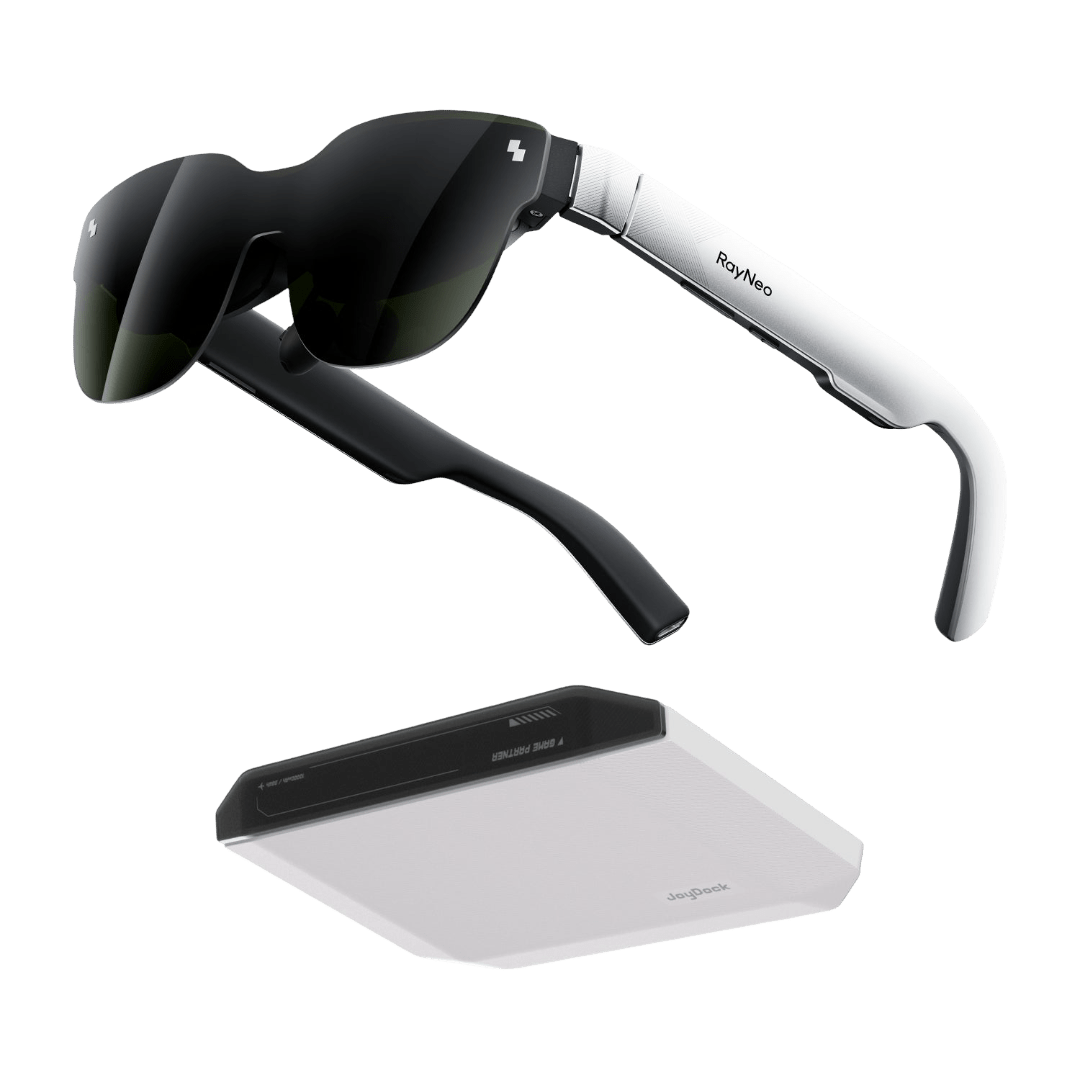
An HDMI Adapter bridges older consoles, PCs without video-out, and Lightning devices (with Apple’s Lightning Digital AV Adapter). Nintendo Switch uses that adapter with a dock, or the separate JoyDock accessory; check the product pages for GT and GT Max specifically.
One accessory gets you closer to a phone-free setup: the RayNeo Pocket TV Pro. It’s a self-contained Google TV device with:
Pair it with GT or GT Max over the same USB-C cable for a portable movie or show setup that doesn’t use your phone. It also enables Dolby Vision playback for Dolby Vision content, which GT and GT Max don’t support when connected directly to a phone, tablet, or laptop.
A few controls don’t need a phone or app, even though the display always needs a live connection. GT and GT Max have a physical Spatial Mode button on the frame:
AI 2D-to-3D video conversion needs a supported host: RayNeo’s support documentation lists iPhone 15, 16, and 17 series with USB-C DisplayPort support, and eligible Android phones released in 2022 or later with USB-C DisplayPort output and a supported Snapdragon chip (8 Gen 2, 8 Gen 3, 8 Elite, 8 Elite Gen 5, or newer); non-Snapdragon phones are currently unsupported.

RayNeo X3 Pro has a different architecture. RayNeo describes it as a standalone smart-glasses platform with its own processor, storage, Wi-Fi, and battery. It runs a Snapdragon AR1 Gen 1 chip, has a 245mAh battery, and connects over Wi-Fi 6 and Bluetooth 5.3 rather than a wired video feed. It has a binocular full-color MicroLED display that it renders itself, not a mirror of a phone’s screen.
RayNeo rates the battery by scenario rather than giving one all-day figure. The official figures, each an “up to” rating, are:
Treat these as separate benchmarks for specific features. Actual runtime depends on which features you use, brightness, and conditions.
Its onboard processor and camera mean core functions such as taking photos, recording video, and showing the AR overlay don’t depend on mirroring a phone. In principle, that lets you capture photos or clips with X3 Pro and nothing else in your pocket.
X3 Pro’s “Hey RayNeo” wake word activates Google Gemini as its voice assistant, and its real-time translation supports 14 languages: Chinese, English, Cantonese, German, French, Spanish, Italian, Japanese, Korean, Russian, Thai, Vietnamese, Indonesian, and Malay. Online features need a network connection. RayNeo doesn’t document whether these go through X3 Pro’s own Wi-Fi or a paired phone’s data connection, so if a phone-free day with working AI translation matters to you, test it on your own network first.
RayNeo iO takes a third path. It has a monochrome MicroLED display, no camera, and no speaker, and its only listed radio is Bluetooth 5.4 with Apple MFi certification. No Wi-Fi chip appears on its spec sheet.
Its headline features include:
Features that use cloud AI models need an internet connection, which on iO comes through the paired phone. Which parts of a feature, such as capturing audio, storing it, syncing, and processing it, work without a connection isn’t documented feature by feature, so check RayNeo’s documentation for the one you care about.
iO is designed to extend a phone you already carry onto your face hands-free, not to replace it. Physical controls such as the Smart Crown (a rotating, clickable dial on the right temple) and head gestures handle notifications without opening an app in the moment, while the app handles setup and the work behind features such as translation, dashboard updates, and meeting notes.

| Model | Own battery / standalone platform? | Own Wi-Fi radio? | Needs a live connection for display? | Can a non-phone device substitute? |
|---|---|---|---|---|
| Air 2s / Air 3s / Air 3s Pro / Air 4 Pro | No battery; depends on a host | No | Yes, always | Yes, varies by model (tablet, laptop, Steam Deck on Air 4 Pro) |
| GT / GT Max | No battery; depends on a host (has display and tracking chips) | No | Yes, always | Yes (tablet, laptop, console, or Pocket TV Pro) |
| X3 Pro | Yes (Snapdragon AR1 Gen 1, 245mAh, standalone platform) | Yes (Wi-Fi 6) | No, renders its own display | Not applicable; doesn’t mirror another device |
| iO | Yes (240mAh) for the glasses’ own hardware | No (Bluetooth 5.4 only) | Not a mirrored-video display; app features use a paired phone | Not confirmed |
If the goal is watching movies or playing games with no phone involved, GT or GT Max paired with a Pocket TV Pro is the combination RayNeo documents for that. Prices change, so check the product pages for current prices on each item.
If the goal is a camera and display you can wear without another device, X3 Pro is the closest match, since it’s the only model described as a standalone platform with its own processor, storage, Wi-Fi, and battery. RayNeo hasn’t published how far that independence extends into AI and translation features that need a network.
If the goal is an all-day AI companion for notifications, translation, and meeting notes, iO works alongside the phone you already carry rather than instead of one.
If the goal is a large virtual screen at a lower price and you don’t mind carrying whatever device drives the picture, Air 3s, Air 3s Pro, and Air 4 Pro remain straightforward options, with the understanding that some device always has to be connected: a phone, tablet, laptop, or, in Air 4 Pro’s case, a Steam Deck.
Can I take photos with RayNeo X3 Pro if I leave my phone at home?
Do the Air glasses work with a laptop or tablet instead of a phone?
Does GT Max still need a phone if I’m using it with the Pocket TV Pro?
Is there a RayNeo product that works with zero other devices nearby?
Why doesn’t iO have Wi-Fi?
Does any RayNeo model need the companion app running in the foreground to work?





Share:
RayNeo Wired vs. Wireless Glasses: What the Cable Actually Means
RayNeo Air 3s Pro Display Resolution Explained: 1920x1080 (2D) and 3840x1080 (3D)