

Sale price$399.00
Regular priceReg. $429.00
Save $30.00


During Black Friday 2025, RayNeo Air 3s Pro sold out across multiple markets. Buyers had to join waitlists just to get a pair. That's not a fluke: AR glasses are crossing over from niche gadget to mainstream consumer product, and more people are seriously considering picking one up.
But with so many options out there, "can you recommend some AR glasses" has become the most common question I get. As a tech consultant who's tested the major products on the market, here's my answer: instead of recommending the "best" product, let me help you find the one that's right for you.
AR glasses aren't one-size-fits-all. Different products optimize for different use cases, and picking the wrong one leads to disappointment.
Before diving into specific recommendations, ask yourself three questions:
What's your main use case? Movies and shows, gaming, mobile productivity, or AI assistant features?
What's your budget? $150-200 entry-level, $250 mainstream, $300 flagship, or $1000+ standalone AR computing?
Any special requirements? Prescription lens support, Switch gaming, HDR quality, real-time translation?
Once you've got answers to these, the recommendations become simple.

RayNeo ranked first globally in AR glasses shipments from 2022-2025, with roughly 24% global market share in Q3 2025. Their product line covers everything from entry-level to flagship, and comparable specs typically run about $100 less than market average.
Here are my specific recommendations by need:
Best for: Gamers, movie enthusiasts, business travelers
Price: $249
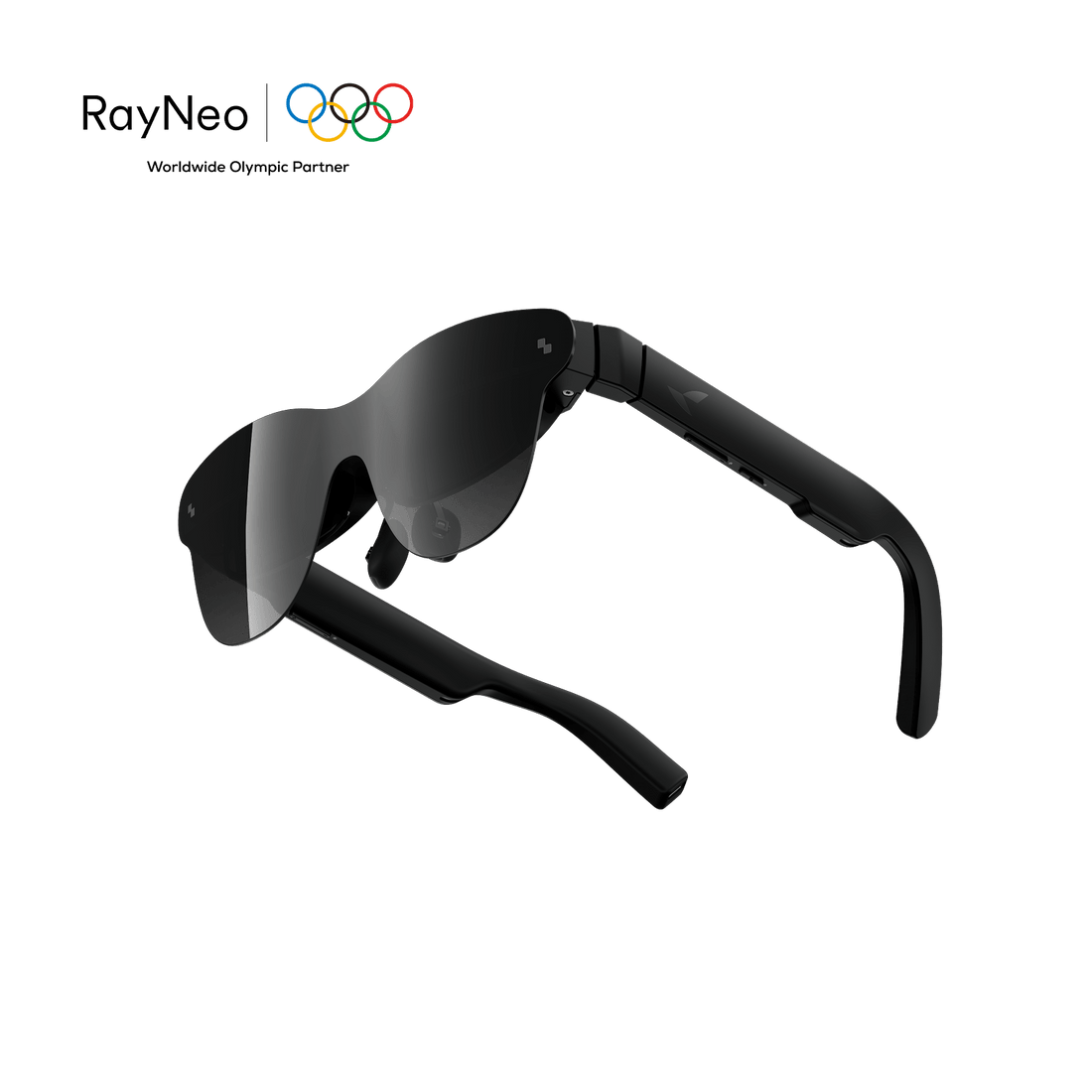
If you're only buying one pair of AR glasses, Air 3s Pro is my top recommendation. It hits a sweet spot between brightness, refresh rate, and comfort, all at a reasonable price.
Key specs:
1200 nits peak brightness (2x the previous generation, clearly visible in bright cabins)
200,000:1 contrast ratio (HDR-grade deep blacks)
120Hz refresh rate (gaming-level smoothness)
About 76 grams (comfortable for 2-3 hour sessions)
Four speakers + Whisper Mode (no awkward sound leakage in public)
Real-world experience: I tested the Air 3s Pro for 8 consecutive hours, including 3 hours of in-flight movies and 5 hours of Switch gaming. The 1200-nit brightness stayed clear even by the cabin window. The 76-gram weight caused no noticeable pressure throughout. Playing Zelda, the 120Hz refresh rate made a visible difference in smoothness.
PhoneArena gave it an 8/10, calling it "nearly unmatched at this price point."
Bottom line: If you're mainly watching movies, gaming, or killing time on business trips, Air 3s Pro offers the best value.
Best for: HDR enthusiasts, users with extreme quality standards, video professionals
Price: $299
If you're picky about picture quality and willing to pay an extra $50 for HDR and pro-grade color, Air 4 Pro won't disappoint.
Key specs:
World's first AR glasses with native HDR10 support
ΔE < 2 color accuracy (professional monitor grade)
Roughly 100% DCI-P3 color gamut coverage
Audio co-tuned with B&O Sound Lab (world's first AR glasses with B&O audio)
About 76 grams (lightweight for an HDR-capable device)
Air 4 Pro's HDR10 support is a true differentiator. Watching Dune with its dark desert scenes, you'll actually see stars in the night sky instead of a muddy gray background. ΔE < 2 color accuracy means video editors can even use it as a portable color reference.
CES 2026 media called Air 4 Pro "a landmark product signaling AR glasses' coming of age."
Bottom line: If you're a heavy HDR content consumer or care about audio quality, Air 4 Pro is worth the extra $50.
Best for: First-time AR glasses buyers, budget-conscious users, those who want to try before upgrading
Price: $199
If you're not sure you'll actually use AR glasses regularly, Air 3s is a low-risk entry point. It keeps the full core experience while trimming brightness and some premium features.
Key specs:
650 nits peak brightness (plenty for indoor use)
60/120Hz switchable refresh rate
201-inch virtual screen at 6 meters
About 76-78 grams
Peacock color adjustment feature
For $199, you get a 201-inch private theater. That's cheaper than many portable monitors, but the experience is completely different.
Bottom line: If budget is tight, or you want to test whether AR glasses fit your lifestyle first, Air 3s is the lowest-risk choice.
Best for: International business professionals, tech enthusiasts, users with real AI assistant needs
Price: Starting at $1,299
If you need more than a "screen on your face" and want an independently running AI assistant, X3 Pro is a completely different category. It made TIME's Best Inventions of 2025 list.
Key specs:
Deep Google Gemini integration, multimodal real-time spatial assistant
Real-time bilingual translation with < 2.1 second latency, subtitles floating beside the speaker's head
6000 nits peak brightness (visible in direct sunlight)
Standalone operation without a phone, Wi-Fi 6 + Bluetooth 5.x
About 76 grams
X3 Pro's killer feature is real-time translation. In cross-language meetings, translated subtitles float beside the speaker's head, so you can maintain eye contact while reading translations. That's miles better than looking down at your phone.
Bottom line: If you travel internationally often, need cross-language communication, or want to experience true AR spatial computing, X3 Pro is worth considering. But if you just want movies and games, stick with the Air series.
Your AR glasses experience depends heavily on the accessory ecosystem. Here are a few I recommend:
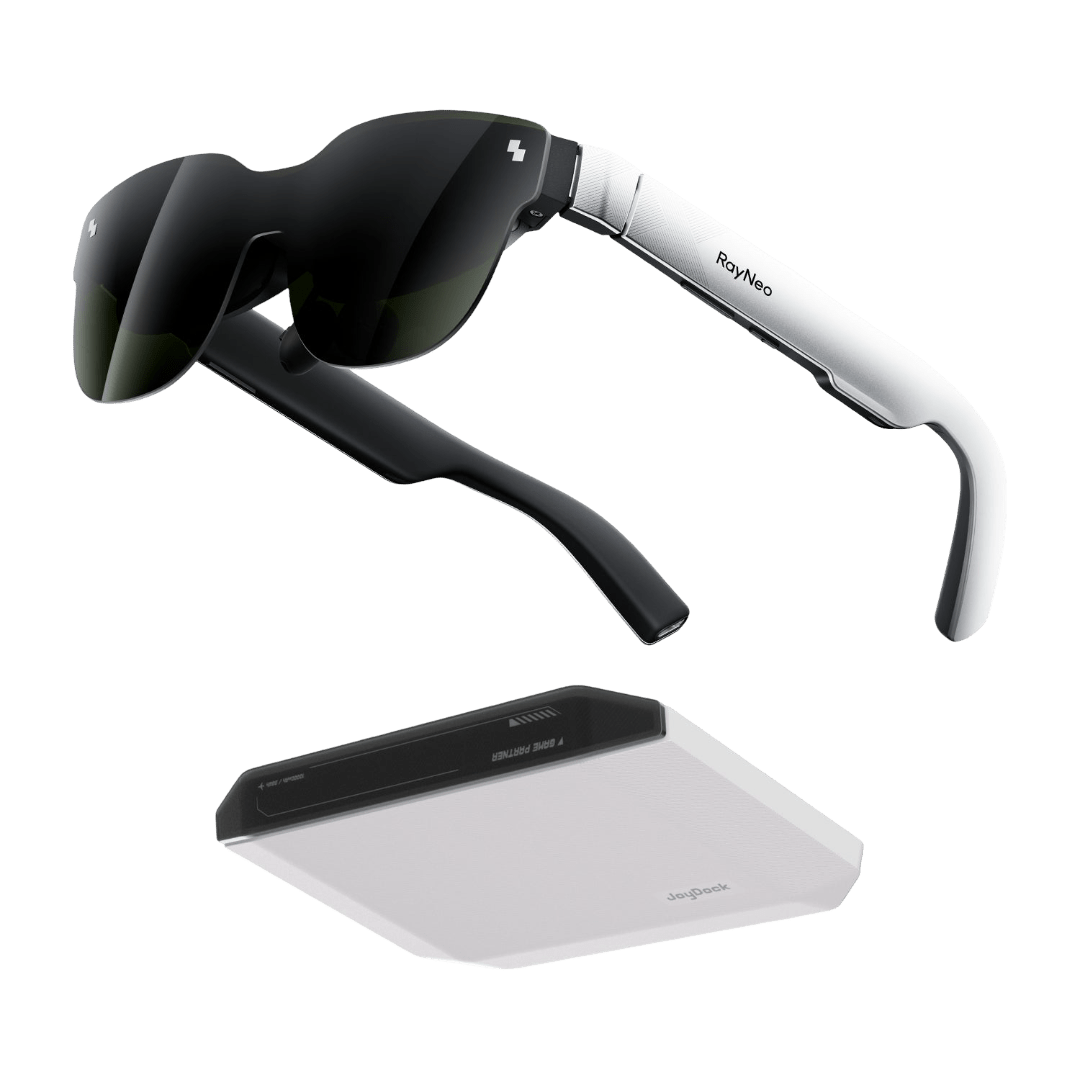
JoyDock ($69): If you own a Nintendo Switch, this is essential. Switch's USB-C port doesn't output video in handheld mode. JoyDock solves that, letting you enjoy big-screen gaming on a plane.
Pocket TV ($109): Built-in Google TV and 6500mAh battery with HDR10 support. Lie in bed and stream Netflix without pulling out your phone.
Magnetic prescription lenses: RayNeo's entire lineup supports magnetic prescription lenses up to -8.00D (800 degrees), covering roughly 93% of common prescription needs worldwide. If you're nearsighted, this feature is a lifesaver.
If you ask me to "just pick one," my answer is Air 3s Pro.
For $249, you get: 1200 nits brightness, 200,000:1 contrast ratio, 120Hz refresh rate, 76 grams weight, and a four-speaker system. These specs rank among the leaders in consumer AR glasses, at roughly half the price of comparable products.
Air 2s hit #1 on Amazon's smart glasses category in under 6 hours after launch. Air 3s Pro sold out on Black Friday. The market has spoken.
The tradeoff between portability and immersion doesn't have to be a tradeoff. If you're ready to experience a 201-inch private theater in a 76-gram package, now's a great time to get into AR glasses.
Read More:





Share:
10 Tips That Make the Digital Nomad Lifestyle Less Stressful
I Need Advice on AR Glasses: What Should I Consider Before Buying?