

$429.00

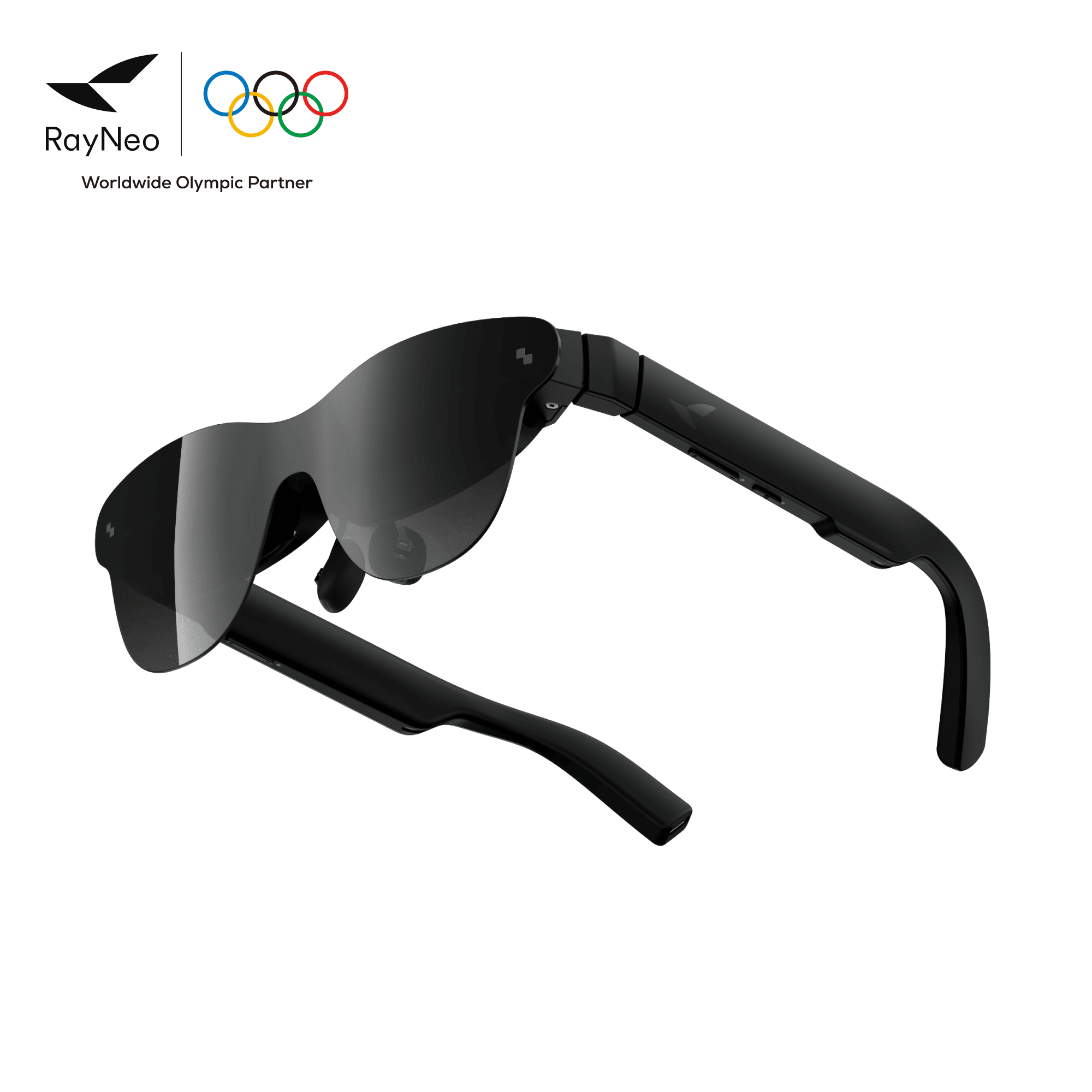
"Smart audio glasses" actually covers two very different products, and mixing them up is a common, understandable mistake. Some buyers assume any pair with built-in speakers can also handle phone calls hands-free, the way calling-enabled earbuds do. On most AR display glasses, including nearly all of RayNeo's current lineup, there's no microphone built in at all, so that assumption doesn't hold.
One kind of "smart audio glasses" is audio-first: no display, just open-ear speakers built into the temples, designed to replace earbuds for calls and music (a category some competitors occupy). The other kind is AR display glasses that happen to have decent speakers, where the screen is the main feature and the audio is along for the ride. RayNeo's current lineup sits almost entirely in the second category, with one exception.
The RayNeo Air 2s, Air 3s Pro, and Air 4 Pro are AR display glasses first, built for watching video, gaming, or mirroring a screen, with speakers tuned to match movies and games rather than to talk into a phone. The RayNeo X3 Pro is the outlier: a standalone AI and AR device built around calls and a voice assistant, with a microphone array and wireless connection of its own. It has a small display too, but that's for notifications, translation, and navigation, not for watching a two-hour film.
So if phone calls and an AI assistant matter most to you, the X3 Pro is the model to look at; it's the only one in the lineup with a microphone and Bluetooth. If you mainly want better sound for music, movies, and gaming with comfortable all-day wear, the Air series is where to shop instead. Here's how each model breaks down, and what you'd be giving up either way.
Only one: the RayNeo X3 Pro.
Here's why that's a hard line, not a marketing preference. According to RayNeo's own product pages and independent reviews, the connectivity setup differs across the lineup:
That's also consistent with how RayNeo positions the two product lines internally: its own audio comparison guide recommends the X3 Pro specifically for "calls and AI assistance," and points to the Air series for movies and gaming instead.
So if hands-free phone calls are your primary use case (say, walking meetings, hands-free navigation calls, or an AI assistant you can talk to throughout the day), the Air series isn't the right fit no matter how good its speakers sound. You'd want the X3 Pro.
One practical caveat worth knowing before you buy: independent reviews (including Tom's Hardware) have flagged the X3 Pro's battery life as a real limitation for heavy use. RayNeo's own figures put it at roughly 245 mAh, translating to about 5 hours of mixed use, 3 hours of continuous music playback, or notably less for camera-heavy tasks like video recording. If you're picturing all-day standalone calling without a recharge, that's not what this device delivers.
This is where the Air series makes sense, as long as you're comfortable with the fact that you're buying a pair of AR display glasses that happens to sound good, not a pair of audio glasses that happens to have a screen.
The Air 2s is RayNeo's entry-level AR glasses, and its audio system is built around a "push-push" quad-speaker layout with Whisper Mode 2.0, RayNeo's phase-cancellation technology that keeps sound from leaking to people nearby (RayNeo's own materials describe it as up to a 400% improvement in dynamic stereo sound over earlier designs; that figure comes from RayNeo, not an independent lab test). At 76 grams, with a 9-point FlexiFit frame and what RayNeo describes as 15% less clamping force than earlier designs, it's built for wearing through a flight or a long commute without the temple pressure that heavier AR headsets can cause.
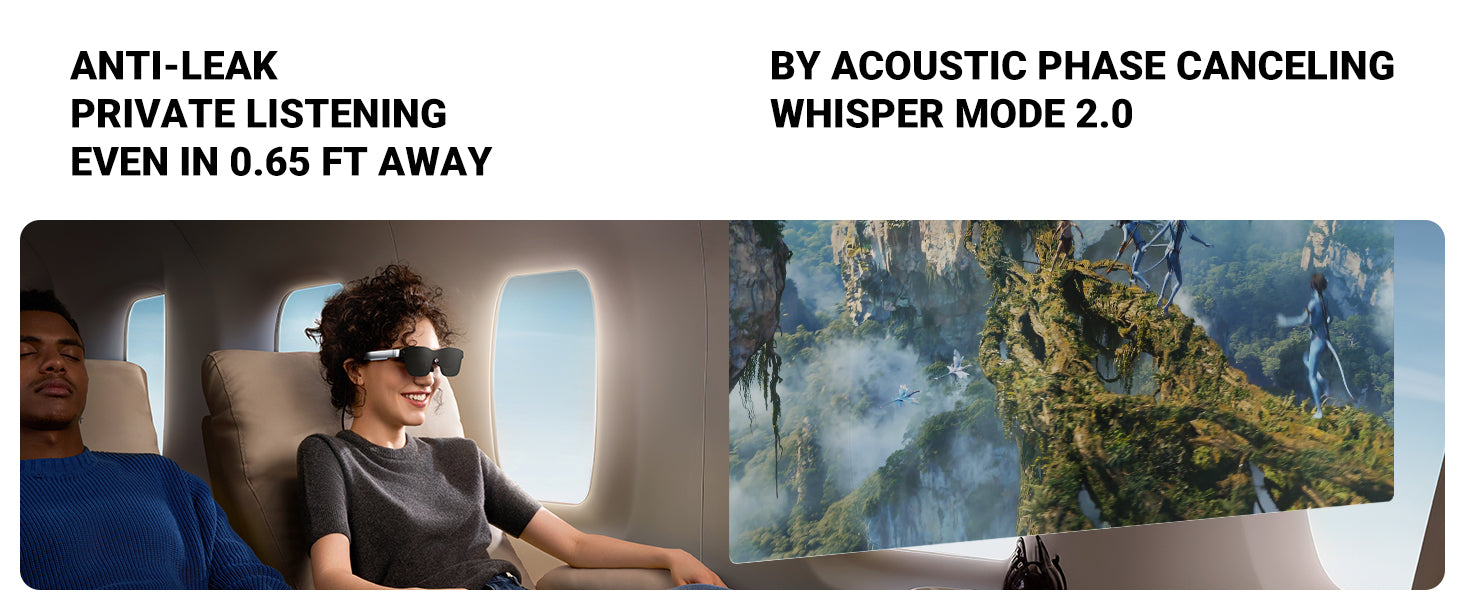
For glasses wearers, RayNeo sells Lensology clip-on prescription lenses that attach over the standard lenses, which matters if daily wear is your priority: you don't want to be choosing between your prescription glasses and your AR glasses every day.
The Air 3s Pro pushes brightness to 1,200 nits, which RayNeo describes as the highest to-eye brightness of any AR glasses at the time of launch. In practice, that extra brightness matters most outdoors: checking a virtual screen near a sunny gate or window doesn't wash out the way it can on dimmer AR displays.
On the audio side, RayNeo pairs the display with what it calls a "self-developed quad-speaker system with spatial audio algorithms," a Dual Opposing Acoustic Chamber design specific to this model's speaker housing, and the same Whisper Mode 2.0 privacy feature used across the Air lineup. RayNeo markets the result as aiming for a "theater-grade" soundstage for movies and games; it's worth noting this is RayNeo's own quad-speaker tuning, not a co-branded audio partnership. The payoff is most noticeable during anything with layered sound, an action scene or a game with directional effects, and less noticeable during quiet dialogue, where a simpler speaker setup would sound about the same.
For prescription wearers, RayNeo also lists customized nearsighted lenses for the Air 3s Pro through its Lensology partner, built around a 14×7mm eyebox, a different fit approach than the clip-on lenses sold for the Air 2s. Its official spec page doesn't list Bluetooth or Wi-Fi; connectivity is USB-C only, consistent with RayNeo's own Bluetooth compatibility guide, which groups the Air 3s Pro with glasses that don't carry a Bluetooth chip.
The Air 4 Pro is currently the only RayNeo model that carries a Bang & Olufsen (B&O) co-tuned audio system: four speakers designed for 360° spatial sound in an open-ear format, plus the same Whisper Mode privacy tech using phase-cancelling acoustics. The difference is most obvious in anything with directional sound: an explosion sweeping across the screen, or a game effect meant to come from one side. The spatial tuning gives those moments a distinct location instead of blending into one wall of sound.
On the display side, it adds HDR10 support, a first for the AR glasses category according to RayNeo, along with a 200,000:1 contrast ratio and a Vision 4000 display chip co-developed with Pixelworks for real-time SDR-to-HDR upscaling. Put on a color-graded film at night and the extra contrast is the kind of difference that's noticeable without checking a spec sheet: dark scenes hold more detail instead of crushing into flat black. There's also an optional Sound Tube accessory, sold separately, for anyone who wants more volume and clarity than the open-ear speakers alone provide.
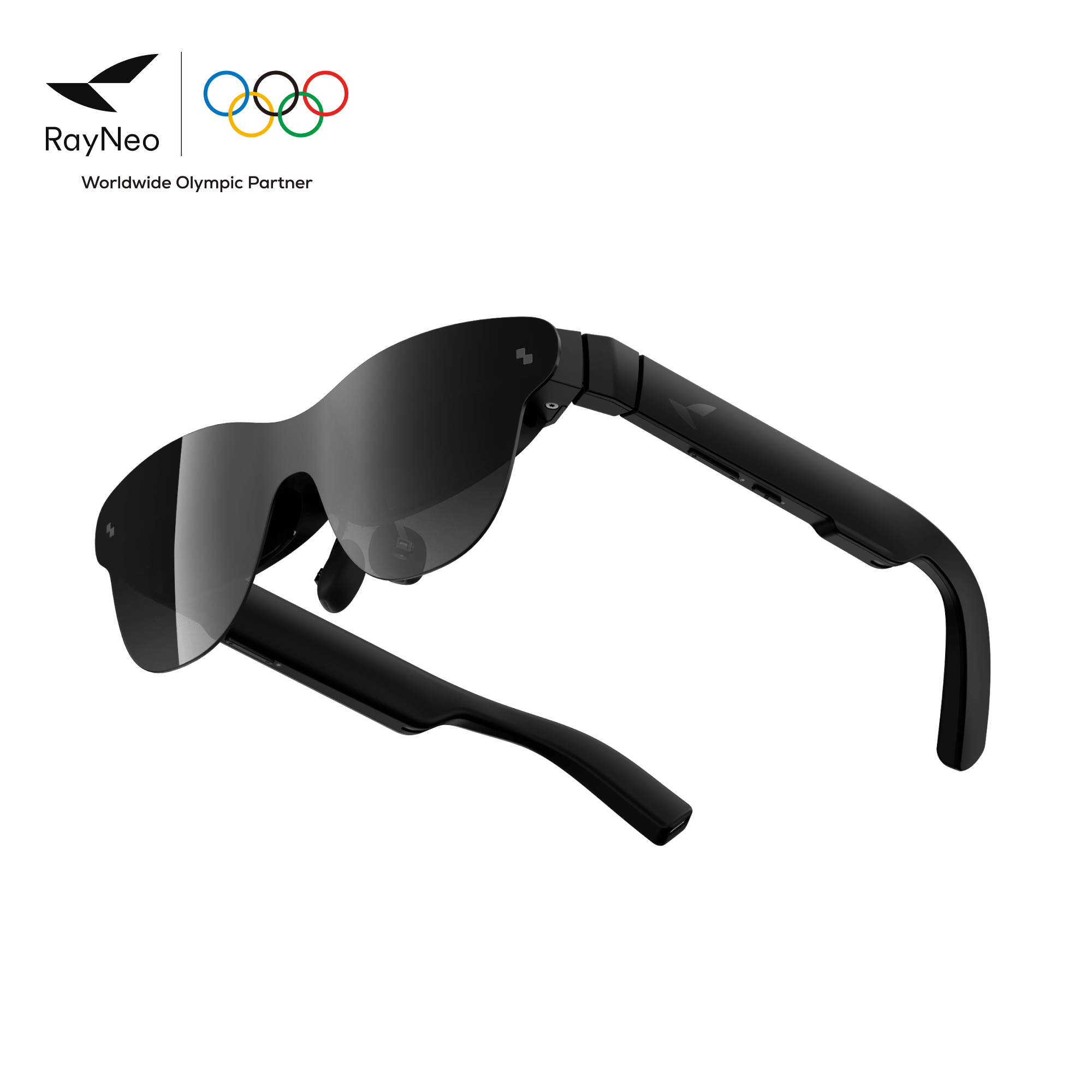
At 76 grams (the same official weight RayNeo lists for the Air 2s, Air 3s Pro, and X3 Pro), the Air 4 Pro doesn't ask you to trade comfort for the upgraded audio and display hardware, at least on paper. It also uses a different approach to prescription needs than the Air 2s: instead of clip-on lenses, it has a magnetic frame that accommodates prescriptions up to 1000 degrees of myopia. Connectivity is USB-C only, the same as the rest of the Air lineup.
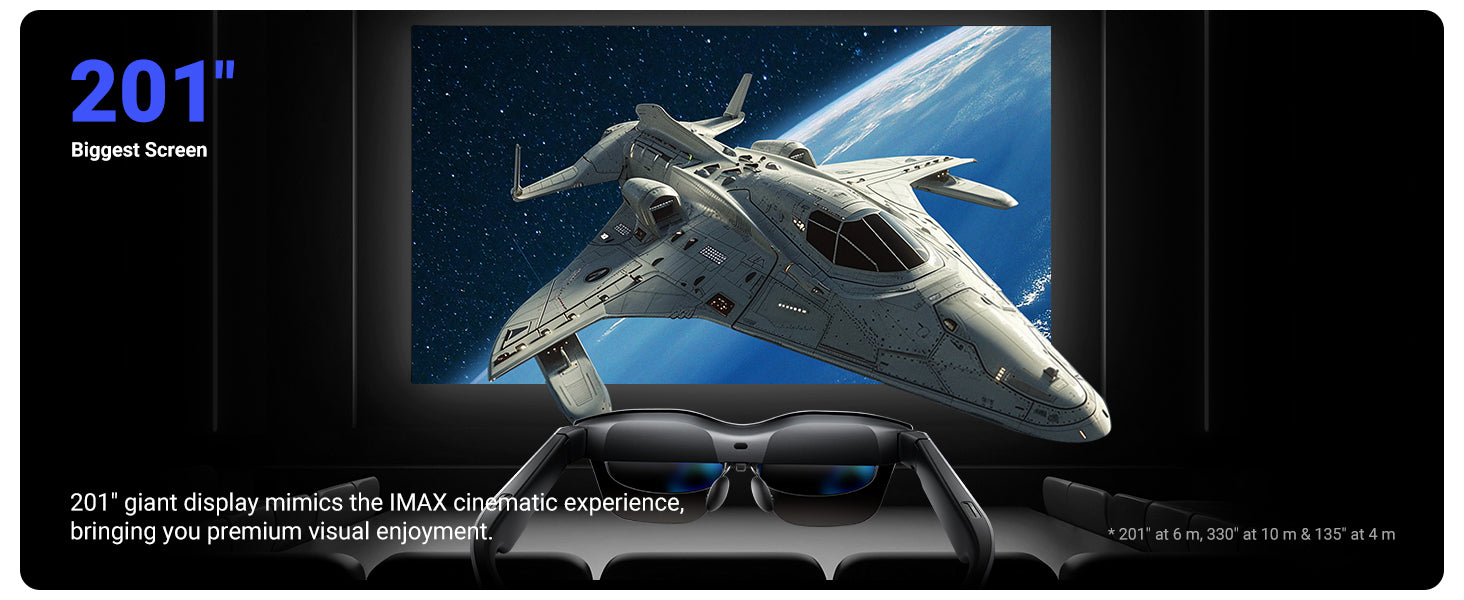
It's worth setting expectations here, and this applies to open-ear audio glasses as a category, not just RayNeo: without a seal in your ear canal, no open-ear speaker design can reproduce deep sub-bass the way sealed earbuds or over-ear headphones can. That's a matter of physics, not something better tuning can fix. Whisper Mode-style phase cancellation reduces how much sound leaks to the people around you, but it doesn't eliminate the fundamental trade-off between open-ear comfort and bass response.
Similarly, in genuinely loud environments (a subway car, a crowded street), open-ear audio glasses of any brand won't out-perform noise-cancelling earbuds or headphones with an in-ear seal. If your primary use case is blocking out noise on a commute, that's a real limitation to weigh, regardless of which model you pick.
| RayNeo Air 2s | RayNeo Air 3s Pro | RayNeo Air 4 Pro | RayNeo X3 Pro | |
|---|---|---|---|---|
| Product type | AR display glasses | AR display glasses | AR display glasses | Standalone AI+AR glasses |
| Best for | Lightweight entry-level video/gaming, budget daily wear | Brighter display + upgraded audio for movies/games | Premium movie/gaming audio (B&O) + HDR10 display | Calls, AI assistant, translation, hands-free tasks |
| Weight | 76g | 76g | 76g | 76g |
| Audio system | Quad-speaker "push-push" design, Whisper Mode 2.0 | Self-developed quad-speaker + spatial algorithms, Whisper Mode 2.0 | Bang & Olufsen co-tuned 4-speaker 360° spatial sound | Standard speakers + 3-mic beamforming array |
| Built-in microphone | Not listed | Not listed | Not listed | Yes (3-mic, noise cancelling) |
| Bluetooth / wireless | No (USB-C wired only) | No (USB-C wired only, per RayNeo's Bluetooth compatibility guide) | No (USB-C wired only) | Yes, Bluetooth 5.3 + Wi-Fi 6 |
| Can make/receive phone calls | No | No | No | Yes |
| Display | Sony Micro-OLED, 1080p, 120Hz, 5000 nits | SeeYa micro-OLED, 1200 nits, 120Hz | SeeYa Micro-OLED, HDR10, 200,000:1 contrast, 120Hz | Full-color MicroLED, 640×480 |
| Prescription support | Lensology clip-on lenses | Lensology customized nearsighted lenses, 14×7mm eyebox | Magnetic frame, up to 1000° myopia | Prescription lens partners |
| Official price (at time of writing) | $159 (sale) / $299 list | $299 | $299 (early-bird pricing has been offered) | 1, 299(1,099 early-bird has been offered) |
Prices, promotions, and connectivity details are based on RayNeo's official product pages as of August 2026 and are subject to change. Always confirm current pricing and specs on rayneo.com before purchasing.
Do any RayNeo glasses work like Bluetooth audio glasses for calls? Only the RayNeo X3 Pro. It has Bluetooth 5.3, Wi-Fi 6, and a 3-microphone array, so it can pair with your phone and handle calls the way wireless earbuds do. The Air 2s, Air 3s Pro, and Air 4 Pro connect via wired USB-C only and don't have a built-in microphone.
Which RayNeo glasses have Bang & Olufsen audio? As of this writing, that's the Air 4 Pro. It's the only model in RayNeo's current lineup whose product page specifically names a Bang & Olufsen co-tuned audio system.
Are RayNeo Air glasses comfortable enough for all-day wear? RayNeo lists the Air 2s, Air 3s Pro, and Air 4 Pro at the same official weight (76 grams) with adjustable FlexiFit frames. Comfort for extended wear also depends on nose bridge fit and whether you need prescription support, which differs between clip-on lenses (Air 2s) and the magnetic prescription frame (Air 4 Pro).
Can I stream music from my phone to RayNeo Air glasses over Bluetooth? No. Based on RayNeo's official specs, the Air 2s, Air 3s Pro, and Air 4 Pro all connect via wired USB-C, not Bluetooth. Audio plays through the built-in speakers when the glasses are plugged into whatever device is producing the sound (phone, PC, or console). None of the three product pages list a companion app as a wireless alternative.
Is open-ear speaker audio as good as earbuds for music? Not for bass-heavy listening. Open-ear designs, including RayNeo's, can't reproduce deep sub-bass the way sealed in-ear or over-ear headphones can, because there's no ear-canal seal to hold in low frequencies. They also won't block outside noise the way noise-cancelling earbuds do. They're a reasonable trade for people who want to stay aware of their surroundings, not a direct replacement for premium closed-back audio.





Share:
Smart Glasses Wiki: Everything You Need to Know
Which Glasses Have a Built-In Camera for Hands-Free Video Recording?