For a larger screen for existing PC, handheld or console games, shortlist RayNeo GT for a lighter native-spatial display or GT Max for its wider view and optical-size choices. If you want games that interact with the room, compare a mixed-reality headset such as Meta Quest 3 instead. These are different gaming architectures, not interchangeable “AR” specifications.
Instead of offering full virtual reality motion tracking, our AR hardware for gaming acts as a massive, highly portable external display. You simply plug the glasses into your console, PC, or handheld device. The glasses then project a giant, high-definition screen directly into your field of view.
A display setup can be used while seated at a desk, on a couch or when travel rules permit. Your existing gaming device still runs the game. Check the finished optical fit and cable routing rather than assuming any pose is comfortable for an extended session.
How Wearable Displays Change the Experience
The biggest advantage of using AR glasses for gaming is the sheer scale of the display you can carry in a small case. While a premium handheld gaming PC might have a seven-inch screen, routing that video through AR glasses can simulate the experience of playing on a theater-sized screen from just a few meters away.
A direct video cable avoids a separate wireless video-streaming stage. End-to-end latency still includes the game, source, adapter and display processing; a wired connection is not proof of zero latency or competitive superiority.
To keep the glasses incredibly light for extended gaming sessions, the RayNeo GT series is designed without built-in batteries. They draw power directly from your connected gaming device through the cable. This streamlined design means you do not have to worry about charging another device, though it does utilize your handheld console or phone's battery during play.
Enhancing Your Gaming Visuals
GT and GT Max list up to 120Hz for 2D and 60Hz for 3D. Select a mode supported by the source and adapter. The panel refresh rate does not guarantee 120 rendered game frames per second or eliminate motion blur.
Field of view changes the angular size of the image, while ambient light and the selected brightness mode affect contrast. Check the actual game and lighting; a maximum brightness label does not guarantee clarity beside a sunny window.
GT and GT Max provide Follow, Steady and Pinned modes. Follow moves with head rotation; Pinned holds a chosen angular position. These native 3DoF modes do not establish room-scale positional tracking or a comfort result.
Connecting Consoles and Handhelds
Compatibility depends on the exact source output. USB-C handhelds need DisplayPort Alt Mode and power for direct use; HDMI sources need a complete supported powered-adapter route. The RayNeo HDMI Adapter is listed at US$64, but verify supported modes and power rather than assuming every console or PC works identically.
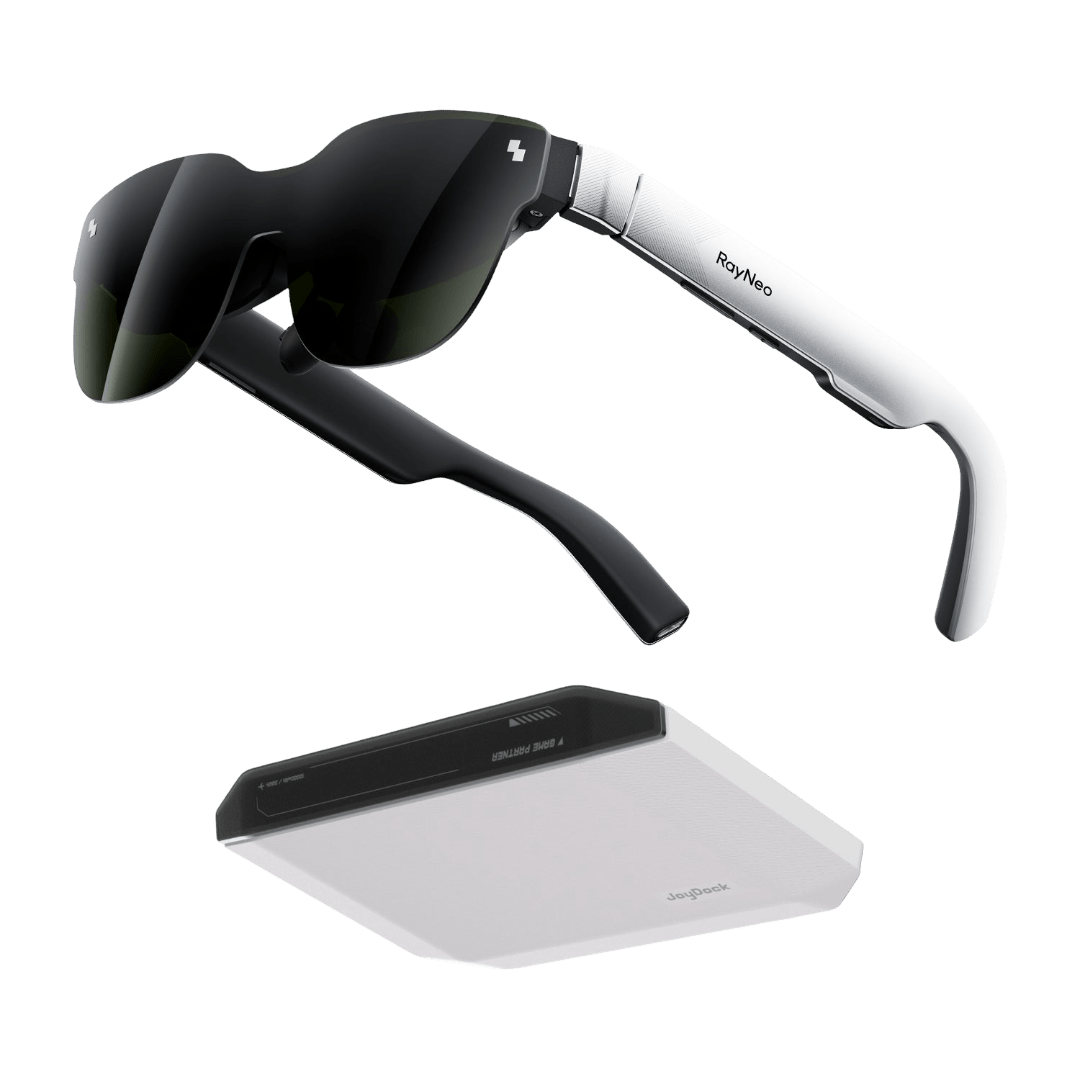
Nintendo Switch players have a dedicated solution. Our JoyDock accessory for $89 routes the video signal and power for your Switch; depending on your Switch generation, an additional Back Clip accessory may also be required, so check the JoyDock product page for current compatibility.
If you prefer mobile gaming or streaming cloud games from your phone, tablets, or laptops, the direct USB-C connection requires video-output support on the exact device, including eligible models such as the iPhone 15, 16, and 17 series, Android phones like the Galaxy S8 through S25, iPads from the 10th generation onwards, and MacBooks from 2015 and newer. Keep in mind that some devices, like the iPhone 16e, 17e, and iPhone Air models, lack video output support, and we do not currently offer a confirmed adapter for them. For Windows gaming laptops, we recommend checking your specific computer's specifications to ensure its USB-C port supports DisplayPort Alt Mode video output.
Recommended Hardware: The RayNeo GT Series
GT Max is listed at US$429, with a 78g frame, 59° field of view and S/M/L optical-fit options. Its Full HD panels support 2D 120Hz and 3D 60Hz modes. Check the selected size and readable corners; multiple sizes do not guarantee a perfect optical fit.

GT Max uses Vision 4000 display processing and Zone 360 native 3DoF tracking. Pinned-mode brightness is listed at 336 nits; non-Pinned modes reach up to 1,200 nits. Choose the mode for the setting and check the readable image.

GT is listed at US$329, with a 68g frame, 46° field of view and fixed 64mm optical IPD. It offers the same Follow, Steady and Pinned mode choices, with 336 nits listed in Pinned mode and up to 1,200 nits outside it. Choose by fit and the view you want, not weight alone.

Both models feature open-ear quad speakers tuned by Bang & Olufsen to deliver spatial sound directly to your ears. While they include Whisper Mode 2.0 to minimize sound leakage, the game audio can still be faintly heard by people sitting right next to you in very quiet environments, so you might still want to pair your own wireless headset for total acoustic privacy on a plane.
Frequently Asked Questions
Do these glasses have their own built-in games or an operating system? The GT series operates purely as high-end external monitors for your existing gaming devices. You navigate menus and launch games using the exact same interface of the console, PC, or phone you have plugged them into, giving you immediate access to your entire existing game library without buying new versions.
Can I play 3D games on AR glasses? A game must provide a supported stereo output; ordinary compatibility with its video signal does not make it a native 3D game. AI video conversion is a separate RayNeo XR App function with eligible iPhone and Snapdragon Android conditions in the support guide. It is not a universal 3D mode for every live console game.
Can I use prescription correction for gaming? GT/GT Max support model-specific inserts through Lensology. Confirm the prescription, optical size, complete lens quote and finished fit; inserts are not a guarantee of comfortable multi-hour play.
Final Thoughts
Stepping into a game should feel like leaving your physical surroundings behind, and a massive virtual screen is one of the best ways to achieve that immersion. With our GT series, you no longer have to compromise on display size just because you are traveling with a handheld console or sharing a living room with family.
Whether you prioritize the maximum field of view of the RayNeo GT Max or the lighter, streamlined design of the RayNeo GT, you can finally carry a private, theater-sized gaming setup in your backpack. Check out the product pages to secure the perfect visual upgrade for your gaming arsenal.
Pick the Gaming Architecture, Then Price the Setup
| Gaming task |
Relevant shortlist |
Before paying |
| Ordinary handheld/PC/console game on a worn screen |
GT / GT Max / Air 4 Pro |
Video route, adapter power, output mode, optical fit |
| Tracked VR or room-interactive mixed-reality games |
Meta Quest 3 |
Actual game catalogue, controllers, play space and PC route if needed |
| Shared couch gaming or competitive desktop play |
TV/monitor |
Shared image, text, complete input/display latency and resolution |
US device listings checked November 18, 2026: GT $329, GT Max $429, Air 4 Pro Standard $299. Prescription lenses, a source device, adapters, accessories, subscriptions and taxes are separate unless the selected package includes them. Compare the complete setup rather than a dated launch discount.
For a ROG Ally, use the handheld buying guide and its connection checklist. The recommendations here use documented functions; no controlled latency or gaming-session comfort test is claimed.




For a larger screen for existing PC, handheld or console games, shortlist RayNeo GT for a lighter native-spatial display or GT Max for its wider view and optical-size choices. If you want games that interact with the room, compare a mixed-reality headset such as Meta Quest 3 instead. These are different gaming architectures, not interchangeable “AR” specifications.
Instead of offering full virtual reality motion tracking, our AR hardware for gaming acts as a massive, highly portable external display. You simply plug the glasses into your console, PC, or handheld device. The glasses then project a giant, high-definition screen directly into your field of view.
A display setup can be used while seated at a desk, on a couch or when travel rules permit. Your existing gaming device still runs the game. Check the finished optical fit and cable routing rather than assuming any pose is comfortable for an extended session.
How Wearable Displays Change the Experience
The biggest advantage of using AR glasses for gaming is the sheer scale of the display you can carry in a small case. While a premium handheld gaming PC might have a seven-inch screen, routing that video through AR glasses can simulate the experience of playing on a theater-sized screen from just a few meters away.
A direct video cable avoids a separate wireless video-streaming stage. End-to-end latency still includes the game, source, adapter and display processing; a wired connection is not proof of zero latency or competitive superiority.
To keep the glasses incredibly light for extended gaming sessions, the RayNeo GT series is designed without built-in batteries. They draw power directly from your connected gaming device through the cable. This streamlined design means you do not have to worry about charging another device, though it does utilize your handheld console or phone's battery during play.
Enhancing Your Gaming Visuals
GT and GT Max list up to 120Hz for 2D and 60Hz for 3D. Select a mode supported by the source and adapter. The panel refresh rate does not guarantee 120 rendered game frames per second or eliminate motion blur.
Field of view changes the angular size of the image, while ambient light and the selected brightness mode affect contrast. Check the actual game and lighting; a maximum brightness label does not guarantee clarity beside a sunny window.
GT and GT Max provide Follow, Steady and Pinned modes. Follow moves with head rotation; Pinned holds a chosen angular position. These native 3DoF modes do not establish room-scale positional tracking or a comfort result.
Connecting Consoles and Handhelds
Compatibility depends on the exact source output. USB-C handhelds need DisplayPort Alt Mode and power for direct use; HDMI sources need a complete supported powered-adapter route. The RayNeo HDMI Adapter is listed at US$64, but verify supported modes and power rather than assuming every console or PC works identically.
Nintendo Switch players have a dedicated solution. Our JoyDock accessory for $89 routes the video signal and power for your Switch; depending on your Switch generation, an additional Back Clip accessory may also be required, so check the JoyDock product page for current compatibility.
If you prefer mobile gaming or streaming cloud games from your phone, tablets, or laptops, the direct USB-C connection requires video-output support on the exact device, including eligible models such as the iPhone 15, 16, and 17 series, Android phones like the Galaxy S8 through S25, iPads from the 10th generation onwards, and MacBooks from 2015 and newer. Keep in mind that some devices, like the iPhone 16e, 17e, and iPhone Air models, lack video output support, and we do not currently offer a confirmed adapter for them. For Windows gaming laptops, we recommend checking your specific computer's specifications to ensure its USB-C port supports DisplayPort Alt Mode video output.
Recommended Hardware: The RayNeo GT Series
GT Max is listed at US$429, with a 78g frame, 59° field of view and S/M/L optical-fit options. Its Full HD panels support 2D 120Hz and 3D 60Hz modes. Check the selected size and readable corners; multiple sizes do not guarantee a perfect optical fit.
GT Max uses Vision 4000 display processing and Zone 360 native 3DoF tracking. Pinned-mode brightness is listed at 336 nits; non-Pinned modes reach up to 1,200 nits. Choose the mode for the setting and check the readable image.
GT is listed at US$329, with a 68g frame, 46° field of view and fixed 64mm optical IPD. It offers the same Follow, Steady and Pinned mode choices, with 336 nits listed in Pinned mode and up to 1,200 nits outside it. Choose by fit and the view you want, not weight alone.
Both models feature open-ear quad speakers tuned by Bang & Olufsen to deliver spatial sound directly to your ears. While they include Whisper Mode 2.0 to minimize sound leakage, the game audio can still be faintly heard by people sitting right next to you in very quiet environments, so you might still want to pair your own wireless headset for total acoustic privacy on a plane.
Frequently Asked Questions
Do these glasses have their own built-in games or an operating system? The GT series operates purely as high-end external monitors for your existing gaming devices. You navigate menus and launch games using the exact same interface of the console, PC, or phone you have plugged them into, giving you immediate access to your entire existing game library without buying new versions.
Can I play 3D games on AR glasses? A game must provide a supported stereo output; ordinary compatibility with its video signal does not make it a native 3D game. AI video conversion is a separate RayNeo XR App function with eligible iPhone and Snapdragon Android conditions in the support guide. It is not a universal 3D mode for every live console game.
Can I use prescription correction for gaming? GT/GT Max support model-specific inserts through Lensology. Confirm the prescription, optical size, complete lens quote and finished fit; inserts are not a guarantee of comfortable multi-hour play.
Final Thoughts
Stepping into a game should feel like leaving your physical surroundings behind, and a massive virtual screen is one of the best ways to achieve that immersion. With our GT series, you no longer have to compromise on display size just because you are traveling with a handheld console or sharing a living room with family.
Whether you prioritize the maximum field of view of the RayNeo GT Max or the lighter, streamlined design of the RayNeo GT, you can finally carry a private, theater-sized gaming setup in your backpack. Check out the product pages to secure the perfect visual upgrade for your gaming arsenal.
Pick the Gaming Architecture, Then Price the Setup
US device listings checked November 18, 2026: GT $329, GT Max $429, Air 4 Pro Standard $299. Prescription lenses, a source device, adapters, accessories, subscriptions and taxes are separate unless the selected package includes them. Compare the complete setup rather than a dated launch discount.
For a ROG Ally, use the handheld buying guide and its connection checklist. The recommendations here use documented functions; no controlled latency or gaming-session comfort test is claimed.
Share:
Leave a Comment
We'd love to hear your thoughts. Comments are reviewed before publication.