


Contents
- Fit Check: Which "Audio Type" Are You?
- The Physics: Why Open-Ear Audio is Hard
- Market Comparison: The Incumbents (Audio-Only)
- The New Frontier: High-Fidelity AV Glasses
- The AI Alternative: RayNeo X3 Pro
- Actionable Setup: Getting Audiophile Sound from Glasses
- Comparison Table: The 2026 Landscape
- Limits & Realistic Expectations
- Act: Choose Your Experience
- FAQ

You are here because the idea of "invisible audio" is seductive. Imagine walking through a city, working in a cafe, or sitting on a train with a personal soundtrack floating around your head—no earbuds plugging your canals, no heavy headphones heating up your ears. You want to stay connected to your environment while enjoying your content.
But you have doubts. You might be asking: "Do these things actually sound good, or are they just tinny speakers on a stick? Can I really hear the bass? Will the person sitting next to me hear everything I'm listening to?"
The Short Answer: "Best Audio" is a misleading term because physics dictates a harsh trade-off in the open-ear form factor.
-
If you prioritize convenience and awareness: You want a device for podcasts, phone calls, and background music while maintaining full situational awareness. For this, standard Audio-First Glasses (like the market leaders from Meta or Bose) are the superior choice. They are lightweight, wireless, and socially acceptable.
-
If you prioritize immersion and fidelity: You want to watch a movie on a plane or play a AAA game and feel the sound. Standard audio frames will disappoint you with their lack of bass and depth. For this, you need a different category entirely: AV (Audio-Visual) Glasses that prioritize acoustic volume and chamber size over invisibility.
In this comprehensive guide, we will dissect the physics of open-ear audio, analyze the top market contenders for 2026, and help you decide which compromise fits your lifestyle.
Fit Check: Which "Audio Type" Are You?
Before we look at frequency response curves or driver sizes, we must diagnose your primary use case. The #1 reason for returning smart glasses is expecting them to perform a task they weren't engineered for.
Type A: The "Soundtrack of Life" User (Commuter / Multitasker)
The Scenario: You are biking to work, navigating a busy subway station, or sitting in an open-plan office. You want to listen to a podcast or take a Zoom call, but you must hear the car honking behind you or your boss calling your name.
-
Your Priority: Safety, situational awareness, and all-day comfort.
-
The Trade-off: You accept that bass will be weak (like a small radio), and the audio will struggle to compete with loud wind or construction noise.
-
Recommended Category: Bluetooth Audio Frames.
Type B: The "Deep Immersion" User (Traveler / Gamer)
The Scenario: You are settling into a 5-hour flight to London. You are lying in a hotel bed. You are playing Cyberpunk 2077 on your Steam Deck. You want to block out the world and be transported into the content.
-
Your Priority: Dynamic range, stereo separation, volume headroom, and crucially—Visual Context.
-
The Trade-off: You accept a slightly heavier device that may require a cable connection (USB-C) to drive high-fidelity video and lossless audio.
-
Recommended Category: AV / XR Glasses.
The Physics: Why Open-Ear Audio is Hard
To understand why different glasses sound so different, we need to talk about air.
The Problem: No Seal = No Bass
Traditional headphones (like AirPods Pro or Sony WH-1000XM5) rely on a "seal." They close off your ear canal, creating a trapped volume of air. This acts like a spring, allowing tiny drivers to pressurize the air easily, creating deep, thumping bass.
Smart glasses are "Open-Ear." There is no seal. When a speaker on the temple arm pushes air to create a bass note, the air simply escapes into the room rather than pressurizing your eardrum. This phenomenon is called acoustic short-circuiting. Without clever engineering, this results in a sound profile that is all treble and mids, with zero impact.
The Solution: Dipole Acoustics & Beamforming

High-end audio eyewear manufacturers use Dipole Speaker Arrays to fight this physics problem.
-
Direct Fire: The primary speaker fires sound directly into your ear canal.
-
Cancellation Fire: A second port fires an "inverted" sound wave outward.
When these two waves meet in the air away from your ear, they cancel each other out. This "Beamforming" technique does two things: it focuses the audio energy like a laser beam into your ear (improving perceived bass) and significantly reduces sound leakage (protecting your privacy).
Market Comparison: The Incumbents (Audio-Only)
Let's look at the current market leaders for "Type A" users who want wireless freedom.
1. Meta Ray-Ban (Gen 2)
These are currently the gold standard for social audio.
-
Audio Profile: Tuned heavily for voice clarity. Podcasts, audiobooks, and phone calls sound crisp and natural.
-
Limitations: Musical performance is thin. Complex tracks (like heavy metal or orchestral scores) lose detail. The bass "rolls off" very early, meaning you won't feel the kick drum.
-
Best For: Social media creators and podcast listeners.
2. Bose Frames (Tempo / Tenor)
Bose pioneered this category and focuses on outdoor volume.
-
Audio Profile: Louder and punchier than the Meta Ray-Bans. They use larger temples to house bigger drivers, allowing for better wind resistance for cyclists.
-
Limitations: The styling is sporty and bulky (especially the Tempo). They lack the sleekness of everyday eyewear.
-
Best For: Runners, cyclists, and outdoor athletes.
The New Frontier: High-Fidelity AV Glasses
If you identified as a "Type B" (Immersion) user, the options above won't satisfy you. You need a device that can match the audio quality of a home theater. This is where the industry is heading in 2026.
The Audio-Visual Synergy
Audio does not exist in a vacuum. Psychoacoustics tells us that your brain perceives sound as "better" and "louder" when it matches a high-quality visual stimulus. Watching an explosion on a 201-inch virtual screen makes the accompanying sound effect feel more impactful than listening to it in the dark.
This is the gap that RayNeo is aiming to fill. While competitors focused on making glasses lighter, RayNeo focused on making the experience richer.
Feature Spotlight: RayNeo Air 4 Pro (Coming Jan 2026)
Scheduled for release on January 22, 2026, the RayNeo Air 4 Pro represents a pivot in the market. It is the first consumer AR device to integrate a dedicated acoustic system tuned by Bang & Olufsen (B&O).
1. Audio by Bang & Olufsen
This partnership involves a complete redesign of the temple's internal acoustic chamber. B&O engineers tuned the Digital Signal Processor (DSP) to create a sound signature that is "warm" and "expansive."
-
Why it matters: Most smart glasses sound harsh or digital. The Air 4 Pro aims to replicate the warm, natural timbre of high-end floor speakers. This reduces listening fatigue during long movie sessions.
2. Visuals that Match the Sound (HDR10)
The Air 4 Pro is the world's first XR glass to support HDR10 (High Dynamic Range).
-
The Connection: When you watch a movie like Dune: Part Two, the HDR10 display delivers blindingly bright highlights and deep blacks. The B&O audio tuning ensures the soundstage has the same "dynamic range"—whisper-quiet dialogue is clear, and sudden loud orchestral swells don't distort.
3. Whisper Mode 2.0
RayNeo has implemented an aggressive phase-cancellation algorithm specifically for quiet environments. This allows you to use the glasses in a library or a quiet waiting room with minimal risk of "leaking" your audio to the person next to you.
Note: For those interested in the Air 4 Pro specs, you can sign up for launch alerts here.
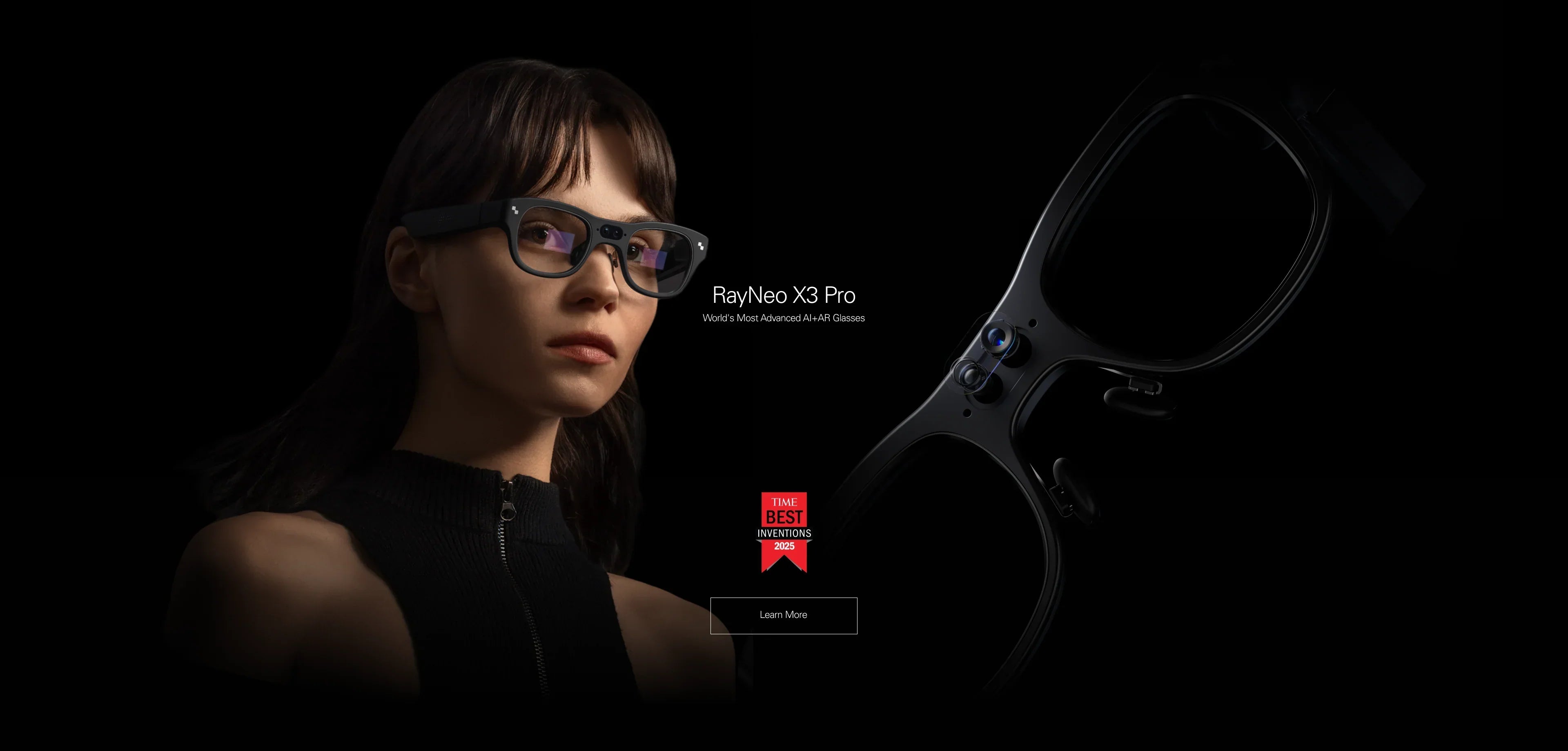
The AI Alternative: RayNeo X3 Pro
While we are discussing audio, it is important to mention the other side of the spectrum: AI Utility.
The RayNeo X3 Pro (Available Now) takes a different approach. It uses its audio system primarily for interaction, not consumption.
-
Use Case: The speakers are optimized for the voice of the Google Gemini assistant and real-time translation outputs.
-
The Difference: The X3 Pro prioritizes latency and speech intelligibility over cinematic bass. It is designed so you can clearly hear a translation in a noisy airport, or hear navigation instructions over traffic.
-
Who is it for? If you want a standalone computer on your face that helps you navigate the world, the X3 Pro is the choice. If you want a portable cinema, wait for the Air 4 Pro.
Check the RayNeo X3 Pro product page for current availability.
Actionable Setup: Getting Audiophile Sound from Glasses
Regardless of which brand you choose, open-ear audio requires precise setup. Unlike earbuds that you just jam in, glasses need calibration.
Step 1: Mechanical Alignment (The "Sweet Spot")
Directional speakers act like flashlights. If the "beam" of sound hits your earlobe or cheekbone instead of your ear canal, you lose 50% of the bass immediately.
-
The Fix: On devices like the RayNeo Air 4 Pro, use the 3-level temple adjustment. Tilt the arms up or down while playing a bass-heavy track. You will hear a sudden jump in volume when the alignment is perfect.
Step 2: Source Quality Matters More
Open-ear speakers are revealing. They will expose low-quality compression artifacts.
-
Streaming: Go to your Spotify/Apple Music settings and ensure "Audio Quality" is set to "Very High" or "Lossless."
-
Gaming: On Steam Deck, go to Audio Settings and ensure the output device is set to "External Device" (not Default). This bypasses the Deck's internal limiter and sends the raw digital signal to the glasses' DAC.
Step 3: EQ for the Situation
Don't use one setting for everything. Use the companion app (e.g., the RayNeo App) to switch profiles.
-
Voice Mode: Cuts bass frequencies (which can sound muddy in open-ear) and boosts the 2kHz-4kHz range. Essential for podcasts.
-
Movie Mode: Expands the stereo width to simulate surround sound.
Comparison Table: The 2026 Landscape
A neutral look at how the top contenders stack up across key audio dimensions.
Limits & Realistic Expectations
We believe in being transparent consultants. Even with B&O tuning, open-ear audio has physics-based limitations you must accept.
-
The Sub-Bass Limit: No open-ear device can physically replicate the chest-thumping feeling of a subwoofer or the skull-shaking pressure of sealed over-ear headphones. The Air 4 Pro delivers excellent "perceived bass" through harmonics, but it won't rattle your teeth.
-
No Active Noise Cancellation (ANC): These devices do not plug your ears. If you are on a loud subway or a plane with roaring engines, the background noise will mix with your audio.
-
Pro Tip: For flights, many users wear the RayNeo Air series for the visual screen, but pair their high-end ANC headphones (like Bose QC Ultra) to their phone for the audio. This combination is the ultimate travel setup.
-
-
Battery Drain: Driving high-fidelity speakers requires energy. Wireless frames (Meta) have their own batteries. AV glasses (RayNeo Air) draw power from your phone. Using max volume and high brightness will drain your phone faster. Consider a "Charge & Play" adapter like the JoyDock for long sessions.
Act: Choose Your Experience
The era of "one size fits all" audio is ending. Your choice should be dictated by what you want to do, not just what you want to hear.
Option 1: The Casual Listener If you prioritize wireless freedom, lightness, and hearing your surroundings while walking the dog, stick with Meta Ray-Ban or similar Bluetooth frames.
Option 2: The Audiophile & Cinephile If you want to carry a private IMAX theater in your pocket, the RayNeo Air 4 Pro is redefining the category.
-
Launch Date: January 22, 2026.
-
Action: Sign up for launch alerts to secure early bird pricing.
-
Preparation: Check your phone's compatibility for video output here: Compatibility Checklist.
Option 3: The AI Pioneer If you prioritize a standalone AI assistant that can translate languages and navigate the world, the RayNeo X3 Pro is available today.
FAQ
Q: Can I use the RayNeo Air 4 Pro for phone calls? A: Yes. It features built-in microphones with noise reduction for clear voice calls. However, its primary design focus is immersive media playback, whereas devices like Meta Ray-Ban are optimized specifically for voice calls and voice assistants.
Q: Can I wear hearing aids with open-ear glasses? A: Yes. This is a major advantage of the form factor. Because the speakers hover over the ear rather than going inside it, most users can wear in-ear hearing aids comfortably underneath the frames without interference.
Q: What if I want to use my own headphones with the RayNeo glasses? A: You can! The RayNeo Air 4 Pro allows you to output video to the glasses while sending audio to a separate Bluetooth device (via your phone or game console settings). This gives you the best of both worlds: a 201-inch screen + your favorite noise-cancelling headphones.
Q: Is the "Bang & Olufsen" tuning just marketing? A: No. Unlike simple "white label" licensing, B&O engineers were involved in the physical design of the acoustic cavity and the tuning of the DSP frequency curves. They defined the sound signature to ensure it meets their standard of tonal balance, warmth, and clarity.
共有:
Which Smart Glasses Have Live Translation? The 2026 Guide
Which Smart Glasses Offer Real-Time Translation? The 2026 Guide