

Sale price$399.00
Regular priceReg. $429.00
Save $30.00


The average American spends 4.5 hours daily staring at a smartphone screen, much of it watching video on a 6-inch display. For travelers, gamers, and remote workers, this creates a fundamental tension: you want immersive, big-screen experiences, but you're stuck with the limits of portability.
AR glasses are changing this equation. But with so many products flooding the market, asking "what are the best AR glasses" is actually the wrong question. The better question is: what makes AR glasses worth buying? This guide will help you build a clear framework for making that decision.
There's no such thing as the "best" AR glasses. There's only the best fit for your needs.
A home theater enthusiast cares about HDR support and color accuracy. A Switch gamer prioritizes 120Hz refresh rates and low latency. A business traveler needs lightweight comfort and privacy. Judging every product by the same criteria will only lead you astray.
The smarter approach is building a buying framework: understanding which specs actually matter for real-world experience, and which ones are just marketing fluff. Let's break down the key dimensions one by one.

Display quality is where AR glasses live or die. Four key specs determine what you'll actually see.
Brightness directly affects usability across different environments. In a well-lit airplane cabin or a sunny coffee shop, a dim display becomes nearly impossible to read.
The industry is moving toward 1000+ nits as the new standard. RayNeo's Air 3s Pro and Air 4 Pro both hit 1200 nits peak brightness, among the highest in consumer AR glasses. That's bright enough to stay visible in a sunlit cabin.
Contrast ratio determines how much depth and dimension you'll see in the image. When you're watching a film like Dune with lots of dark scenes, high contrast means you'll actually see the stars in the desert night sky instead of a muddy gray background.
200,000:1 contrast is HDR-grade territory. RayNeo Air 3s Pro hits this mark with its HueView 2.0 Tandem OLED technology, which stacks two OLED layers for deeper blacks.
For movie watching, 60Hz works fine. But if you're planning to play Zelda or Astro Bot on your AR glasses, 120Hz delivers noticeably smoother visuals with less screen tearing and motion blur.
Color accuracy is measured by ΔE values, where lower is better. ΔE < 2 is the professional monitor standard, meaning the human eye can barely distinguish between displayed colors and real-world colors.
RayNeo Air 4 Pro achieves ΔE < 2 color accuracy with roughly 100% DCI-P3 coverage. It's the world's first AR glasses with native HDR10 support. For video editors and colorists, that's portable reference monitor territory.
| Display Spec | Entry-Level | High-End | RayNeo Benchmark |
|---|---|---|---|
| Peak Brightness | 400-600 nits | 1000+ nits | 1200 nits (Air 3s Pro/4 Pro) |
| Contrast Ratio | 50,000:1 | 100,000:1+ | 200,000:1 (Air 3s Pro) |
| Refresh Rate | 60Hz | 120Hz | 120Hz (all models) |
| Color Accuracy | ΔE < 5 | ΔE < 2 | ΔE < 2 (Air 4 Pro) |
Specs don't matter if you can't wear the thing. Comfort is often ignored in spec sheets, but it directly determines whether you'll actually use your AR glasses.
AR glasses typically weigh between 70-90 grams. That doesn't sound like much, but after two hours on your nose, every gram gets magnified.
Under 76 grams is the sweet spot. Both RayNeo Air 4 Pro and Air 3s Pro come in at about 76 grams. Both sit comfortably in this range.
Chasing raw lightness isn't enough. The front-to-back weight ratio determines whether glasses "press on your nose" or "slide down your face."
A 4:6 ratio (40% front, 60% temples) is ideal, distributing weight evenly between your nose bridge and ears.
If you wear glasses, this feature alone determines whether AR glasses are usable for you. Magnetic prescription lenses are the most elegant solution. No need for contacts or awkwardly stacking AR glasses over your regular frames.
RayNeo's entire lineup supports magnetic prescription lenses up to -8.00D (800 degrees), covering roughly 93% of common prescription needs worldwide.
AR glasses face a tough audio challenge: open-ear design means you can't fully block out ambient noise, while also needing to keep sound from leaking to people around you.
Most AR glasses have just two speakers. A four-speaker Push-Push setup delivers fuller sound staging and clearer vocals. RayNeo's Air series uses this design, with volume output 400% higher than the original generation.
The most awkward moment with AR glasses in public? When the person next to you can hear exactly what you're watching. Whisper Mode uses directional sound fields and leak-reduction design to keep audio focused near your ears.
RayNeo Air 4 Pro features audio co-tuned with Bang & Olufsen Sound Lab. It's the world's first AR glasses with B&O audio. For A/V enthusiasts, this means audio quality is no longer a weak link.
How many devices your AR glasses can connect to directly determines how many scenarios you can use them in.
USB-C with DisplayPort Alt Mode support is the most seamless connection method. Plug in the cable, and the display mirrors automatically. No apps, no drivers, no setup.
This means you can directly connect to MacBooks, iPad Pros, Steam Decks, ROG Allys, and more. Zero learning curve.
Nintendo Switch is a special case: its USB-C port doesn't output video in handheld mode. You need a dock adapter.
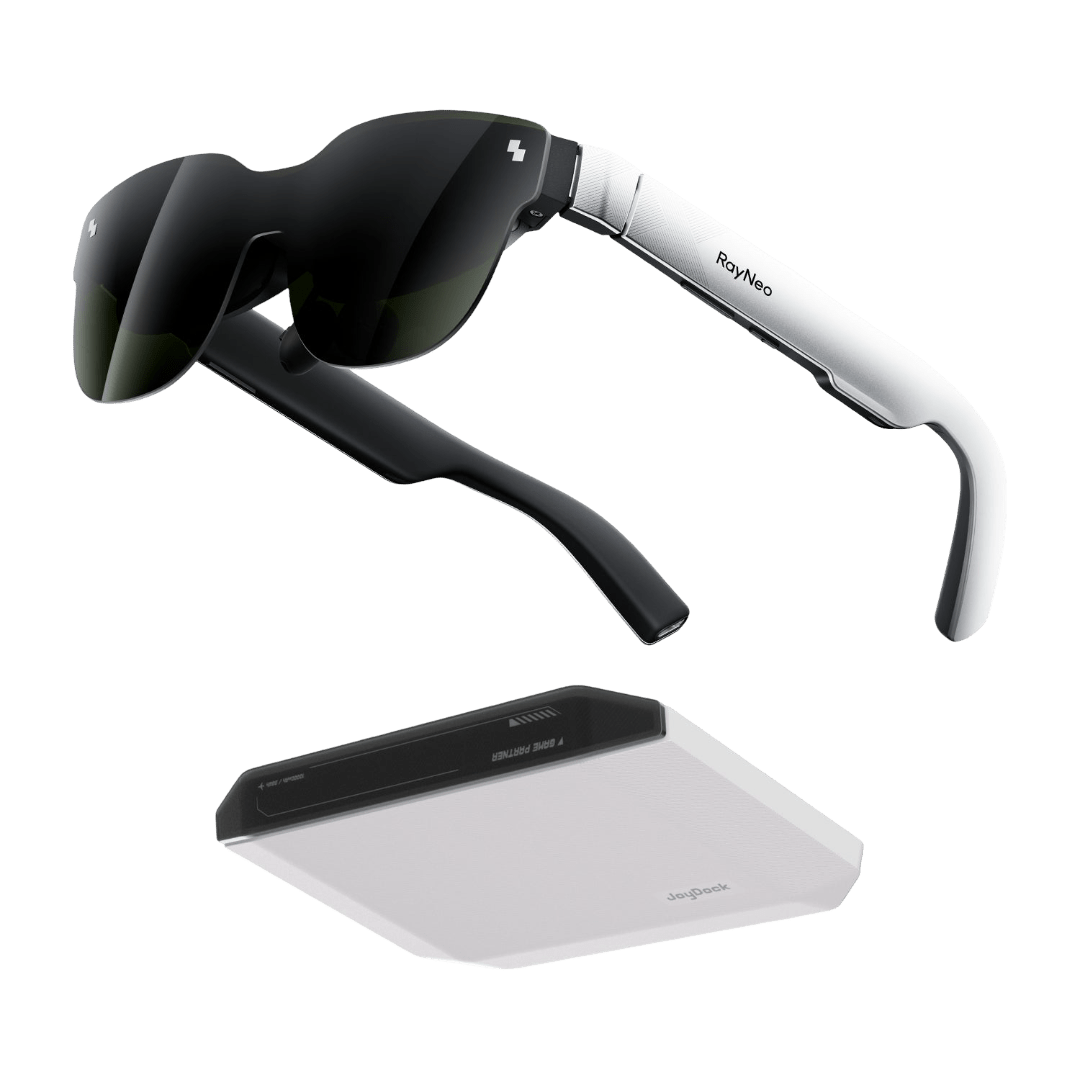
JoyDock is a gaming dock designed specifically for Switch, priced at $69. It solves the handheld video output problem, letting you enjoy big-screen gaming on a plane.
If you just want to lie in bed and watch Netflix without pulling out your phone, Pocket TV is an option. It runs Google TV, packs a 6500mAh battery, supports HDR10 output, and costs $109.
Based on the criteria above, here's a breakdown by use case:

RayNeo ranked first globally in AR glasses shipments from 2022-2025, with about 24% global market share in Q3 2025. Air 4 Pro was called "a landmark product signaling AR glasses' coming of age" by media at CES 2026.
"What are the best AR glasses" doesn't have a universal answer. But "what makes AR glasses worth buying" has a clear framework: 1200+ nits brightness, 200,000:1 contrast, 120Hz refresh rate, under 76 grams weight, and a solid accessory ecosystem.
The tradeoff between portability and immersion doesn't have to be a tradeoff. For gamers, travelers, and remote workers, AR glasses offer a real solution, not a gimmick. If you're ready to experience 201 inches of private viewing in a 76-gram package, RayNeo Air 3s Pro offers an accessible entry point at $249.





Share:
I Need Advice on AR Glasses: What Should I Consider Before Buying?
What Are the Best AR Glasses for Nintendo Switch? A Gamer's Guide