

$429.00

For those who frequently use smart glasses to binge-watch shows, play games, or stay entertained during business travel, the sense of space and direction provided by spatial audio is the deciding factor in whether you’ll actually want to wear them for the long haul. In this article, we will start with a conceptual explanation of what spatial audio actually is. We will help you understand how this three-dimensional sense of space is transformed into a repeatable, engineered capability. This technology ensures that headphones, speakers, and smart glasses no longer just cram sound between your two ears, but instead effectively paint an entire 3D environment directly into your auditory perception.
At its most basic definition, spatial audio is an audio technology that simulates a three-dimensional sound field. It no longer simply distributes sound to the left and right ears. Instead, it assigns a specific direction, distance, and height to every sound element, making you feel as if the audio is coming from the front, the sides, or even above you. For the human brain, this is a very natural way to perceive sound because, in the real world, we constantly determine the position of a sound source through tiny differences in timing, volume, and how our outer ears filter the sound.

This 3D audio effect can be achieved through multi-channel speakers or through headphones and near-ear speakers combined with specialized algorithms. Audio manufacturers like Dolby, Bose, and Sonos all emphasize a common point: the core of spatial audio is the reconstruction of spatial information, not just adding more channels. For wearable devices like smart glasses that sit close to the ears, spatial audio allows you to perceive the direction and distance of sound without completely blocking out ambient noise. This helps you stay more focused during commutes, travel, and casual movie watching.
Modern consumer entertainment is increasingly emphasizing immersion. Streaming platforms have launched a vast amount of movies and series supporting spatial audio, music services are promoting Dolby Atmos and 3D music mixing, and games and VR applications have made spatial hearing a core component of the experience.
For users, the value of spatial audio is very concrete. When your primary goal is buying tv glasses for immersive viewing to watch movies on a plane, you want the people next to you to hear as little as possible, yet you expect the sound to come naturally from the direction of the virtual screen rather than being forced directly into your ears. When playing a first-person game, you want to be able to hear footsteps and environmental reflections even without a large speaker setup. When using smart glasses to binge-watch shows or scroll through videos, you expect dialogue, ambient sound, and soundtracks to be distributed more naturally in space. RayNeo Air 4 Pro focuses on spatial audio specifically to ensure that a portable virtual big screen isn't just visually impressive, but also sounds great.
To understand how spatial audio works, we can start with how the human ear determines direction. In the real world, our ability to know where a sound comes from relies primarily on two types of cues. One is the time and volume difference between our two ears, and the other is the frequency filtering of sounds from different directions caused by the pinna and the head. Together, these factors form what is known as the Head-Related Transfer Function or HRTF.
Spatial audio systems create a corresponding acoustic model for every virtual sound source during playback. First, sound is converted from traditional left-right channels or multi-channel formats into a representation based on individual sound objects, which are then assigned coordinates in 3D space. Next, the HRTF model calculates the specific time differences, volume differences, and spectral changes each ear should receive based on the current head posture. Algorithms process these signals before they are sent to headphones or near-ear speakers for playback.
On devices that support head tracking, spatial audio also incorporates sensor data. When you turn your head, the system recalculates the position of each sound source relative to your head and dynamically adjusts the distribution of sound between your ears. As a result, you feel as though the sound is fixed in space rather than rotating along with your headphones. This is especially important for video and gaming because the screen position is usually fixed; after turning your head, the sound still needs to stay aligned with the visual elements.
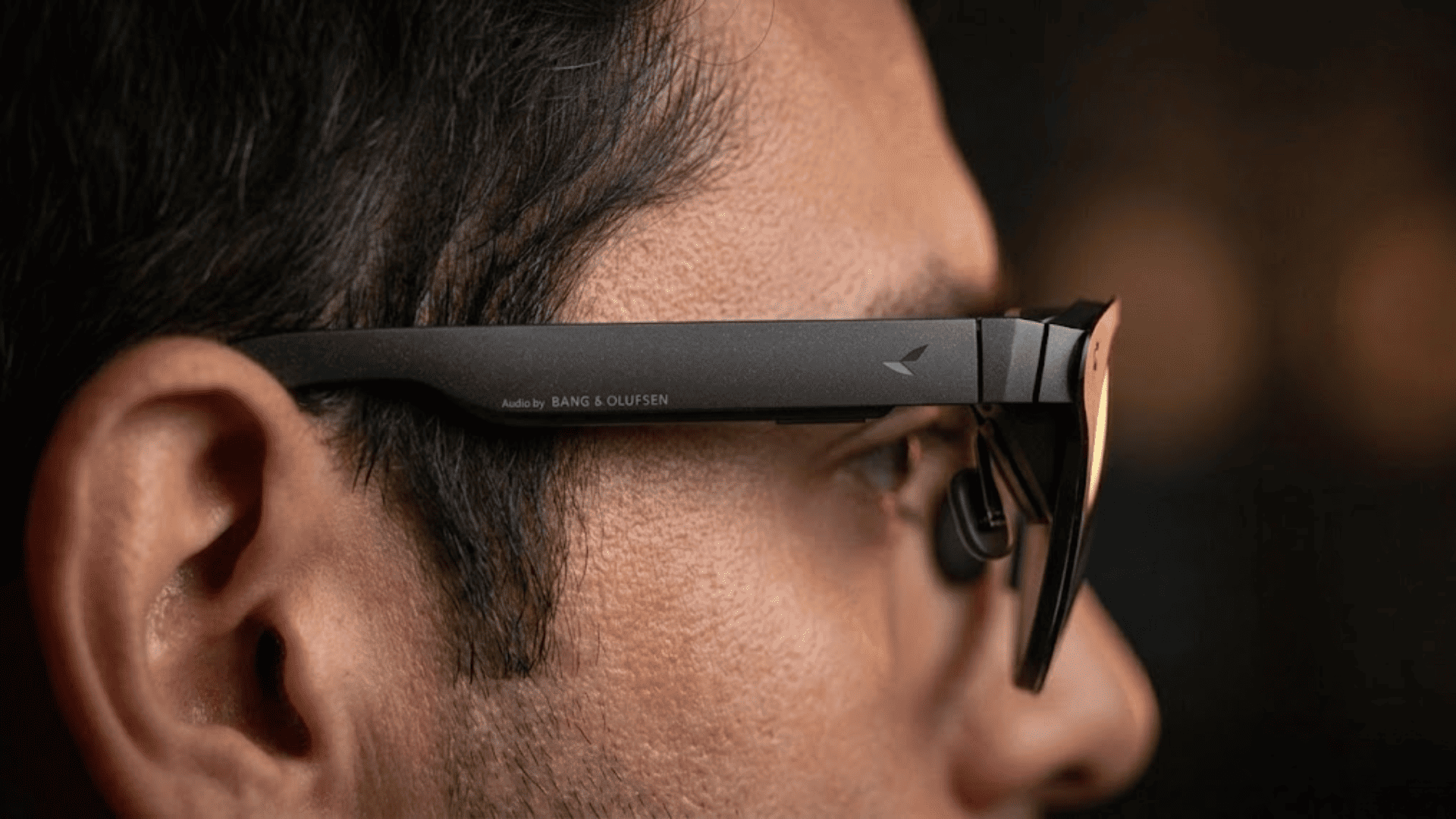
For devices like smart glasses, spatial audio must also solve an additional problem: controlling the range of sound propagation without completely sealing the ears. The audio on the RayNeo Air 4 Pro was tuned with the involvement of Bang & Olufsen, utilizing a four-speaker design with directional acoustic tubes. DSP is used to enhance the spatial audio effect, ensuring a sense of surround sound while reducing sound leakage so the device can be used confidently in public places.
The changes brought by spatial audio can be understood through several dimensions that are close to daily experience. It is about the three-dimensional perception of the soundstage, the level of immersion, and whether you can quickly judge the position of a sound when you cannot see its source.
Traditional stereo is mostly distributed in left and right directions, while spatial audio adds front, back, up, down, and distance on top of that. Through methods like object-based audio and ambisonics, it positions instruments, vocals, and ambient sounds on a complete sphere, reconstructing a 3D soundstage in headphones or near-ear speakers.
In music and movies that support Dolby Atmos or similar formats, you will hear drum beats as if they are landing a meter or two in front of you, audience cheers coming from all around, and the sound of rain forming a sonic dome overhead. These are the effects of spatial audio redistributing sound in three-dimensional directions. For smart glasses, when you are watching a movie on a plane or high-speed train wearing intelligent AR glasses, the virtual big screen is located in front of your field of vision, and the spatial audio tuned by Bang & Olufsen concentrates dialogue and key sound effects toward the screen while extending the background environment to the sides and rear. This allows you to feel as though you are sitting in a small private screening room without being completely cut off from the outside world.
Immersion and realism come from the matching of visuals and audio. Research in Unity and interactive design fields indicates that when spatial audio is synchronized with visual scenes, the user's sense of presence in the scene significantly increases; even if the visuals are not top-tier, the sound can compensate for some lack of immersion.
In virtual environments and games, spatial audio helps you more naturally believe you are actually there, because every sound tells you about the shape and material of the surrounding space.

A report by Grand View Research mentions that 3D audio is one of the key factors driving market growth in immersive entertainment fields such as gaming, VR, and AR. The relevant market size was approximately USD 137.70 billion in 2025 and is expected to grow several times over by 2033. For video content, spatial audio can also strengthen emotions without adding a burden to the visuals, such as by letting the soundtrack better envelop the audience or allowing detailed sound effects to appear at just the right locations.
In smart glasses scenarios, the immersion brought by spatial audio does not necessarily mean complete isolation. The four-speaker system of the RayNeo Air 4 Pro, combined with directional acoustic tubes and Whisper Mode, allows users to enjoy a strong sense of envelopment while watching shows or playing games in offices, airport lounges, or cafes, while still retaining a basic perception of ambient sounds. This state of semi-immersion is actually more in line with the rhythm of daily life.
Another important role of spatial audio is enhancing the sense of direction and positioning capabilities. In interactive scenarios, sound tells you what is happening off-screen, helping you turn toward key positions immediately.
In VR gaming and training simulations, spatial audio provides users with additional cues about environmental construction. Analysis from the Interaction Design Foundation points out that through accurate directional audio, users can more quickly understand the layout of a virtual environment, improving navigation efficiency and reaction speed. In AR and smart glasses scenarios, this capability is equally useful. Imagine connecting the RayNeo Air 4 Pro to a console to play an action game; footsteps and enemy sounds will come from the corresponding directions, helping you judge potential threats without looking at the minimap. Meanwhile, because the audio is open-ear, you can still hear people around you calling your name, avoiding total isolation from reality.
Currently, applications of spatial audio are mainly concentrated in several types of scenarios. Home theatres and music playback are the earliest and most mainstream areas. Dolby and multiple audio brands are promoting Atmos movies and spatial audio music; as long as users have a compatible soundbar or headphones, they can experience a 3D soundstage in their living room.
Games and VR applications already view spatial audio as a must-have capability. Game engines like Unity and Unreal provide mature spatial audio tools, allowing developers to make footsteps, gunfire, and ambient sounds change according to spatial logic, making it easier for players to understand the virtual environment.
In professional fields, spatial audio is also used for training and simulation. For example, in complex equipment operation training, sound prompts guide trainees to notice invisible gauges or events happening behind them, and in flight training, it simulates engine noise, wind, and environmental feedback. As smart glasses and wearable devices develop, spatial audio is beginning to extend into scenarios like mobile movie watching, portable gaming, and lightweight navigation, becoming a part of personal entertainment and information acquisition.
Many smart glasses and AR glasses have already prepared their hardware and tuning for spatial audio. Some products use multi-speaker arrays to create a sound field around the head, while others use algorithms to enhance the sense of direction. Because these devices are becoming a significant investment in personal entertainment, it is important to review all specifications before you buy the best smart glasses to ensure the audio-visual synergy meets your expectations. The overall trend is that spatial audio is penetrating from headphones into more wearable devices, supplementing the audio dimension for visual hardware.
Smart audio glasses RayNeo Air 4 Pro is a typical example. These smart glasses feature a four-speaker system, combined with a directional acoustic tube design and acoustic tuning involving Bang & Olufsen, achieving a spatial audio effect directed at the user's ears while reducing sound leakage, making them suitable for use in public spaces. The product specifications mention that its AI 3D Audio feature can spatialized different types of content, which, paired with HDR10 visuals and AI SDR-to-HDR conversion, creates a more complete integrated audiovisual experience.
RayNeo X3 Pro focuses more on information overlay and spatial computing, with built-in speakers used more for voice assistants, navigation prompts, and lightweight entertainment scenarios. While not as high-profile as the Air 4 Pro in terms of spatial audio marketing, this more restrained audio design is actually more practical for many users who need to listen to navigation and translation results while moving through the city, ensuring prompts are clear without over-occupying environmental awareness.

In addition to the RayNeo series, Meta Ray-Ban, certain Rokid models, and AR glasses from other brands have also optimized for spatial audio to varying degrees, combining multi-unit speakers near the ears with DSP algorithms to provide more natural sound imaging and positioning. The overall trend is that spatial audio is penetrating from headphones into more wearable devices, supplementing the audio dimension for visual hardware.
Looking back at the concept of spatial audio, it is a spatial framework that brings everyday hearing closer to the real world. For smart glasses users, spatial audio acts as a bridge connecting the virtual screen with the physical environment, firmly pinning the floating image in front of you into an environment constructed by sound. Whether you are watching a show on a plane, a sofa, or in bed wearing RayNeo Air 4 Pro, the screen is no longer just a visual rectangle. The soundstage in your ears will make you believe the image is truly at a specific location in front of you, with both distance and direction. We hope this helps you understand the principles and value of spatial audio, helping you look beyond just resolution and brightness numbers during your next purchase and leave room for a dimension with a greater sense of presence for your ears.
Yes, especially in immersive experiences. Traditional stereo sound only moves between the left and right channels. However, Spatial Audio combines complex head-related transfer functions (HRTF) and sound source positioning algorithms. Spatial Audio not only simulates the direction of the sound but also fully takes into account the unique way your ears capture the sound, as if the sound really comes from a specific point around you.
If used properly, spatial audio does not cause any special harm to the ears. From the perspective of auditory perception and fatigue level, Spatial Sound is more natural. The human brain is naturally accustomed to processing sounds from all directions. Spatial audio simulates the way sound waves rebound in nature. Compared to the powerful stereo sound that directly targets the ear canal, it can reduce the oppressive feeling caused by "enclosed listening".
We need to note that spatial audio itself does not harm the ears. However, due to its strong immersion, users tend to increase the volume unconsciously or wear it for a long time. Therefore, we recommend listening in a quiet environment and maintaining an appropriate volume.
In scenarios such as watching movies, playing games, or using AR/VR, turning it on is the better choice; but in daily calls or situations requiring high audio clarity, turning it off is better. When wearing smart glasses and enabling spatial audio, you can experience 360-degree positioning capabilities, allowing you to directly identify the source of the sound by turning your head.
However, when listening to traditional podcasts or pure human voice broadcasts, spatial audio may introduce unnecessary reverb, making the voice sound less pure. In such cases, it is not recommended to enable Spatial Audio.





Share:
How AI Glasses Text Recognition Helps Reading
What is HDR 10? The Ultimate Guide to High Dynamic Range