Translated captions help only when they can be read, and the same goes for the face of the person speaking. For people who rely on prescription glasses, translation glasses need to carry their vision correction as well as the caption display.
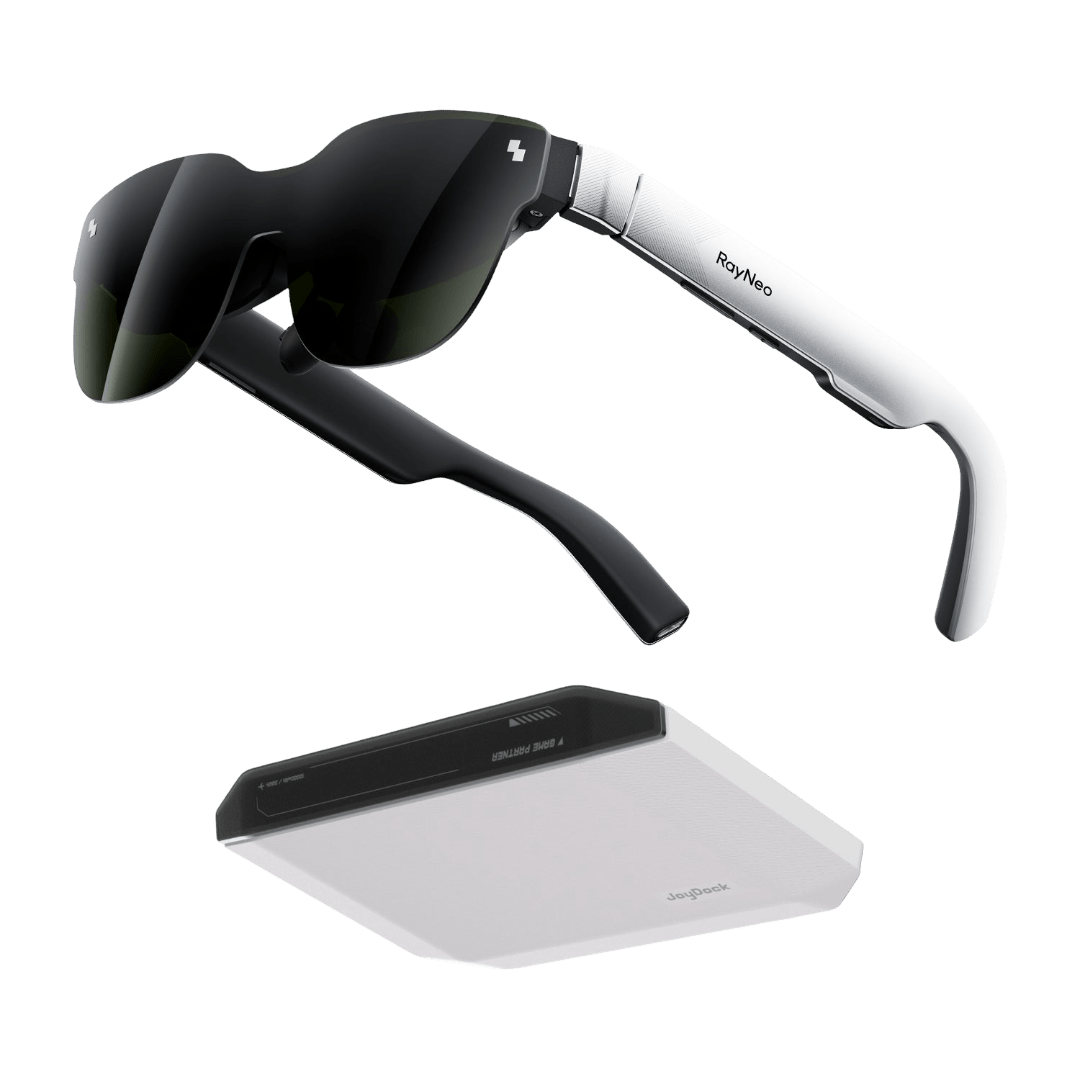
RayNeo iO with prescription lenses solves this during manufacturing. The corrective elements are custom-built and fused directly with the display optics, so live translation across 55 languages arrives in a pair made to the wearer's own prescription. RayNeo X3 Pro takes a second route, with custom prescription lenses from RayNeo's official lens partner, Lensology.

Why the prescription belongs inside the translation glasses
A translated conversation asks the eyes to do two jobs in quick succession: read a line of text, then read the speaker's expression, the item they are pointing at, or the number they have written down. Both need to be sharp, and both happen through the same lenses. A pair that carries both the wearer's correction and the caption display removes the need to choose between them.
iO's display is designed with that in mind. Its Blue Lake waveguide is precision-engineered to integrate with prescription lenses, and on the prescription version the corrective optics become part of the glasses themselves. The result is a single pair: the wearer's everyday vision correction and the translation display, with no separate insert to fit before a conversation.

For a wider look at how prescription support works across RayNeo glasses, this guide to AI glasses with prescription lenses compares the approaches by model.
Getting the prescription ready before ordering
The order form asks for the values found on an eyeglass prescription, and it helps to know what each one means before entering them:
- OD and OS mark the right eye and the left eye. Each eye has its own row of values.
- SPH, or sphere, is the main correcting power. A minus value corrects nearsightedness and a plus value corrects farsightedness.
- CYL and AXIS describe astigmatism correction: CYL is the correction value and AXIS is its angle.
- PD, or pupillary distance, is the distance between the centers of the pupils in millimeters.
A short example shows how those values read on a slip. A right-eye row of SPH -2.25, CYL -0.75 and AXIS 180 describes nearsightedness with some astigmatism correction set at an angle of 180 degrees, and a PD of 62 gives the distance between the pupils as 62 millimeters. The left-eye row follows the same pattern with its own values.
Three points are worth settling before the order, ideally at the eye exam itself:
- The prescription type. The form needs an eyeglass prescription. A contact lens prescription is written for a lens that sits on the eye, so its values are not interchangeable with those for glasses.
- The PD. It is often printed on the prescription sheet, and when it is missing, the eye care specialist or optical provider who wrote the prescription can supply it.
- The date. Prescriptions are generally valid for one to two years from the date of issue, depending on regional guidelines and individual vision changes, and the upload is preferably one issued within the last 12 months.
A copy of the prescription as an image or PDF, issued by a qualified optometrist or ophthalmologist, is the last item to have ready for the upload.
Ordering iO with prescription lenses
The prescription order happens online in three steps:
- Start from the product page: select the iO frame and click "Shop Prescription" to begin.
- Enter the prescription: a pop-up window asks for SPH, CYL, AXIS and PD values and a copy of the official prescription. The upload can be an image or PDF issued by a qualified optometrist or ophthalmologist, preferably within the last 12 months.
- Confirm and check out: certified optical lab technicians review the prescription data before precision grinding, and RayNeo's in-house optical team cross-checks every submission by hand.
Because the lens elements are made for one specific order and fused with the display optics, the finished glasses arrive as a complete pair, with the corrective lenses already in place.
Entering the values exactly as they appear on the slip, with the right eye in the OD row and the left eye in the OS row, gives the optical team a clean match between the form and the uploaded prescription when they cross-check the order. A quick comparison before confirming covers the details most easily mistyped:
- The plus or minus sign in front of SPH, which separates nearsighted from farsighted correction, and the sign in front of CYL, which has to match the way the prescription is written.
- The AXIS figure, the angle that goes with the CYL value.
- The PD, which some prescriptions give as a single figure and others as one figure per eye.
What the fused lens means once a conversation starts
On iO, translation runs through Live Captions, which can be opened from the App List on the glasses or from the Glasses page of the RayNeo AI app. Before starting, the wearer turns on Translation and sets both speakers' languages, chosen from the 55 that Live Captions & Translation covers. The other person's translated speech then appears in view as they talk, while the microphone array keeps the captions focused on the other person by filtering out the wearer's own voice.
For a prescription wearer, the benefit is continuity: the corrective lenses made for that wearer are the lenses the captions appear through, so a conversation in another language can begin without changing glasses.
Single vision or progressive for a translation pair
Single vision lenses carry one correcting power across the whole lens, set for one viewing distance. Progressive lenses change power gradually from top to bottom, so one pair covers distance and closer reading, a design often prescribed when focusing up close becomes harder with age.
iO prescription lenses come in both designs. The design to order is the one the wearer's eye doctor has prescribed and the wearer already uses day to day. Someone who currently switches between separate distance and reading glasses can ask the eye doctor at the next exam whether a progressive design would suit all-day wear.
The Lensology route on X3 Pro
X3 Pro supports prescription lenses through Lensology, RayNeo's official prescription lens partner. The custom lenses are ordered separately from Lensology, which ships worldwide.

That route suits travelers who want translation as part of a broader AI+AR toolkit. X3 Pro's real-time translation is something to see and hear, with text on a full-color display or synchronized audio, across 14 languages. The Gemini-powered assistant answers questions after a "Hey RayNeo," the glasses include a camera and heads-up navigation, and the Lensology lens brings the wearer's prescription into that setup.
Choosing between the two prescription routes
For translation glasses that also serve as everyday prescription eyewear, iO keeps the whole setup in one frame, with the prescription, the display and 55 languages of live translation ordered together online. X3 Pro, with its Lensology lens, fits travelers who want 14-language translation they can see as text or hear as synchronized audio, along with camera capture and full-color AR in view.
Prescription-and-translation FAQ
Can HSA or FSA funds pay for iO with prescription lenses?
iO with prescription lenses is HSA and FSA eligible for holders of an active, eligible U.S. HSA or FSA account, and FSA and HSA debit cards are accepted at checkout. Pre-tax health funds can therefore go toward glasses that combine vision correction with real-time translation. HSA funds roll over from year to year, while FSA funds typically follow a use-it-or-lose-it rule within the plan year, which makes a prescription pair a way to put a remaining FSA balance to use.
What role does Truemed play at checkout?
Truemed is RayNeo's partner for HSA and FSA payments. During checkout, the Truemed logo marks the step where an HSA or FSA card is used. The savings come from paying with pre-tax money rather than from a discount, and the product itself is paid at full price.
Does the prescription version translate the same way as standard iO?
The prescription version runs the same Live Captions & Translation feature across 55 languages, with the same Translation setting and the same choice of both speakers' languages. The difference is in the optics, where the wearer's prescription is built into the lenses.
Does the prescription need to come from a particular kind of eye doctor?
The upload can be an official prescription issued by a qualified optometrist or ophthalmologist, as an image or PDF. Either kind of eye care professional can provide the eyeglass prescription the order needs.




Translated captions help only when they can be read, and the same goes for the face of the person speaking. For people who rely on prescription glasses, translation glasses need to carry their vision correction as well as the caption display.
RayNeo iO with prescription lenses solves this during manufacturing. The corrective elements are custom-built and fused directly with the display optics, so live translation across 55 languages arrives in a pair made to the wearer's own prescription. RayNeo X3 Pro takes a second route, with custom prescription lenses from RayNeo's official lens partner, Lensology.
Why the prescription belongs inside the translation glasses
A translated conversation asks the eyes to do two jobs in quick succession: read a line of text, then read the speaker's expression, the item they are pointing at, or the number they have written down. Both need to be sharp, and both happen through the same lenses. A pair that carries both the wearer's correction and the caption display removes the need to choose between them.
iO's display is designed with that in mind. Its Blue Lake waveguide is precision-engineered to integrate with prescription lenses, and on the prescription version the corrective optics become part of the glasses themselves. The result is a single pair: the wearer's everyday vision correction and the translation display, with no separate insert to fit before a conversation.
For a wider look at how prescription support works across RayNeo glasses, this guide to AI glasses with prescription lenses compares the approaches by model.
Getting the prescription ready before ordering
The order form asks for the values found on an eyeglass prescription, and it helps to know what each one means before entering them:
A short example shows how those values read on a slip. A right-eye row of SPH -2.25, CYL -0.75 and AXIS 180 describes nearsightedness with some astigmatism correction set at an angle of 180 degrees, and a PD of 62 gives the distance between the pupils as 62 millimeters. The left-eye row follows the same pattern with its own values.
Three points are worth settling before the order, ideally at the eye exam itself:
A copy of the prescription as an image or PDF, issued by a qualified optometrist or ophthalmologist, is the last item to have ready for the upload.
Ordering iO with prescription lenses
The prescription order happens online in three steps:
Because the lens elements are made for one specific order and fused with the display optics, the finished glasses arrive as a complete pair, with the corrective lenses already in place.
Entering the values exactly as they appear on the slip, with the right eye in the OD row and the left eye in the OS row, gives the optical team a clean match between the form and the uploaded prescription when they cross-check the order. A quick comparison before confirming covers the details most easily mistyped:
What the fused lens means once a conversation starts
On iO, translation runs through Live Captions, which can be opened from the App List on the glasses or from the Glasses page of the RayNeo AI app. Before starting, the wearer turns on Translation and sets both speakers' languages, chosen from the 55 that Live Captions & Translation covers. The other person's translated speech then appears in view as they talk, while the microphone array keeps the captions focused on the other person by filtering out the wearer's own voice.
For a prescription wearer, the benefit is continuity: the corrective lenses made for that wearer are the lenses the captions appear through, so a conversation in another language can begin without changing glasses.
Single vision or progressive for a translation pair
Single vision lenses carry one correcting power across the whole lens, set for one viewing distance. Progressive lenses change power gradually from top to bottom, so one pair covers distance and closer reading, a design often prescribed when focusing up close becomes harder with age.
iO prescription lenses come in both designs. The design to order is the one the wearer's eye doctor has prescribed and the wearer already uses day to day. Someone who currently switches between separate distance and reading glasses can ask the eye doctor at the next exam whether a progressive design would suit all-day wear.
The Lensology route on X3 Pro
X3 Pro supports prescription lenses through Lensology, RayNeo's official prescription lens partner. The custom lenses are ordered separately from Lensology, which ships worldwide.
That route suits travelers who want translation as part of a broader AI+AR toolkit. X3 Pro's real-time translation is something to see and hear, with text on a full-color display or synchronized audio, across 14 languages. The Gemini-powered assistant answers questions after a "Hey RayNeo," the glasses include a camera and heads-up navigation, and the Lensology lens brings the wearer's prescription into that setup.
Choosing between the two prescription routes
For translation glasses that also serve as everyday prescription eyewear, iO keeps the whole setup in one frame, with the prescription, the display and 55 languages of live translation ordered together online. X3 Pro, with its Lensology lens, fits travelers who want 14-language translation they can see as text or hear as synchronized audio, along with camera capture and full-color AR in view.
Prescription-and-translation FAQ
Can HSA or FSA funds pay for iO with prescription lenses?
iO with prescription lenses is HSA and FSA eligible for holders of an active, eligible U.S. HSA or FSA account, and FSA and HSA debit cards are accepted at checkout. Pre-tax health funds can therefore go toward glasses that combine vision correction with real-time translation. HSA funds roll over from year to year, while FSA funds typically follow a use-it-or-lose-it rule within the plan year, which makes a prescription pair a way to put a remaining FSA balance to use.
What role does Truemed play at checkout?
Truemed is RayNeo's partner for HSA and FSA payments. During checkout, the Truemed logo marks the step where an HSA or FSA card is used. The savings come from paying with pre-tax money rather than from a discount, and the product itself is paid at full price.
Does the prescription version translate the same way as standard iO?
The prescription version runs the same Live Captions & Translation feature across 55 languages, with the same Translation setting and the same choice of both speakers' languages. The difference is in the optics, where the wearer's prescription is built into the lenses.
Does the prescription need to come from a particular kind of eye doctor?
The upload can be an official prescription issued by a qualified optometrist or ophthalmologist, as an image or PDF. Either kind of eye care professional can provide the eyeglass prescription the order needs.
Share:
Leave a Comment
We'd love to hear your thoughts. Comments are reviewed before publication.