

$429.00

Many people assume that lacking a USB-C DisplayPort Alternate Mode connection on their phone or console means they cannot use modern wearable displays. This guide focuses on how our current AR glasses lineup breaks down for this exact need. While a single-cable connection requires this native hardware standard, you can easily bridge the gap using dedicated adapters.
AR glasses require both video data and electrical power simultaneously to operate. DisplayPort Alternate Mode handles both over a single USB-C cable, which is why devices like MacBooks from 2015 onwards and the iPhone 15, 16, and 17 series offer a seamless plug-and-play experience.
When a device lacks this protocol, it cannot send the video feed directly to the lenses. This applies to older smartphones, traditional living room gaming consoles, and even specific newer phones like the iPhone 16e, 17e, and Air models. For Android users, compatibility heavily depends on the exact phone model, so we recommend checking your device's specification sheet to see if it supports USB-C DisplayPort Alternate Mode video output.
Our GT and GT Max models are designed without built-in batteries to maintain a lightweight profile. They are powered directly by the connected host device during a direct USB-C connection, which naturally utilizes your phone or laptop's battery. However, when using an active adapter to bypass missing native video support, these adapters typically feature an extra port to inject external power, preserving your device's charge.
You can still enjoy a massive private virtual screen on unsupported hardware by using the right accessories. The solution varies based on the physical ports available on your source device.
For home gaming consoles like the PlayStation 5, Xbox, and traditional PCs, the video output is HDMI. An HDMI port does not provide the electrical current needed for AR glasses. To solve this, you need the RayNeo HDMI Adapter ($64). This accessory merges the HDMI video signal with an external USB power source, outputting a compatible USB-C connection for the glasses.
If you are using an iPhone 14 or older, your device uses a Lightning port. The official Apple Digital AV Adapter is required to convert the Lightning output to HDMI. From there, you connect it to the RayNeo HDMI Adapter to complete the circuit.
For newer USB-C devices that simply lack video output capabilities, like the iPhone 16e, 17e, and Air, the situation is different. Because they use USB-C rather than Lightning, the Apple Digital AV Adapter is not compatible. We don't currently offer a confirmed adapter solution for these specific models, so we recommend checking our official compatibility page before purchasing.
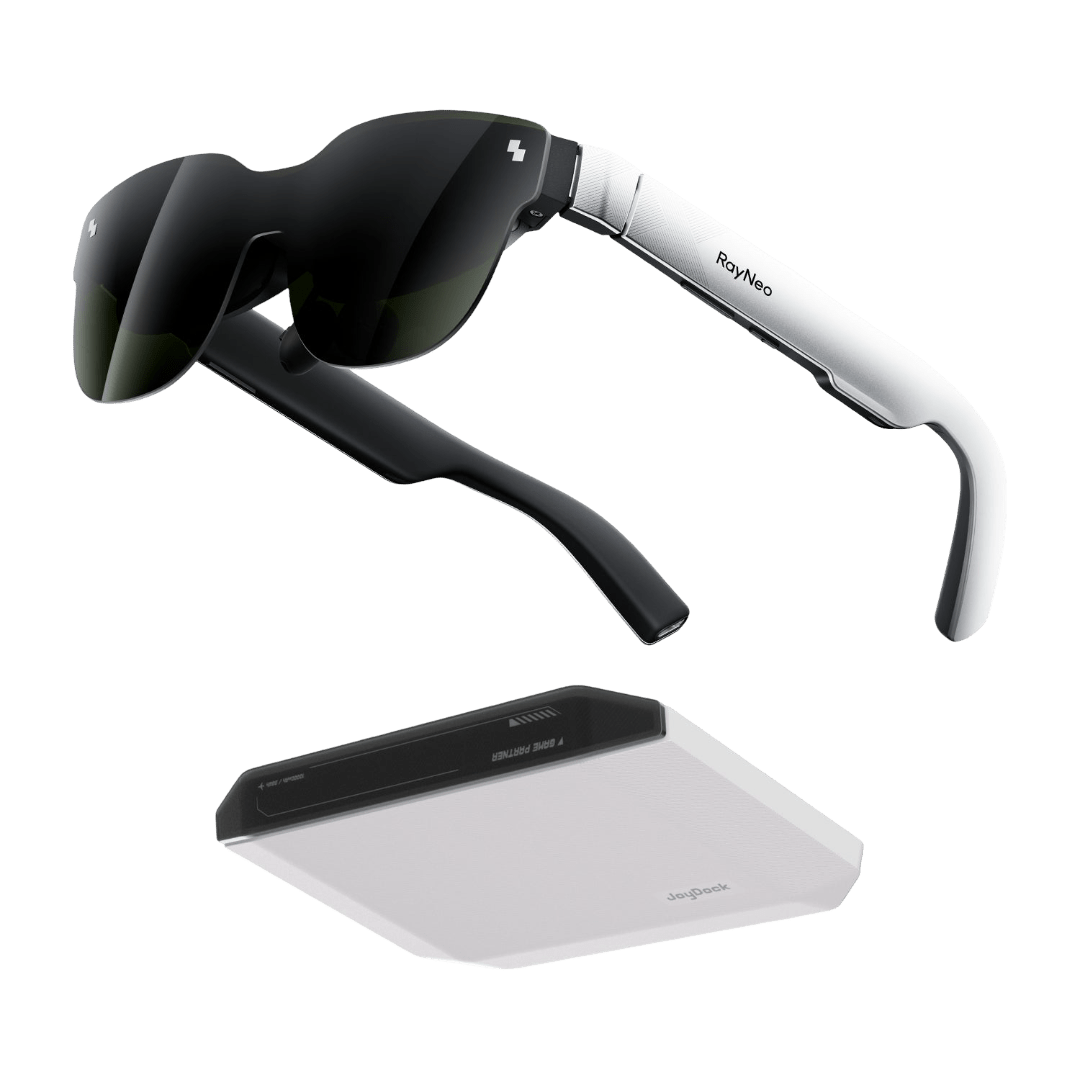
Nintendo Switch users face a unique challenge because the console uses a custom power delivery system. The JoyDock ($89) is designed to bridge this connection; depending on your Switch generation, an additional Back Clip accessory may also be required, so check the JoyDock product page for the current compatibility details before you buy.

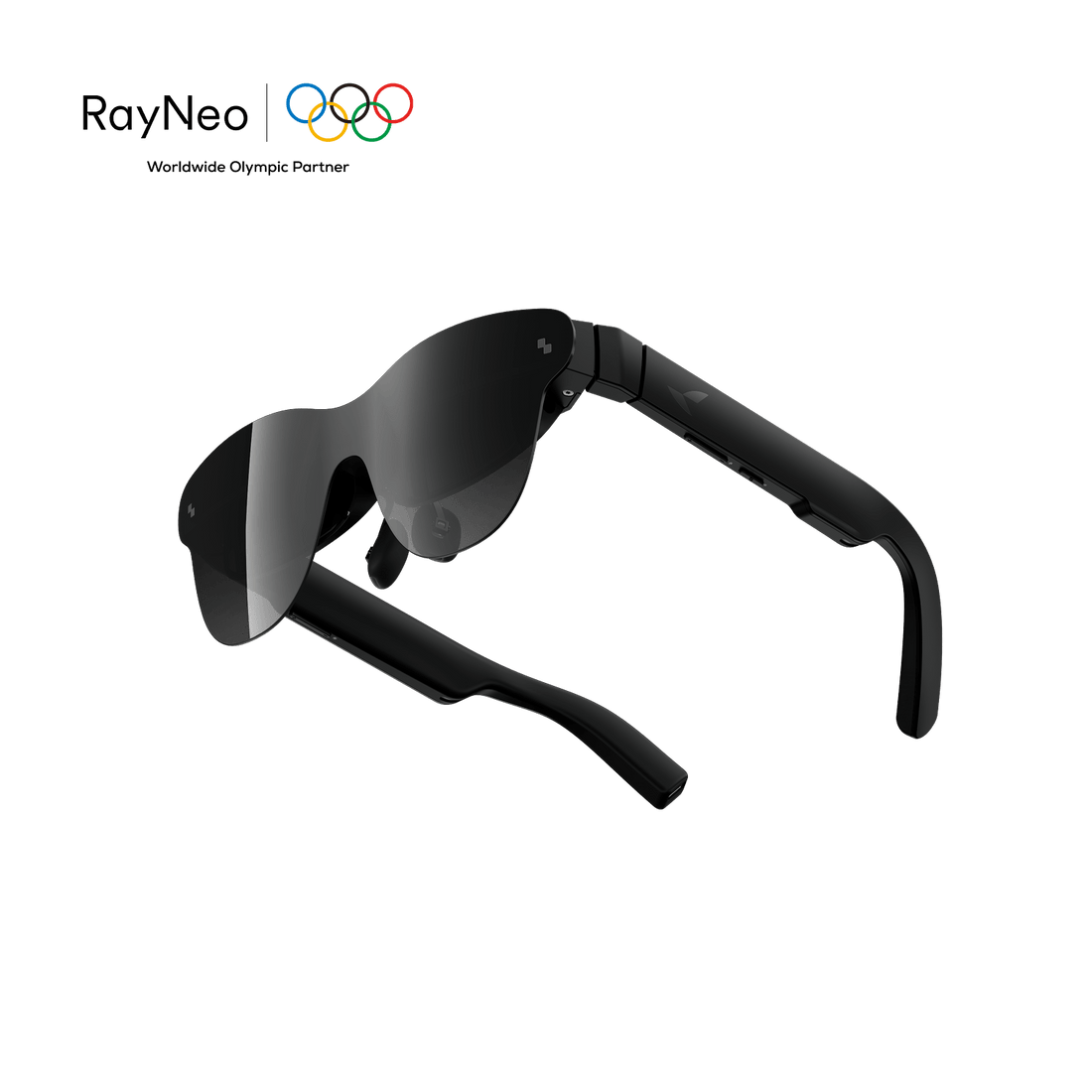
For your display hardware, the RayNeo GT Max ($399) features a 267-inch virtual screen and offers three different physical sizes (Small, Medium, and Large) to perfectly match your interpupillary distance (IPD).
This tailored sizing ensures edge-to-edge clarity, which is crucial when reading small text in games or movies. The GT Max weighs 78 grams and reaches up to 1200 nits of brightness in non-Pinned mode. This high brightness means the display remains vivid even in well-lit rooms.

The RayNeo GT is our more accessible option at $299. It offers a slightly smaller 201-inch virtual screen and shares the same peak brightness of up to 1200 nits in non-Pinned mode. It utilizes a fixed 64mm IPD, meaning it relies on nose pad adjustments for alignment rather than tailored optical spacing. At 68 grams, it provides a highly comfortable fit for long movie sessions.

Both models are designed as private viewing experiences, meaning only the wearer can see the screen. They utilize an open-ear design with four Bang & Olufsen tuned speakers. While they sound expansive to the user, people standing nearby might hear the audio, though our built-in Whisper Mode helps minimize this.
Both glasses also feature an AI-driven 2D-to-3D conversion tool, but this specific feature requires the RayNeo XR App and is exclusively available when connected directly to the iPhone 15, 16, or 17 series.
Using official conversion accessories allows you to enjoy the full display capabilities of the GT and GT Max across different platforms without degrading the visual experience.
Even when routing your signal through a multi-cable setup rather than a direct connection, hardware-level protections remain fully active on the glasses. Both models feature OptiCare 3840Hz high-frequency dimming and TÜV SÜD certification for low blue light. This ensures you still get the same reduction in visual fatigue during long gaming sessions on a connected console.
Regardless of your connection setup, you do not need to wear these AR glasses over your daily spectacles. We partner with Lensology for custom prescription inserts (starting at £95) that clip straight into your AR glasses. This means your comfort and visual clarity stay consistent whether you are plugged directly into a laptop or using adapters for a television setup.
The RayNeo Pocket TV Pro ($199) is an excellent workaround if your phone isn't compatible, but it is not strictly required. It operates as a standalone Google TV device with a 6500mAh battery and built-in apps, which bypasses your phone entirely. We position the GT series paired with the Pocket TV Pro as the world's first Dolby Vision AR glasses system, as Dolby Vision is exclusively supported through this combination. If you just want to connect your existing console, our standard adapters work perfectly fine.
The RayNeo iO ($449) is designed for a completely different use case and does not accept HDMI video input. It focuses on Everyday AI and Productivity using a Bluetooth connection to your phone. It displays text, notifications, and live translations on a smaller visual footprint and runs on its own internal 240mAh battery for up to two days of use. Because it operates wirelessly for these specific tasks, it does not require or utilize DisplayPort Alternate Mode.
The RayNeo X3 Pro ($1,299) handles its own processing and does not rely on a wired video input from a host device. It is our AI+AR glasses model designed for immersive AR and spatial computing. It operates independently with a built-in Snapdragon AR1 Gen 1 chip, a 245mAh battery, and Wi-Fi 6 connectivity. This allows it to compute and render its own full-color MicroLED interface natively.
Not having a native DisplayPort Alternate Mode connection shouldn't keep you from experiencing a massive private screen. From expanding your living room console setup with the RayNeo HDMI Adapter to taking your Nintendo Switch on the road with the JoyDock, the right accessory makes the connection seamless. If you are ready to upgrade your portable entertainment, explore the RayNeo GT Max and RayNeo GT to see which display best fits your daily routine.





Share:
The Best Private Screen Glasses for Working in Public
Are AR Display Glasses Actually Worth Buying for Everyday Use?