
Table of Contents
At the boundary of human vision, there is an ultra-thin layer of glass or resin where light behaves like a patiently guided traveller, constantly reflecting and being released into your eyes at the perfect angle. This is the significance of optical waveguides: they enable the screen to evolve from a rectangle in your hand into an invisible layer of text and images on the surface of the world, turning Smart AI glasses and AR glasses from laboratory prototypes into tools for daily wear.
What Is an Optical Waveguide?
An optical waveguide is a physical structure used to confine and guide the propagation of light in a specific direction. Through precisely designed geometry and refractive index distribution, it enables light to undergo total internal reflection within the medium, allowing it to travel along a set path without leaking into the surrounding environment.
Definition and Core Optical Function
An optical waveguide is a structure composed of a core and cladding made of optically transparent materials. The core region has a higher refractive index, while the cladding has a lower refractive index. This difference in refractive index is key to confining the light within the core and guiding it in a specific direction.
The core optical functions of waveguide technology include:
-
Light Guidance: The fundamental function of an optical waveguide is to transport light from one point to another efficiently. Whether it is signal transmission in fiber optic communications or light path steering in display technology, both rely on this characteristic of the waveguide.
-
Mode Control: Waveguides can be designed as single-mode or multi-mode. Single-mode waveguides (such as those used for high-precision displays) can eliminate light interference noise to ensure image clarity.
-
Optical Integration: In modern optoelectronic devices, waveguides act as more than just transmission lines; they are often integrated with functional modules like modulators and beam splitters to form complex optical chips.

Role of Optical Waveguides in AR Glasses
Optical waveguides are the core display technology for mainstream Augmented Reality (AR) glasses (such as Microsoft HoloLens 2 and Magic Leap One). They guide light through transparent materials to the user's eyes without blocking the view of the real world.
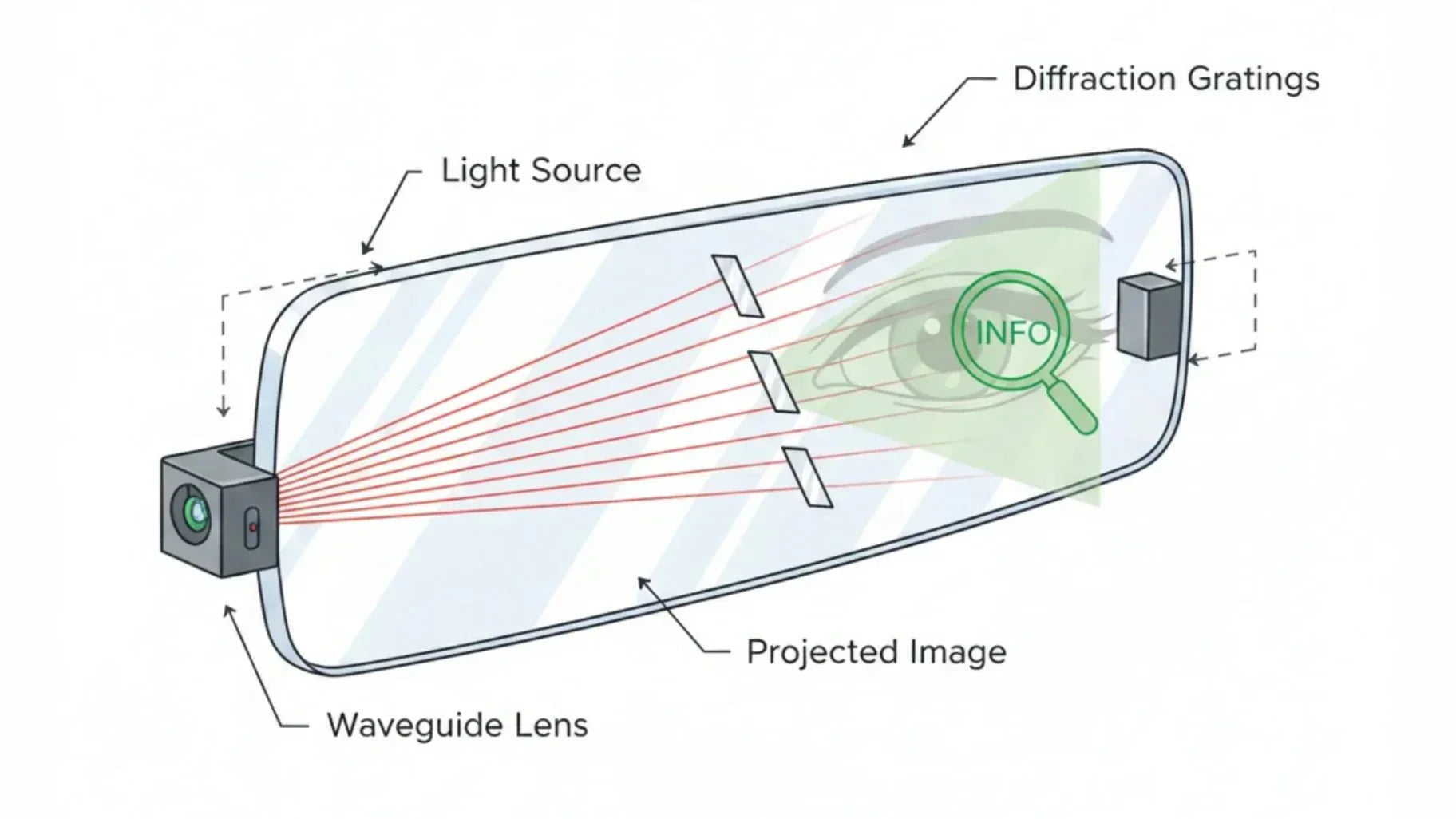
In AR glasses, light signals generated by a display module (such as a micro-projector) are transmitted through the waveguide. Internal structures within the waveguide (such as holographic gratings) refract or reflect these light signals so they enter the human eye, creating a virtual image.
Unlike traditional LCD or OLED screens, the optical waveguide itself is transparent. This allows users to see their real-world surroundings clearly while viewing virtual content.
Another major significance of optical waveguides is that they enable devices to be more lightweight. Traditional display technologies often require multiple lenses and complex optical paths, resulting in bulky hardware. In contrast, optical waveguides compress light within a thin plate through holographic or diffractive technology, allowing AR glasses to be as thin and light as ordinary eyewear.
Differences Between Optical Waveguides and Traditional Lenses
While optical waveguides and traditional lenses are both optical components, they handle light in fundamentally different ways. There are basic distinctions in their principles, structures, and application scenarios. Regarding light processing, the core function of an optical waveguide is to maintain the path of light rather than change its divergence; therefore, waveguides are primarily used for light guidance and transmission. Light is guided to a specific output point within the waveguide mainly through total internal reflection or diffraction. Lenses, however, change the divergence or convergence of light rays through refraction to form a clear image; thus, traditional lenses are primarily used for focusing and imaging.
How Optical Waveguides Work
Before understanding how optical waveguides support AR optics, we must return to the path of light itself. For a truly usable pair of AR glasses, the key is not how flashy they are, but whether they can reliably receive, transmit, and redistribute light from a micro-display within a transparent medium just a few millimeters thick, while minimizing any disturbance to the natural field of vision.
Industry data indicates that breakthroughs in this type of AR optical waveguide module are driving the rapid growth in demand for thin and light AR devices. The market size for these modules is projected to be approximately 1.5 billion dollars in 2025 and is expected to expand at a compound annual growth rate of about 18 percent through 2033.

Total Internal Reflection in Waveguide Systems
The fundamental physics of optical waveguides is based on total internal reflection (TIR). When light within a high-refractive-index material hits the boundary at an angle exceeding a specific critical value, it does not refract out of the material. Instead, it reflects internally, propagating along the waveguide in a nearly lossless manner through multiple bounces. This repetitive TIR allows designers to achieve long path lengths and exit pupil expansion within a limited thickness, effectively distributing light from a small micro-display across a larger area usable by the eye.
In actual AR glasses, optical engineers precisely control material refractive indices, waveguide thickness, and incident angles to ensure light can reflect stably dozens of times or more while maintaining sufficient brightness and clarity. Both data and experimentation indicate that as long as TIR conditions are consistently met, energy loss within the waveguide depends primarily on surface processing precision and coupling structure design, rather than the propagation distance itself.
In-Coupling, Light Propagation, and Out-Coupling Processes
A complete AR optical waveguide system is generally broken down into three stages. First is incoupling, where light from the micro-display enters the waveguide via an input grating or geometric coupling structure at an angle that triggers total internal reflection. Next is the internal propagation phase. Light bounces through the waveguide via multiple internal reflections while a specific structure handles exit pupil expansion, spreading the narrow beam into a larger effective viewing area. Finally, outcoupling occurs. An output grating or partial reflection structure releases the light from the waveguide at a specific position and angle, directing it into the eye.
This workflow sets the upper limits for AR waveguide performance in brightness, field of view, exit pupil range, and color. For example, the RayNeo X3 Pro uses a binocular full-color MicroLED projection system and lenses with embedded waveguides. Through internal coupling and pupil expansion, it scales the output of a 0.36 cubic centimetre optical engine into a roughly 30-degree field of view. This setup delivers a typical brightness of around 3500 nits and a peak brightness of up to 6000 nits.
Virtual Image Formation and Eye Delivery
For the wearer, the most immediate sensation is not the distance light travels through the waveguide, but rather where the virtual image appears. By designing the waveguide geometry and exit structures, the system can control the focal length of the virtual image. This makes the display look like it is several meters away instead of being flat against the lens. This reduces eye strain and allows virtual information to sit naturally near streets, buildings, or people. This creates a true sense of augmented reality.
What Are the Main Types of Optical Waveguides Used in AR
Optical waveguides are not a single technology. They are a collection of different structures and material choices. Different types of waveguide optics make trade-offs in field of view, light efficiency, transparency, and cost. Because of this, they play different roles in various segments of the smart glasses and AR glasses market.
The AR market utilizes three primary optical waveguide architectures, each balancing specific technical trade-offs:
-
Reflective (Geometric) Waveguides: Prioritize high light efficiency and natural color, but are thicker and heavier, making them ideal for industrial and tactical applications.
-
Diffractive Waveguides: Offer a thin, highly transparent profile with a wide field of view, serving as the mainstream choice for everyday consumer AR glasses.
-
Holographic Waveguides: Enable complex 3D virtual images and real depth of field, representing the next generation of high-end, experimental AR optics.
Reflective Waveguide Architecture
Reflective waveguides are often called geometric waveguides. This technology uses multiple partial mirrors or internal reflective surfaces to output light in segments. This creates multiple exit pupils at different points along the path, which expands the viewing area. The main advantages of this structure are high light efficiency and minimal color dispersion. It is ideal for scenarios that require high brightness and natural colors.
The downside is size and weight. Because they require multiple layers of reflective structures, reflective waveguide modules are hard to make extremely thin. They are also more noticeable visually. This is a limitation for consumer AR glasses where everyday comfort is a priority. Therefore, reflective solutions appear more often in early head-mounted devices or industrial terminals where appearance is less critical, such as industrial maintenance headsets and tactical display systems.
Diffractive Waveguide Architecture
Diffractive waveguides rely on nanoscale grating structures for incoupling, light guiding, and outcoupling. An input grating bends light from the micro display into the waveguide. The light travels through the waveguide via total internal reflection. Then, an output grating directs the light toward the eye from multiple positions at specific angles. This method allows for a large field of view and wide exit pupil range within a very thin glass substrate while maintaining high transparency. It is the current mainstream choice for consumer AR glasses.
New generations of diffractive waveguides use improved grating periods and materials to significantly reduce rainbow artifacts and improve full-color consistency. Single-layer waveguide solutions based on silicon carbide diffractive structures have achieved full-color display and high fields of view in experiments. This shows there is still room to optimize diffractive technology. The RayNeo X3 Pro features an advanced combination of etched waveguides and a binocular full-color MicroLED projection system. By using exit pupil expansion and high-brightness MicroLED sources, it provides users with full-color AR visuals visible in all lighting conditions. The system delivers these binocular, full-color images while keeping a design that looks and feels like regular glasses.
Holographic Waveguide Architecture
Holographic waveguides look similar to diffractive waveguides in structure. However, the core difference lies in using volume holographic or surface holographic structures to control light phase distribution more precisely. These waveguides can reconstruct complex light fields internally. This allows for 3D virtual images and multi-focal displays in an ultra-thin form factor. It is considered a major direction for next-generation high-end AR optics.
Through holographic waveguides, devices can generate 3D images with real depth of field in a glasses-like form factor. These systems can also use eye-tracking data to adjust the exit pupil position dynamically. This capability is very attractive for medical use, complex industrial tasks, and high-density data displays. However, holographic waveguides face challenges in manufacturing complexity and cost. For now, they appear mostly in experimental devices and high-end prototypes rather than standard consumer products.
Technical Comparison of Waveguide Technologies
From a technical perspective, a concise comparison reveals that reflective waveguides prioritize light efficiency and colour at the expense of thickness and aesthetics. In contrast, diffractive waveguides offer clear advantages in thinness, transparency, and integrability. Holographic waveguides are more forward-looking, particularly regarding their potential for 3D display. Reports indicate that within the current AR optical waveguide module market, geometric waveguides still hold a significant share of industrial and high-brightness applications. However, diffractive waveguides are showing a trend of rapid growth in consumer products and are expected to contribute most of the market increment between 2025 and 2033.
Key Performance Metrics of AR Waveguides
For users who prioritize the actual usability of smart glasses and AR glasses, the most critical factors behind the technical jargon are a few specific metrics. Field of view and coverage determine how much content you can see, while exit pupil and eye relief impact comfort. Brightness and transmittance dictate whether the glasses are functional for outdoor use, and color and uniformity affect the enjoyment of long-term viewing. Industry research from multiple user surveys has consistently shown a stable correlation between these physical metrics and overall user satisfaction.
Field of View and Visual Coverage
Field of view (FOV) is the core metric describing how much of your vision a virtual image occupies. A larger FOV provides a stronger sense of immersion and can carry more information, but it also necessitates more complex optical designs and results in higher light loss. In daily use scenarios, an FOV of approximately 30 degrees is sufficient to support navigation, message notifications, translation subtitles, and medium-sized virtual screens. Larger FOVs are better suited for complex 3D interactions or gaming, which often require heavier head-mounted form factors.
The RayNeo X3 Pro features an FOV of about 30 degrees, which, when paired with its full-color MicroLED waveguide display, allows wearers to gain sufficient information coverage in their line of sight without feeling overwhelmed or having their vision completely obstructed by virtual content. This relatively restrained FOV design is more suitable for information overlays during city walks, exhibition visits, and extended work sessions.

Eye Box, Eye Relief, and Viewing Comfort
The eye box describes the spatial range where your eyes can move and still see the full image. Eye relief refers to the perceived distance of the virtual image, specifically whether it looks close to the eye or floats several meters away. Together, these factors determine if AR glasses are forgiving enough for different face shapes and wearing positions. They also decide if you can look at the screen naturally for a long time.
Optical waveguides use exit pupil expansion structures to spread a narrow light beam over a larger area within a thin lens. This increases the margin for error. When a waveguide is designed well, users can adjust the frame position and still get a complete picture without needing millimeter-level precision. For people who need to check navigation while walking or take their glasses on and off in the subway, this stability is much more important than laboratory resolution limits.
Brightness, Light Efficiency, and Transparency
Brightness and light efficiency are key to whether a waveguide works in the real world. High light efficiency means you get higher brightness at the same power level. It also allows for a bright virtual image while keeping high lens transparency. Transparency is directly related to safety, especially in street and industrial settings.
The optical engine in the RayNeo X3 Pro has a typical brightness of around 3500 nits and a peak brightness of up to 6000 nits. This keeps the display readable in high-contrast environments like subway entrances or outdoor shopping plazas. At the same time, the waveguide lenses remain highly transparent, making them safe for checking directions while walking.
Color Uniformity and Image Consistency
Color uniformity covers several levels. it includes color consistency across different eye box areas, stability of the overall color temperature, and the presence of rainbow artifacts or color fringing. Both diffractive and holographic waveguides must deal with different output efficiencies for various wavelengths. If not controlled, this causes visible stripes and uneven colors on white or high-contrast interfaces.
New waveguide research mitigates these issues by optimizing grating structures and material combinations. Recent papers show full-color display experiments using single-layer waveguide structures that significantly reduce rainbow artifacts. For users, a simple way to judge quality is to look at white backgrounds, small text, and grayscale images. You should check the color stability and clarity at the edges and corners of the field of view.
Optical Waveguide vs. Other AR Display Solutions
Optical waveguides are the main player in AR optics because they offer a balanced solution for thinness, transparency, and long-term wear. In contrast, birdbath optics and free-form prisms are mostly used in headsets and specialized professional gear. While they can provide a larger field of view or higher light efficiency, they struggle to meet the mainstream expectations for smart glasses in terms of looks and comfort.
Waveguide Displays Compared with Birdbath Optics
Birdbath optics usually combine a beam splitter and a curved mirror to reflect micro-display images to the eye. The path of light is straightforward, light efficiency is high, and the manufacturing process is mature. This is why many early AR or MR headsets used this structure. However, the way the light path unfolds makes it very hard to shrink the system down to the size of normal glasses. These devices usually need extra shields and headbands to support the weight. To keep top-tier image quality in a portable form factor, RayNeo refined this traditional structure for the Air 4 Pro.
The RayNeo Air 4 Pro uses a BirdBath design with the Peacock 2.0 optical engine and Micro-OLED screens from SeeYa. This setup features an extremely high contrast ratio of 200,000:1 and supports 1200 nits of brightness at the eye along with HDR10 standards. Although the lenses are thicker and have a dark tint, they provide an immersive experience similar to a giant TV. The RayNeo Air 4 Pro simulates a 201-inch virtual screen viewed from 6 meters away.
In comparison, optical waveguides fold the light path into the lens itself. This only requires a tiny projection module and a waveguide lens to handle most display functions. This allows AR glasses to stay highly transparent and look like regular eyewear. This makes them much easier for users to accept as daily wearable tech. For users who want to wear their glasses all day, the advantage in size and weight is far more important than an extreme field of view.
Waveguide Displays Compared with Freeform Prisms
Free-form prisms use carefully designed aspherical or complex surfaces to fold the light path within a limited space. This is a middle-ground solution between traditional prism systems and waveguides. Their light efficiency is typically higher than early waveguides, and color dispersion is easier to control. However, they need a certain thickness and volume to achieve the light folding. Because of this, their overall weight and visual profile remain significantly higher than those of waveguides.
Trade-Offs in Size, Weight, and Optical Performance
Differences between various display solutions ultimately come down to the balance between volume, weight, and optical performance. Optical waveguides sacrifice certain extreme parameters, such as the ceiling for field of view and light efficiency, in exchange for a volume and weight that truly approach those of ordinary glasses. While Birdbath and free-form prism solutions offer advantages in FOV and light efficiency, they rarely make a user willing to wear them all day.
As waveguide nanofabrication and mass production processes mature, the manufacturing cost of AR optical waveguide modules is gradually decreasing. In the future, more AR glasses will prioritize waveguide solutions, even if they require a disciplined choice regarding field of view and certain visual qualities in the early stages.
Applications of Optical Waveguides in AR
As optical waveguides transition from technical papers into daily life, they represent more than just experimental data; they embody specific, real-world scenarios. For users of smart glasses and AI glasses, the value of the waveguide lies in its ability to let virtual content float naturally within a real-world setting without disrupting interaction with those nearby. These scenarios span multiple sectors, including consumer applications, industrial and field operations, as well as medical education and training, and have already generated quantifiable benefits in actual projects.
Consumer-Oriented AR Glasses
In the consumer sector, the most direct role of optical waveguides is to transform AR glasses into devices that can be worn outdoors every day, rather than electronic toys restricted to the living room. The most common user needs focus on several directions, including real-world navigation and information overlays, language translation and local cultural understanding, message notifications and productivity assistance, as well as video entertainment and gaming experiences.
Enterprise, Industrial, and Field Applications
Industrial and enterprise applications are another pillar of the AR optical waveguide module market. Research from Data Insights Market notes that industrial manufacturing and maintenance scenarios have become a key source of demand for waveguide modules. Relevant applications include remote expert guidance, line-of-sight operational step prompts, and field inspection data overlays. By overlaying critical information directly onto equipment surfaces, workers can complete complex operations without leaving their field of vision, reducing error rates and operation time.
Medical, Educational, and Training Use Cases
In medical and educational training scenarios, the importance of waveguide AR optics lies in maintaining two bottom lines simultaneously: clearly seeing the real world while accessing key information without breaking focus. Surgeons need to see the patient on the operating table while viewing imaging data and monitoring metrics at the edge of their vision. Nursing and complex equipment training aim to overlay procedural guidance onto real devices, rather than having students practice solely on screens.

Conclusion
Optical waveguides refold the path of light into a thin line invisible to the naked eye, and through this line, they securely anchor the digital world to the surface of reality. Within this technological path, the RayNeo X3 Pro, centered on full-color diffractive waveguides and high-brightness MicroLEDs, and the RayNeo Air 4 Pro, centered on Birdbath optics paired with a Micro OLED giant-screen experience, represent two distinct yet complementary directions: one providing an assistive layer for understanding and action within the real world, and the other offering a private and clear optical canvas for travel and leisure. This technology is supporting a market expanding at a double-digit growth rate. From consumer-grade smart glasses to industrial AR glasses, the value of waveguide modules continues to grow. For users, the significance is simpler: it is AR optics that you can truly wear naturally all day, placing translation, navigation, information, and content exactly where you need it, rather than pulling you into a closed screen isolated from the world.
Share:
Surround Sound vs. Stereo: Which Is Better for Watching Movies?
Handheld Consoles Meet AR Glasses: The Ultimate Portable Gaming Setup