
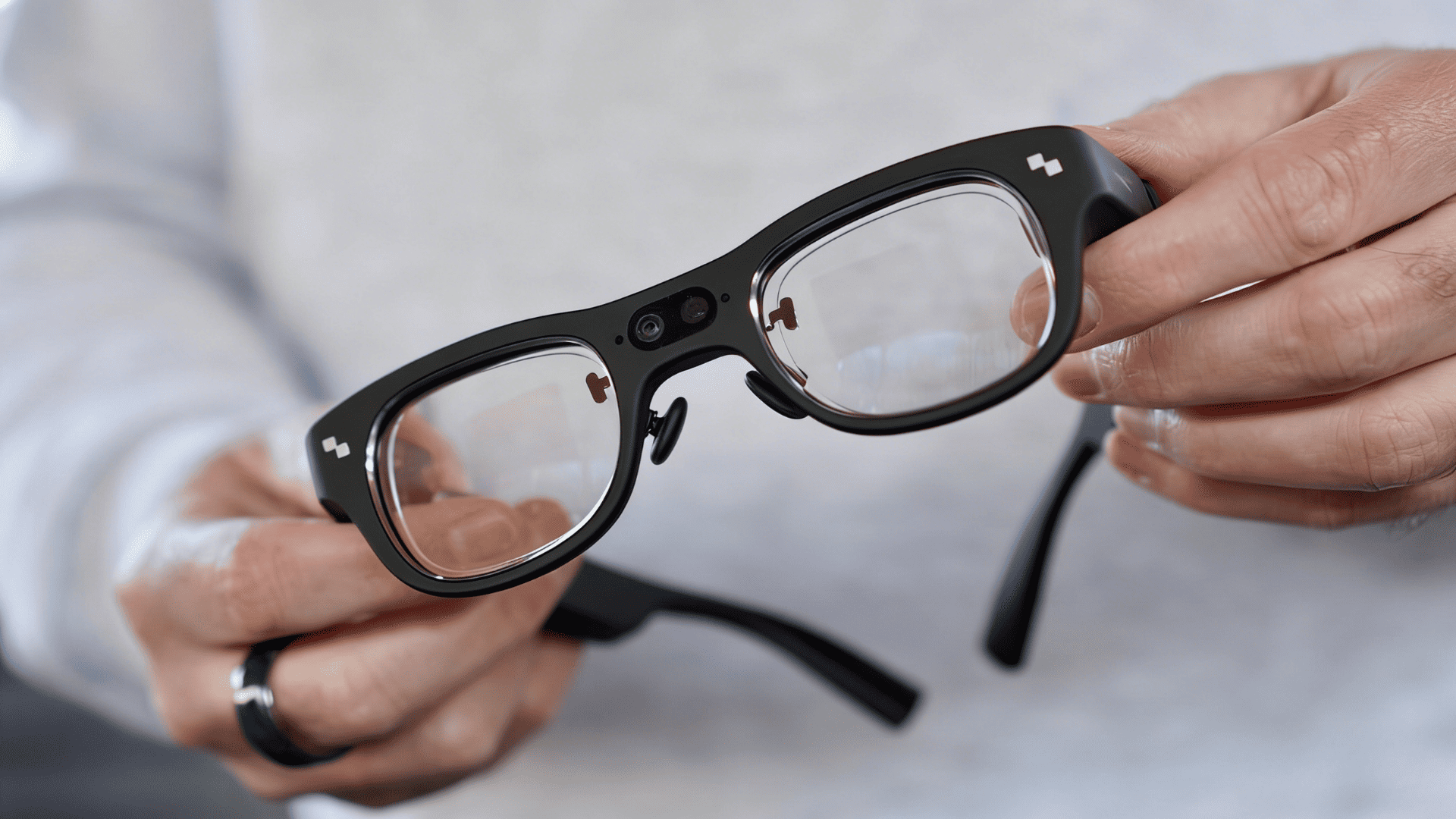
AI glasses in 2026 have entered a very subtle stage. They are not just about stuffing cameras, microphones, and Bluetooth into a frame. AI glasses are attempting to take over the most fragmented and valuable parts of your day, such as rescheduling a meeting on the fly during a commute, the awkward pauses in cross-language communication, or the anxiety of finding your way and your contacts after landing on a business trip. For most users, the real pain point is not a lack of novel features, but rather too much information, the high cost of attention, and hands that are too busy, leading to a cycle where the more we rely on our phones, the more easily we are interrupted. In this article, we will start from the technical foundations and characteristics of AI glasses to help you choose the best AI glasses for 2026.
What are AI Glasses and How do They Work?
AI glasses are a category of smart terminals that compress perception, understanding, and output into the form factor of eyewear. The core workflow typically involves cameras and microphones capturing the environment and voice, followed by recognition, translation, and reasoning performed on-device or in the cloud. The results are then fed back to the user via display, audio, or touch. The reason they have become significantly more practical in 2026 is due to the improved understanding capabilities of multimodal models, combined with specialized chips that move some reasoning back to the local device. This leads to lower latency and more natural interaction, making users more willing to wear them continuously in real life.
When evaluating whether a pair of AI glasses is worth buying, you can think of them as a personal second brain. Their value lies not in how many questions they can answer, but in whether the cost of asking a question is low enough, whether the speed of getting an answer is fast enough, and whether that answer can be directly converted into your next action.
Key Features to Consider in Best AI Smart Glasses
When shopping for the best AI glasses, the spec sheet is only a small part of the story. More importantly, we need to understand how these parameters affect your specific daily experience. You can break down the evaluation logic into five dimensions: clear visuals, fast queries, accurate capture, long-wear comfort, and overall value.
Display and Optical Performance
Display and optics determine whether AI glasses can truly serve as a gateway to information. Micro OLED excels at providing high-contrast and immersive big-screen experiences, making it suitable for audiovisual content, gaming, and desktop-level extended displays. Waveguides and MicroLED are better at lightly overlaying information onto your real-world field of vision, which is ideal for navigation, translation, prompts, and light productivity. While a larger Field of View (FOV) is more immersive, it places greater demands on optical consistency and wearing comfort. For information-based use, users often care more about brightness, clarity, and outdoor readability than simply chasing a larger image.
If you plan to use AI glasses for commuting and city walking, I suggest prioritizing outdoor readability and text sharpness. The real use case is not experiencing a demo in a dark room; it is at a subway entrance, on a street in the afternoon, or at the entrance of an office building with reflective glass walls. Whether you can see a prompt clearly at a glance will directly determine if you continue to wear them.
AI and Smart Interaction Capabilities
This category determines whether AI glasses feel like a tool or a toy. You should focus on whether they support multimodal understanding, real-time translation and voice transcription, and true hands-free interaction—such as voice wake-up, quick touch controls, and a feedback rhythm that can be interrupted. A more practical point is whether they remain usable when it is inconvenient for you to speak; for example, using short gestures to trigger translation or navigation prompts determines their usability in meetings, on subways, and on the street.
Many users buy AI glasses with a lot of initial excitement, only to let them gather dust at home shortly after. Why? We have discussed this with many customers and found that some users feel the interaction cost is too high: you have to unlock your phone, open an app, aim the camera, and then wait for a result. Therefore, good AI glasses should shorten this chain to a single action or a single sentence, with results that are stable and repeatable.
Camera and Visual Capture Quality
The camera on AI glasses determines two things: whether you can capture usable footage and whether the AI can understand the world in front of you. Content creators will care about image quality, dynamic range, and stabilization, while business users will prioritize whether the capture is discreet and natural enough to quickly record whiteboards, ID badges, booth information, and menus. More critically, the reliability of the focus and shutter logic is essential because glasses-based photography is about capturing the moment, frequent blurring or missed shots will cause users to quickly abandon this input method.
If your primary purpose for buying is to use the camera as a visual input for AI, stable exposure and clarity are more important than extreme resolution. AI requires understandable images rather than poster-level sharpness.
Battery Life, Weight, and Wearing Comfort
Battery life and weight determine how long you can wear the device, and naturally, your mental acceptance of it. Just as we experience a certain level of anxiety when our phone battery is low while out, AI glasses will transform from a productivity tool into a burden if they require a midday charge or start pressing on the bridge of your nose after just thirty minutes. You need to view battery life as a system-wide metric: frequent camera use, continuous voice recognition and translation, and high-brightness or high-refresh-rate displays will all significantly impact real-world longevity.
Comfort is about more than just grams; it comes from factors like weight distribution and temple tension. Some of the lightest smart glasses available in 2026 achieve this by using advanced magnesium alloys and ergonomic nose pad structures. Many users underestimate the impact of heat; once the temples become warm or cause discomfort behind the ears, wearing them becomes a signal reminding you to take them off.

Pricing and Value Positioning
The price range for AI glasses in 2026 is broad, ranging from entry-level media display glasses to flagship products aimed at information overlay and AI productivity, and on to light smart glasses focused on content recording and social sharing. The most effective way to shop is to link the price to your frequency of use: if a pair of glasses saves you twenty minutes of fragmented time every day, it has long-term value; if you only use it twice during a business trip, a lightweight solution is more suitable.
Another easily overlooked cost is the ecosystem cost. This includes whether the companion app is mature, whether subscription services are required, and whether it depends on a specific phone system or account framework. You should try to avoid products that require complex configuration to provide value, as that transforms a sense of wonder into a test of patience.
Which AI Glasses Are Best for Different Use Cases in 2026?
Choosing the 2026 Best AI Glasses comes down to which lifestyle rhythm you want to fit them into. Some chase efficiency in travel and meetings, others want superior mobile big-screen entertainment, some aim to record and share moments on the fly, and still others seek the most cutting-edge AI interaction. Below, we use four representative product paths of 2026 to address these four typical needs.

The first category is productivity and urban efficiency. If you commute year-round, attend frequent meetings, require cross-language communication, and want to integrate navigation, translation, transcription, and instant queries into your field of vision, the 2026 best AI glasses RayNeo X3 Pro, is the ideal fit. Its value lies in placing an AI assistant right where you look. Whether you are confirming a meeting room at an elevator, asking for directions on the street, translating a menu at a restaurant, or quickly gathering information at an exhibition, the interaction chain is shorter and the information loop is more closed. For most business users, this experience is not about showing off technology; it is about reclaiming your attention from your phone and putting you back in control of your daily tempo.
The second category is immersive audiovisuals and mobile big-screen entertainment. These users care more about image quality, refresh rates, comfort, and the connection experience with phones, handheld consoles, and laptops. They need a portable large screen that follows them on subways, planes, or into hotels and homes, with less reliance on complex UI or system interaction. When choosing this path, focus on display quality, compatibility, and long-term wearing comfort.

The third category is content creation and outdoor sports. If you frequently cycle, hike, or ski, you should prioritize products with stable cameras and mature voice control. For these users, smart sunglasses with camera offer the dual benefit of eye protection and first-person documentation. The ability to capture usable footage on the fly is more important than raw specs in these high-motion scenarios.
The fourth category is early tech adopters and ecosystem integration. These users are willing to invest in an ecosystem and place higher value on the synergy between the glasses and phone systems, AI assistants, app stores, and third-party services. They require continuous updates, open APIs, and long-term scalability. When purchasing, it is recommended to focus on the manufacturer's software iteration speed, degree of openness, and whether they have a clear product roadmap.
More Buying Tips for the Best AI Glasses Across Different User Groups
Once you have narrowed down your category, performing a final check through the lens of your specific user group will ensure a more reliable choice. Different groups face different pain points; buying the right 2026 Best AI Glasses is essentially about investing in a lifestyle with fewer interruptions.
For Urban Commuters and Business Efficiency Users
For urban commuters and business professionals, the greatest need is transforming information into a heads-up, readable format. You should focus your evaluation on three key areas: whether navigation prompts are clearly visible outdoors, if real-time translation is fast enough to keep up with natural speech, and if transcriptions and recordings can be effectively converted into usable content. For these users, we recommend viewing AI glasses as a serious tool for meetings, business travel, and communication rather than a novelty gadget. This mindset ensures a more consistent return on your investment.
If you are looking for a significant boost in efficiency, try breaking your day into three fixed scenarios: during your commute, while in meetings, and upon arriving at unfamiliar locations. The Best AI Glasses that can provide continuous value in these three specific settings are the ones most likely to become an essential part of your daily carry.
For Outdoor Sports and Content Creation Users
For outdoor enthusiasts and creators, reliability must be the top priority. Confirm that your chosen 2026 Best AI Glasses offer stable audio pickup even in high wind-noise environments, support quick-start recording, allow for one-touch marking of key clips, and remain secure and comfortable during long periods of physical activity. For creators, the content workflow is more vital than AI Q&A; clear footage, fast transfers, and effortless editing are the true markers of productivity.
If safety is a concern, ensure the device does not frequently interrupt your line of sight with pop-up notifications during activity. The most important quality of outdoor gear is its ability to help you stay focused, not keep you busy.
For Tech Early Adopters and Ecosystem-Oriented Users
Early adopters should prioritize products with a clearly defined ecosystem strategy. Look for continuous updates to AI models and applications, open APIs or app frameworks, and support for the specific services you rely on. A strong ecosystem ensures that six months from now, your device will feel like it is evolving rather than becoming obsolete.
It is also wise to maintain realistic expectations for early-generation hardware. While the potential of AI glasses is immense, the baseline experience can still vary. Confirming return policies, warranty terms, and software update commitments will provide peace of mind as you explore the leading edge of technology.
Conclusion
In 2026, the key to choosing the best AI glasses is not about following trends or chasing tech buzzwords. Instead, it is about placing them within your high-frequency daily scenarios to see if they can reduce interruptions, shorten action chains, and allow information to appear more naturally in your field of vision. If you are seeking urban efficiency and information enhancement, we recommend smart glasses with display RayNeo X3 Pro. It functions as a productivity tool that integrates translation, navigation, transcription, and instant queries into your sight, making it ideal for those who want to use a single pair of glasses to regain control over their daily rhythm.
FAQ
What are AI glasses good for?
The scenarios where AI glasses excel most include real-time translation and transcription, navigation prompts, first-person recording, and presenting fragmented information in a hands-free manner. Their value is typically more apparent in high-frequency scenarios, such as commuting, business trips, meetings, exhibitions, and outdoor sports.
Can AI glasses correct vision?
Most AI glasses are essentially smart devices and are not the same as medical corrective equipment. Some products support prescription lenses or clip-on solutions, making them compatible with nearsightedness or astigmatism needs, but they primarily solve information and interaction problems rather than replacing optometry and vision correction.

Are AI glasses safe to wear?
Safety mainly depends on wearing comfort, the degree of visual obstruction, and whether you are distracted by prompts while driving or exercising. It is recommended to turn off pop-up notifications that interfere with attention while walking, cycling, or driving, keep information density within a necessary range, and choose display settings that are readable outdoors without being glaring.
Share:
Clear Teleprompter or Smart Glasses? Choosing the Right Prompting Tool
What is a Heads Up Display?