
Table of Contents
For many, the actual feeling of facing a camera or an audience of hundreds for the first time is not just nervousness, but a total mental block. No matter how well a script is written, the moment your eyes wander, the audience immediately senses a disconnection. The essence of effective prompting has never been about how many words you can memorize, but rather whether you can deliver your message with stability and confidence while maintaining genuine eye contact. Traditional clear teleprompters and the new generation of smart glasses-based prompting are offering two distinct paths to solve this same pain point. Devices like the RayNeo X3 Pro, which are AI glasses with display featuring high-quality visuals and practical teleprompter functions, are starting to transform cold optical technology into tools that truly empower you to speak up and look ahead.
What Is A Clear Teleprompter And How It Works
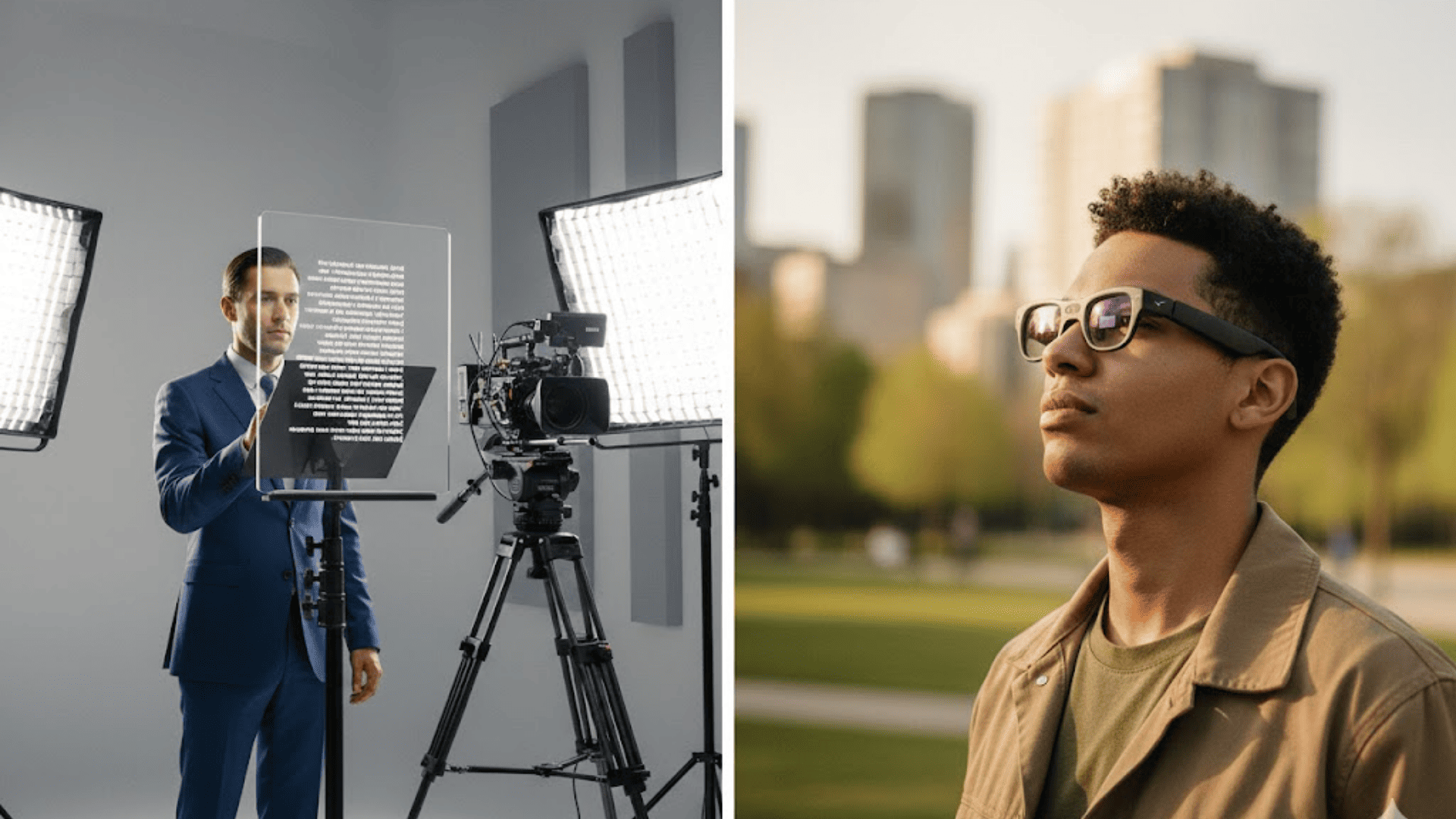
In the video production industry, a clear teleprompter usually refers to a prompting system consisting of a high-definition glass reflector and a display device. Its working principle is relatively straightforward: the camera is positioned behind the glass, while a screen below projects text onto the glass. The glass reflects the image from the screen only to the speaker, while the camera shoots through the glass to capture the speaker's face. This allows the speaker to look directly into the lens while naturally reading the content on the screen.
The advantage of a traditional teleprompter lies in its large viewing area, allowing the font to be scaled very large so speakers with average vision can read smoothly from a distance. Furthermore, the clear reflective surface is almost never captured by the lens; under proper lighting conditions, the audience cannot see any trace of the equipment. This solution has been used for years in television news, presidential speeches, and high-spec live broadcasts, proving to be extremely reliable in fixed-position and well-controlled environments.
What Are Smart Glasses As A Prompting Tool
Unlike a teleprompter mounted in front of a camera, the logic of smart glasses as a prompting tool is closer to a portable display. Through near-eye display and optical waveguides, they overlay text directly onto the wearer's field of vision; the script is no longer fixed in front of the lens but follows your eyes. Users can import scripts via a mobile app, adjust font size and scrolling speed, and then sync the content to the glasses.
Typical cases of this type of AR glasses teleprompter have already appeared across multiple products. Rokid has demonstrated in official tutorials how to import drafts via a mobile app, enable smart scrolling, and control the pace using the touchpad on the glasses or a Bluetooth controller. The glasses can recognize sentences already spoken and automatically scroll forward, allowing the speaker to complete their output smoothly without intentional manual operation. Some users have directly used the RayNeo X3 Pro to replace traditional iPad teleprompters for video recording. After importing text via the RayNeo AR APP, the content is displayed in front of the eyes with adjustable position and size. The system can scroll intelligently based on speaking speed, allowing the speaker to maintain a natural expression when facing a camera or a live audience.

Key Differences Between Clear Teleprompters And Smart Glasses
When clear teleprompters and smart glasses are placed on the same decision-making table, many content creators and enterprise users prioritize the actual shooting environment and degree of mobility over technical specs. The differences between the two in portability, eye contact naturalness, and indoor/outdoor adaptability form the core of the selection path.
Portability And Setup Requirements
The advantage of a clear teleprompter lies in its stability, but the cost is the amount of equipment and setup time required. Whether it is a full-sized professional teleprompter array or a relatively compact tablet-based version, it must be fixed to a camera mount, with the shooting height, lens, and glass positions all finely tuned before a full focus and test run. While this is perfectly fine for fixed studio shoots—and even provides a sense of reliability—it significantly increases preparation time and carrying burden for mobile in-car interviews, outdoor vlogs, or teams that frequently change camera positions.
Smart glasses, on the other hand, house the prompting function within the wearer's own device. For individual creators accustomed to shooting with a phone or a small camera, setting up a glasses-based teleprompter is almost as simple as putting on a pair of glasses. Once the script is imported, whether recording a short video at a desk or moving through an exhibition, the prompting function can be called up instantly. All-in-one AR glasses like the RayNeo X3 Pro concentrate computing and display within the frames and temples. After powering on, the teleprompter app is ready for use without any additional mounting brackets, which significantly lowers preparation costs for YouTubers or livestreamers who need to produce short-form content frequently.
Eye Contact Naturalness And Audience Perception
For many speakers, the naturalness of eye contact is a major concern. The advantage of a clear teleprompter is that the script and the lens are in the same direction, allowing the speaker's eyes to remain fixed on the center of the lens. From the audience's perspective, there is almost no visible eye wandering, which is particularly important in serious news or formal speeches.
The performance of a smart glasses teleprompter depends on the optical design. Some user feedback indicates that when text is displayed too high or to the side of the field of vision, the speaker's eyes may drift slightly from the lens center, which can be seen by the camera. However, the latest generation of waveguide-based AR glasses allows the text position to be finely adjusted near the center of vision to mitigate this issue. In its experience with the RayNeo X3 Pro, ZDNET mentioned that the teleprompter app places text at an appropriately elevated position, displaying it near the natural line of sight. This allows the speaker to read the script by looking up slightly while maintaining a more natural gaze for the camera. Creators sensitive to camera presence can find a text height that works for them through trial recordings, maintaining a sense of authentic dialogue without sacrificing the security of having a script.

Flexibility In Indoor And Outdoor Environments
Clear teleprompters are naturally suited for indoor environments with controlled lighting. In bright outdoor scenes, the reflective glass is prone to interference from direct light, requiring hoods and precise lighting to ensure text contrast. Combined with the bulk of the equipment, it is rare to see a full teleprompter array set up on a rainy street or at a temporary outdoor venue.
The prompting capability of smart glasses offers more environmental flexibility. Since the text is presented directly in a near-eye display, as long as the optical design provides enough brightness and contrast, the wearer can read the script reliably outdoors. This is a significant advantage for creators who need to film at trade shows, on city streets, or while travelling abroad. The RayNeo X3 Pro uses high-brightness waveguide displays with a typical brightness of approximately 3,500 nits and a peak brightness of 6,000 nits, meaning text remains clearly visible even when recording in front of large glass curtain walls.
What Are the Advantages And Limitations Of Each Tool
Comparing the prompting capabilities of clear teleprompters and smart glasses reveals that the true value lies not in a simple list of pros and cons, but in understanding the boundaries behind their respective technical paths. When you place them in specific scenarios, the differences emerge naturally.
Strengths Of Traditional Teleprompters
The greatest strength of a traditional teleprompter is stability and predictability. For television stations, government press conferences, and large-scale corporate annual meetings, each speech typically involves fixed camera positions and a professional photography team, controlled lighting, and a sufficient budget for equipment transport and setup. In this environment, a clear teleprompter allows the speaker to have a massive readable area from a distance, displaying entire paragraphs in large fonts to avoid frequent scrolling or line-skipping.
Furthermore, in live broadcast scenarios with multi-camera switching, multiple teleprompters can be arranged according to each camera angle. The speaker switches their gaze based on lighting cues or director signals, providing the audience with a stable and professional presentation. This highly standardized process makes traditional teleprompters remains irreplaceable in the mainstream broadcasting industry.
Strengths Of Smart Glasses Prompting
The advantage of smart glasses as a prompting tool lies in portability and privacy. Whether a YouTuber is filming a video in a corner of their home or an entrepreneur is recording a quick clip outside a roadshow venue, the script follows the person rather than the equipment. This experience is particularly vital for creators who need to produce short-form videos, livestreams, and mobile content at a high frequency.
In real-world user discussions, people often ask how to choose AR glasses suitable for use as a teleprompter. Core requirements include an appearance that is as close to ordinary glasses as possible, not looking out of place from the audience's perspective, and the ability to read text steadily during a speech. The teleprompter function of the RayNeo X3 Pro allows users to write or import scripts via a mobile app, while the glasses display the text in front of the field of vision in a clear, distance-adjustable manner. The system can even scroll intelligently based on the speaker's pace, reducing the need for manual control. For those who frequently use scripts for internal company sharing, online roadshows, and event hosting, embedding prompting capabilities into glasses is clearly more aligned with a high-frequency usage rhythm than setting up equipment every time.
While the 2026 best smart AR Glasses RayNeo Air 4 Pro is positioned more toward personal cinema and content consumption, its 1920 by 1080 per-eye resolution and HDR10 support, combined with a high refresh rate, provide very fine text display for long-form script reading indoors. When a speaker needs to rehearse, edit, and preview a manuscript for an extended period, this comfortable reading experience is much friendlier than a simple smartphone screen. It also showcases how-glasses-that-display-video-are-changing-desktop-work by working alongside computers and phones to serve as a multi-device collaborative script terminal.
Technical Constraints And Learning Curve
Every tool has its boundaries. The learning curve for a clear teleprompter is relatively short; a speaker only needs to adapt to the text scrolling speed and line spacing settings to read naturally. However, equipment setup and maintenance require a certain level of professional skill, especially in multi-camera live broadcasts and complex lighting environments.
The limitations of smart glasses are more evident in the sense of coordination during initial use. Some users feel that their gaze and head movements need to be recalibrated when first trying a glasses-based teleprompter, requiring a few rehearsals to establish a natural rhythm. Additionally, because the text is displayed in the near-eye area, one must be more cautious when choosing font size and scrolling speed, as settings that are too fast or too dense can easily lead to visual fatigue.

Viewed as a whole, industry research indicates that the overall smart glasses market is growing at a compound annual growth rate of approximately 27.5 percent. The market size was about 5.984 billion dollars in 2024 and is expected to expand significantly by 2031. Behind this trend is the increasing consumer acceptance of wearable information displays and hands-free content consumption. While teleprompting and text reading are just niche applications, they are appearing more and more frequently in content creation and corporate communication.
Which Prompting Tool Is Best For Different Scenarios
Before making a choice, it is helpful to ask yourself a few simple questions. Does your content creation happen more at a fixed camera position or in mobile scenarios? Do you care more about ultimate professional lens presentation or high-frequency, flexible expression opportunities? Is this for a one-time major event, or are you someone who speaks to a camera every week? The answers to these questions will naturally point toward either a clear teleprompter or a smart glasses prompt.
Content Creators And YouTubers
For content creators and YouTubers, the shooting environment is usually highly variable. Many need to record deep-dive videos at a desk, shoot vlogs on the road, or even film in overseas cities. For them, clear prompting is not a one-off necessity but a continuous productivity tool.
In this case, a traditional teleprompter can serve as the infrastructure for fixed studio recording, ensuring stable output for long-form and script-heavy content. However, when mobility and quick scene switching are required, the value of a smart glasses teleprompter becomes evident. Products like the RayNeo X3 Pro allow scripts to float directly in front of the creator. When recording in a home studio or a coworking space, they can simply set up a camera or phone, put on the glasses, and start recording without rebuilding stands and glass. Some users who have used the X3 Pro for a while have shared that they now prefer replacing their original iPad teleprompter setups with the X3 Pro for YouTube recording, significantly simplifying the equipment workflow while keeping their gaze natural.
Corporate Presentations And Public Speaking
In corporate internal sharing and public speaking, the choice of prompting tool often needs to balance professional image with operational cost. Large annual meetings, strategic launches, and media briefings are better suited for clear teleprompters. Using fixed camera positions and multi-teleprompter arrays in the main venue ensures that key speeches avoid obvious errors while maintaining a sense of gravity.

However, in more frequent internal sharing, small-scale roadshows, and online meetings, the flexibility of smart glasses prompting is more attractive. Corporate executives in meeting rooms or livestreaming studios can conduct multiple rounds of reviews and recordings at any time as long as the script is ready in the glasses, without depending on a full broadcast team. For entrepreneurs who frequently perform roadshow reports, this portable script itself provides a sense of security. The RayNeo X3 Pro, combining high-brightness display, spatial positioning, and teleprompter functionality, offers a ready-to-use lightweight solution for these scenarios, allowing people to maintain consistent delivery quality across different cities and meeting rooms.
Field Reporting And Mobile Production
News reporters, documentary teams, and production crews who need to shoot at multiple outdoor locations often have stricter equipment requirements. Using a clear teleprompter in these scenarios is limited by transportation conditions and setup time, generally appearing only in large broadcast trucks or fixed media points.
Mobile reporting and on-site short video production are perfectly suited for smart glasses teleprompters. Reporters can quickly confirm key points of a draft on-site, send outlines or full scripts to the glasses, and speak while looking into the lens without holding papers or frequently looking down at a phone. To some extent, this method is more intuitive than traditional earpieces, especially for reporting scenarios that require precise citation of data and figures. In these situations, the waveguide display performance of the RayNeo X3 Pro in bright outdoor light, along with integrated features like camera recording and real-world translation, makes it not just a teleprompter, but also a practical on-site recording and information assistance device.
Conclusion
Choosing between a clear teleprompter and smart glasses is about choosing a way of speaking. A clear teleprompter sets up a highly controlled stage for you, ensuring that every word lands in its preset rhythm through precise lighting and camera positioning. Smart glasses, on the other hand, act more like an invisible helping hand. Beyond prompting, these devices are becoming a central part of a digital nomad lifestyle, empowering creators and professionals to work and communicate effectively from anywhere in the world. As a mature option, the RayNeo X3 Pro centers on its high-brightness waveguide display and practical teleprompter functionality to keep your script firmly within your line of sight. It supports you through your delivery in any corner where you suddenly need to express yourself.
FAQ
How to make a teleprompter transparent?
Traditional clear teleprompters use specialized beamsplitter glass. One side reflects the image from the prompting screen to the speaker, while the other side allows the camera to shoot through the glass with almost no loss in quality. To achieve visual transparency, you need to select high-quality optical glass, control the reflection and transmission ratios, and avoid direct light hitting the glass surface in the shooting environment.
How to tell if someone is using a teleprompter?
Audiences can sometimes tell if a teleprompter is being used by whether the speaker's gaze remains consistently fixed on a specific area. For clear teleprompters, if the lighting is set up correctly and no reflections or glass edges are visible in front of the lens, it is difficult for viewers to see the device directly; they can only infer its use through the highly stable eye contact and rhythm. Signs of a smart glasses teleprompter are even more subtle. Sometimes, from a side angle, one might see a slight upward or lateral movement of the speaker's eyes, but viewers from the front often find it difficult to detect the specific device.
Can I use my phone as a teleprompter?
Yes. Many content creators use phones with prompting apps by placing the phone below the lens or on a stand as a simple teleprompter. Many also choose to place the phone inside a clear teleprompter rig to read text via reflection. However, the limitation of this method is that the eyes typically cannot look perfectly into the center of the lens, making it better suited for vlogs or instructional videos where gaze requirements are less strict.
Can the audience see the teleprompter?
Under professional lighting and high-quality glass conditions, the audience usually cannot see the surface of a clear teleprompter directly in the frame. Live audience members standing to the side might catch a glimpse of some equipment edges, but from a front-on perspective, the device is almost invisible. A smart glasses teleprompter is completely hidden inside the eyewear; the audience will only see you wearing glasses and will not see any script text.
Can you use smart glasses as a teleprompter?
Yes. Several smart glasses models have integrated teleprompter or text display apps. Users can import scripts via their phones and have the text presented in their field of vision with adjustable size and scrolling speed. The teleprompter function of the RayNeo X3 Pro has received positive feedback in media reviews, with testers using it to replace traditional tablet teleprompters for video recording. The text displays clearly in front of the eyes, and the system can scroll intelligently based on speaking speed, reducing the burden of manual control.
What smart glasses are good for reading text?
Smart glasses suitable for reading text typically possess a few key characteristics: near-eye display resolution high enough for clarity, brightness and contrast sufficient for different environments, clear font rendering, and the ability to flexibly adjust text position and size. With its binocular full-color MicroLED waveguide display, approximately 30-degree field of view, and high-brightness output, the RayNeo X3 Pro is excellent for reading, prompting text and real-time subtitles in both indoor and outdoor scenarios.
Share:
What is Field of View (FOV)?
Cloud Gaming Anywhere: How AR Display Glasses Are Changing Portable Gaming