

$429.00

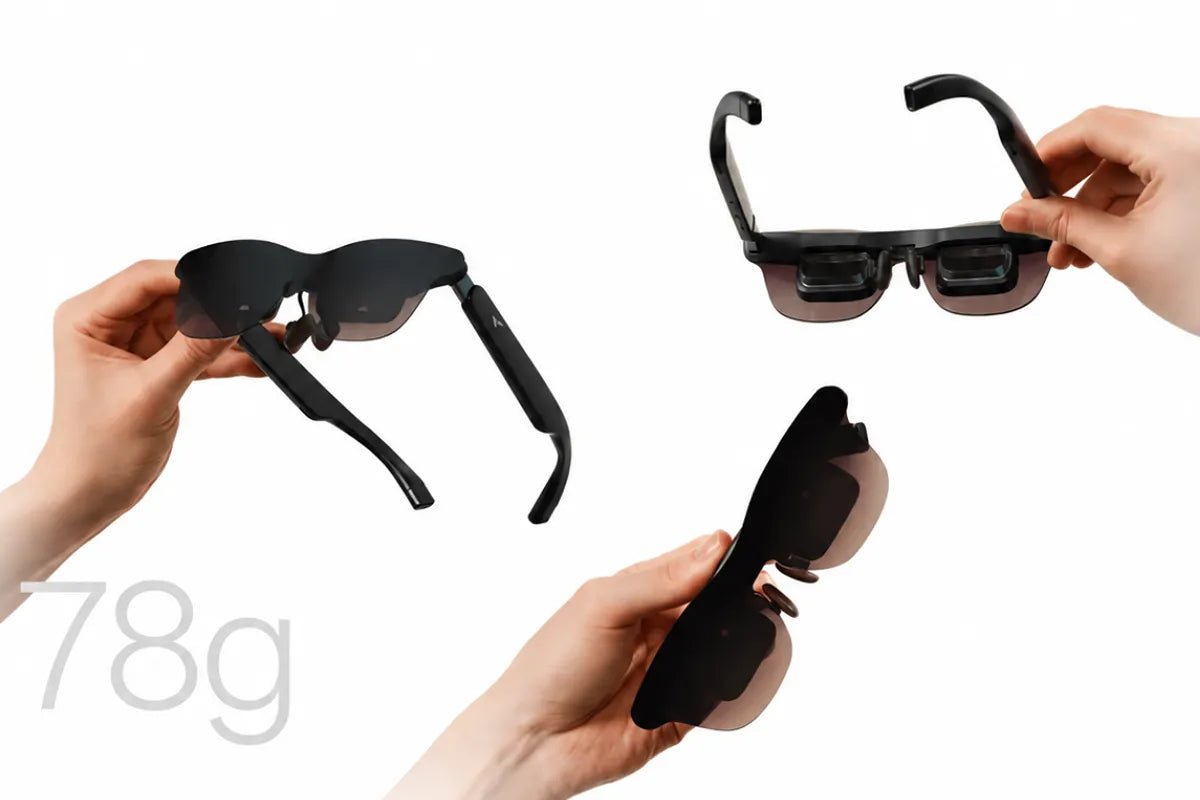
People looking for smart eyewear usually want to seamlessly blend digital content with the physical world. This guide focuses on how our current RayNeo lineup breaks down for this need, helping you find the perfect match whether you want a massive virtual screen or a smart everyday assistant.
We categorize our models to make your choice straightforward. Our AR glasses are built specifically to deliver large virtual screens for entertainment. If you need an ultra-lightweight companion focused on notifications and translation, our AI glasses are the right fit. For those wanting smart environmental analysis paired with a transparent display, we offer a hybrid AI+AR category.
Here is a quick overview of our current lineup to help you find the best starting point.
| Model | Price | Weight | Display / Camera | Best For |
|---|---|---|---|---|
| RayNeo GT Max | $399 | 78g | Up to 307" virtual screen / No camera | Premium immersive movie watching and gaming |
| RayNeo GT | $299 | 68g | Up to 231" virtual screen / No camera | Portable high-resolution entertainment |
| RayNeo X3 Pro | $1,299 | 76g | Transparent heads-up display / 12MP camera | Spatial computing and real-world AI analysis |
| RayNeo iO | $449 | 33g | Single-color heads-up display / No camera | Everyday productivity and translation |
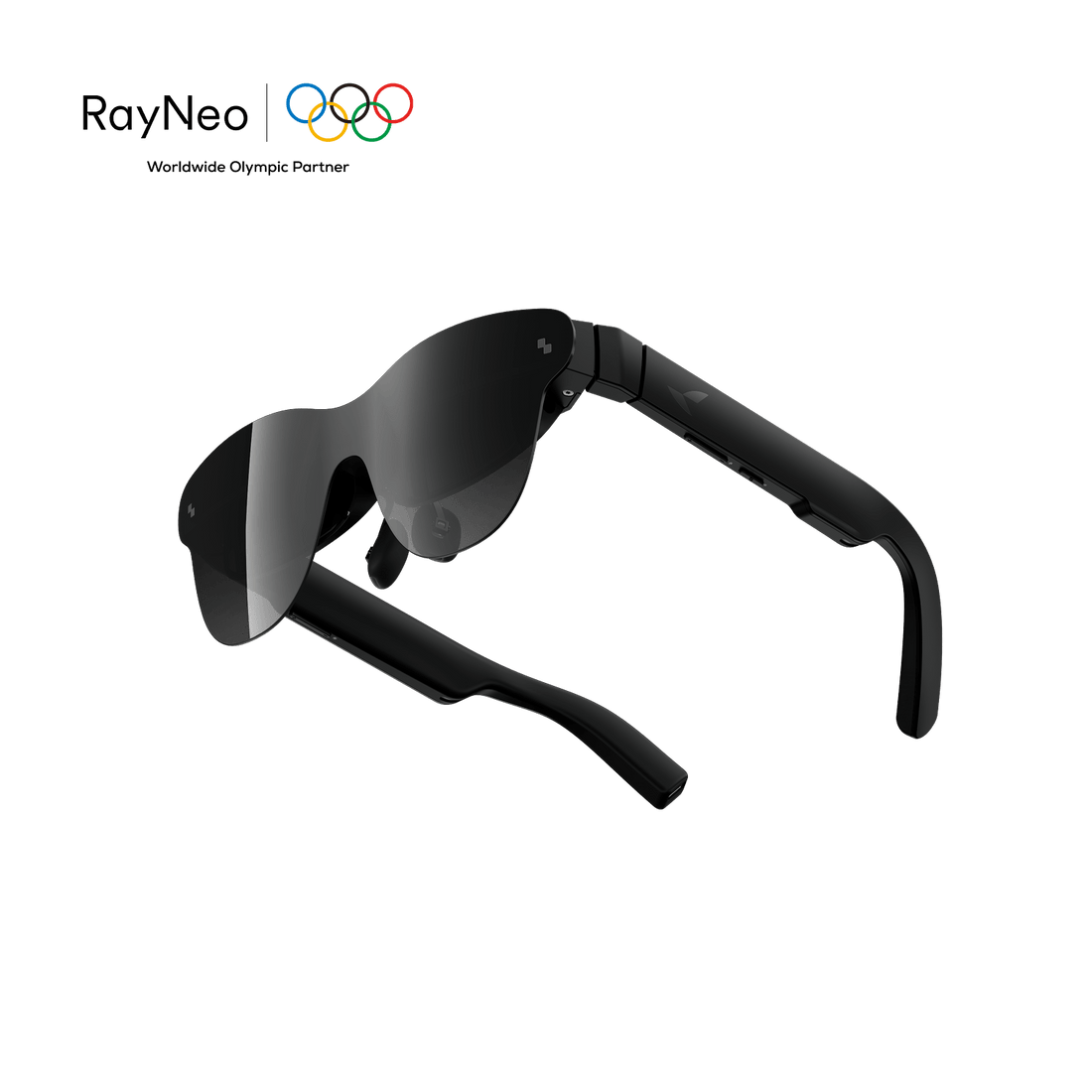
The RayNeo GT Max is available for $399 (please note that pricing can adjust over time, so check the product page for the latest). We designed this model for absolute visual immersion. It uses a 0.6-inch SeeYa Micro-OLED panel to project a default 267-inch virtual screen with a wide 59-degree field of view. The non-Pinned viewing mode reaches up to 1200 nits of brightness, keeping the display clear even in well-lit environments.

Audio is driven by four speakers with immersive spatial sound tuned by Bang & Olufsen. Because we use an open-ear audio design, people sitting very close to you in quiet spaces might hear your media at higher volumes.
We offer the GT Max in three sizes based on your interpupillary distance, which is the physical space between your pupils. Choosing the correct size ensures the optics align perfectly with your eyes, reducing visual fatigue during long movie marathons.
To keep the GT Max as light as possible, we designed it without an internal battery. It draws power directly from your connected phone, laptop, or console via a USB-C cable, which will consume some of the host device's battery during use.
Because the GT series requires a host device for power and video, connectivity is a key consideration. The glasses connect directly to devices that support USB-C DisplayPort Alt Mode, such as MacBooks from 2015 onwards, compatible Android phones, and USB-C handhelds. Windows laptop compatibility depends on the specific computer's USB-C port specifications. For smartphone users, the iPhone 15, 16, and 17 series support direct connections, and this direct link is required if you want to use the AI-powered 2D-to-3D conversion tool. We do not currently offer a confirmed adapter solution for the iPhone 16e, 17e, or Air models, as these specific phones lack direct video output support.
If you want similar high-end features in a more portable package, the RayNeo GT is available for $299. Weighing only 68 grams, it projects a default 201-inch screen with a 46-degree field of view. You still get the same Full HD resolution, native 3D viewing, and 1200 nits of brightness in non-Pinned mode as the Max model.

This model comes with a fixed 64mm interpupillary distance. We recommend the GT if your eyes fall near this measurement, while those needing personalized alignment will find the GT Max a better fit. Just like the Max, the GT relies entirely on your connected host device for video signals and power to maintain its ultra-lightweight profile.
The RayNeo X3 Pro is our flagship AI+AR model, priced at $1,299. We built this for active interaction with the real world, featuring a visible 12-megapixel Sony camera on the front frame. This allows the integrated Google Gemini AI to analyze your environment. You will notice a small LED near the camera that lights up during recording to clearly indicate when it is active.

The display uses a Binocular Diffractive Waveguide paired with a Firefly Optical Engine. In practical terms, this microscopic lens structure routes light directly into your eye to create a transparent interface. It overlays digital information onto your surroundings without blocking your physical view.
The premium capabilities make this a significant investment for those who need spatial computing. For offline use, it provides basic phrase and menu translation in English, Chinese, and Spanish. Full conversational translation across all supported languages is readily available when you have an active internet connection.
Available for $449, the RayNeo iO provides a streamlined approach for daily tasks. Categorized as AI Glasses, the iO does not feature a camera. Instead, we focused on delivering a discreet, single-color green heads-up display for mobile notifications, schedule updates, and real-time translated captions.

The iO includes its own internal 240mAh battery for all-day wear. It offers up to two days of battery life and up to 6.2 hours of continuous translation, so you can leave the cables behind.
Because we focused the iO on everyday AI and text-based scenarios, the minimal display is optimized for text and icons. If your goal is watching videos or playing games, our GT series will be a much better fit for your entertainment needs.
How do I choose between AR, AI, and AI+AR glasses? Your choice depends entirely on your primary goal. Select our AR series (GT and GT Max) if you want a massive virtual screen for immersive movies and gaming. Choose our AI series (iO) for a lightweight, cable-free assistant focused on text notifications and translation. If you need powerful environmental analysis with a transparent display, our AI+AR model (X3 Pro) is the right path.
Can I use these devices if I already wear prescription glasses? Yes, we provide prescription solutions across our lineup so you do not have to wear two pairs of glasses at once. For the GT series and X3 Pro, we partner with Lensology (starting at £95) for custom lenses that clip directly into place. For the iO, we offer a dedicated version with built-in prescription lenses starting at approximately $608.
Do these glasses replace a living room TV for group movie nights? We designed the display to provide a completely private viewing experience tailored specifically for the wearer. Only the person wearing the glasses can see the virtual screen. This makes them an excellent solution for solo entertainment on airplanes or in bed, while your living room TV remains the choice for shared family viewing.
From upgrading your commute with a massive private theater to a smart assistant that simplifies your workday, there is a RayNeo device built for your lifestyle. Explore the specific product pages to check current pricing and find the perfect match for your daily routine.





Share:
What Are the Best 3D Glasses for Watching Movies and Gaming?
Turn Your Sofa Into a Private Theater With Home Cinema AR Glasses