

Sale price$399.00
Regular priceReg. $429.00
Save $30.00


Watching a movie or a show while lying down breaks most screens in the same handful of ways. A phone held above your face tires your arm out fast. A tablet needs a stand that doesn’t work well on a mattress. Rolling onto your side tilts the whole picture. And whatever you’re watching either needs headphones tangled in your pillow or speakers loud enough to wake up anyone next to you.
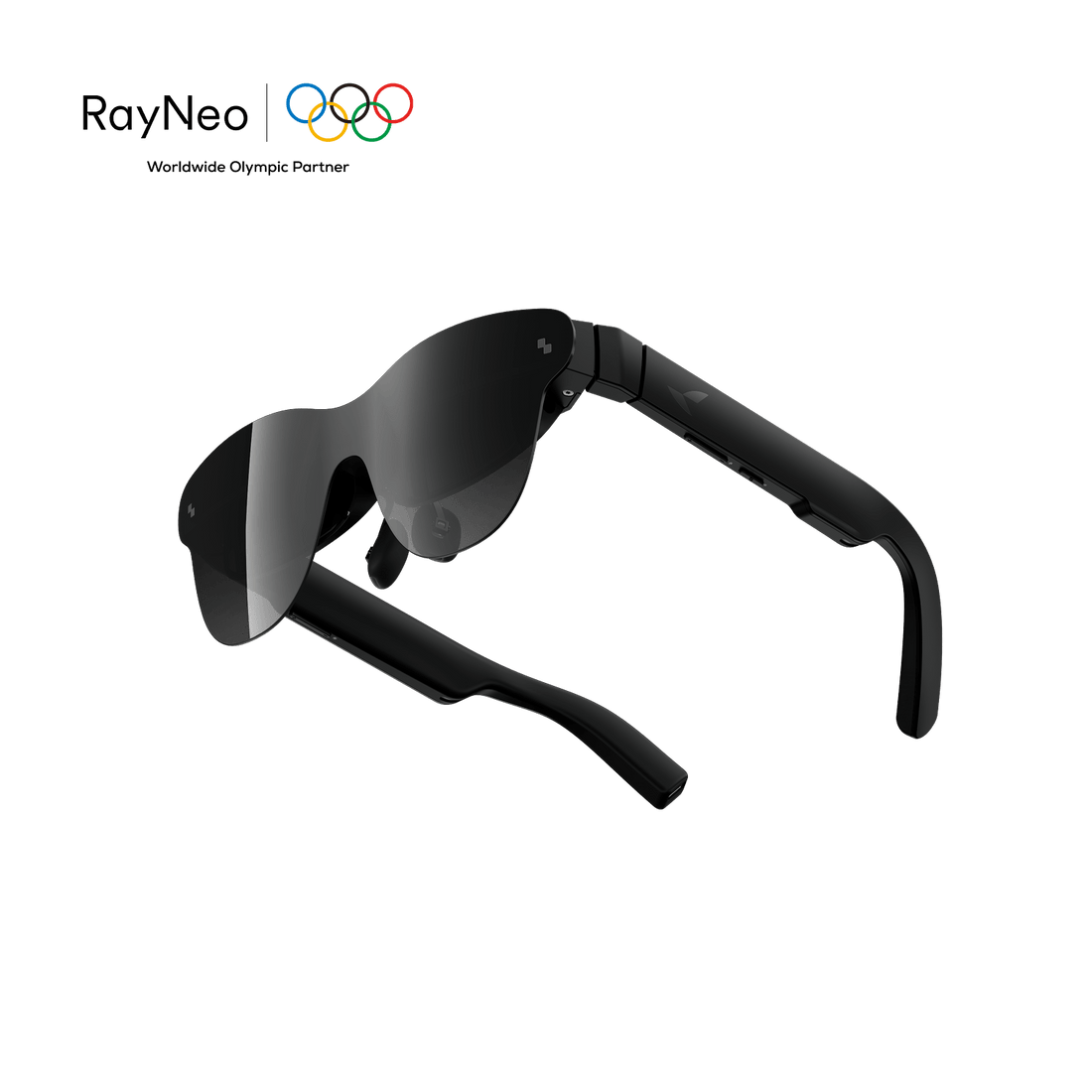
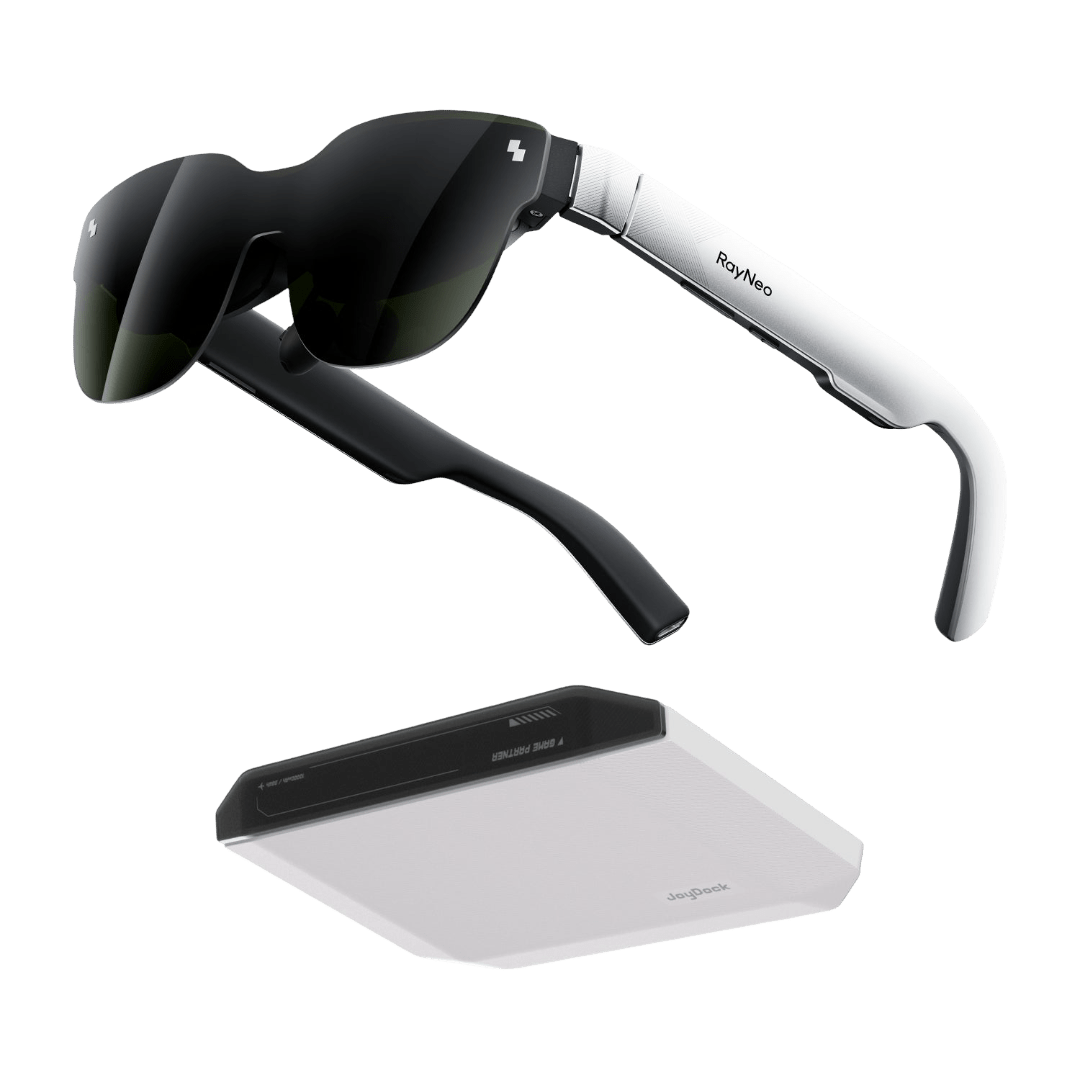
AR glasses solve the arm and tilt problems by putting the screen on your face instead of in your hand, but not every pair of AR glasses is built with lying down specifically in mind. The RayNeo GT Max has a set of spatial modes, a graduated fit system, and a quieter audio setting that line up well with bed use. Here’s how each one addresses a specific pain point, and where the real limits are.

Most virtual-screen glasses anchor the picture to something. The question is what, and RayNeo’s three spatial modes each anchor it differently.
For anyone who changes position in bed, whether that’s a full roll from back to side or just shifting on a pillow, Follow is the mode built to keep the screen with you. Steady is worth testing as an alternative if you want less head-tracking movement than Follow, though RayNeo doesn’t frame it around lying-down use specifically. Pinned fits staying in one fixed position, such as lying flat on your back and treating the display like a screen hung in front of you rather than something that moves with your head.
Switching between spatial modes happens on the glasses themselves, so you can change modes without reaching for your phone once you are settled in.
When you’re sitting upright, glasses that sit slightly off-center on your nose are a minor annoyance. Lying on your side, on a pillow, with the frame’s own weight pulling at a different angle, a poor fit becomes the difference between a sharp image and a blurry one, because your eyes need to line up with the optics.
GT Max addresses this with three IPD (interpupillary distance) sizes rather than one fixed size:
| Size | IPD range |
|---|---|
| S | Under 64mm |
| M | 64mm to 67mm |
| L | Over 67mm |
RayNeo publishes an IPD measurement tool (ipd.rayneo.com) to help pick the right SKU before ordering, since GT Max is sold as three separate size variants rather than one adjustable frame. On top of the sized frame, GT Max’s nose pads also come in S, M, and L heights, which RayNeo’s FAQ recommends swapping to improve vertical eye alignment.

The standard RayNeo GT skips this step: it uses a fixed 64mm IPD, and RayNeo’s FAQ describes adjusting the nose pads and wearing position to help center the image. That works fine for a lot of faces, but if your interpupillary distance is well outside the 64mm range, GT Max’s sized-SKU approach gives a more precise starting point.
Weight matters too. GT Max is 78g and GT is 68g. A typical pair of everyday eyeglasses weighs somewhere around 20 to 40 grams, so both models carry more weight, and when you rest your head sideways part of that weight presses into whichever side is down. Two things work in your favor here: the frame’s weight is spread across the temples and adjustable nose pads rather than concentrated on the bridge, and the S/M/L IPD sizing keeps the lenses centered so you are not compensating with head position. If every gram counts for you, GT saves 10g for $100 less; if you want the wider 59° view and sized-to-you optics, GT Max is the one built for it.
Both models support prescription lenses through RayNeo’s official partner Lensology, which fits a prescription insert into the frame. Insert pricing and lead times are set by Lensology, so check current options there when you order.
GT Max uses open-ear speakers tuned by Bang & Olufsen, not sealed earbuds, which is relevant in bed because sound carries outward: RayNeo’s own product FAQ states that at roughly 1.5 meters the audio becomes hard to make out clearly, though at close range (like next to you in the same bed) it can still be audible.
For quieter late-night viewing, a long press on the volume rocker cycles between three audio settings: Standard, Whisper Mode 2.0, and Spatial Surround (Whisper Mode can also be toggled through the RayNeo XR App under Glasses Settings). RayNeo’s FAQ describes Whisper Mode as designed to “reduce audio leakage in quiet or public environments,” which is the setting to reach for when someone next to you is trying to sleep. It’s still an open-ear design rather than a sealed, private-listening experience, so if the person next to you is a light sleeper, that’s worth knowing going in rather than discovering at midnight.
Two separate things affect how a bright screen feels a few inches from your eyes in a dark bedroom: the display mode and the brightness level.
GT Max includes four display modes: Standard, Movie, Eye Protection, and Office, though RayNeo’s product pages don’t detail exactly what changes under the hood in Eye Protection mode.
Brightness also splits by spatial mode, per RayNeo’s specs: Pinned mode runs at 336 nits, while Follow and Steady are rated at up to 1,200 nits of perceived brightness. If you’re staying in one position long enough to use Pinned mode (flat on your back, not turning your head much), the lower figure is worth knowing about for a blacked-out room. If you’re using Follow or Steady instead because you shift position often, those modes are rated at the higher brightness level.
On top of that, GT Max uses OptiCare’s 3840Hz PWM hybrid dimming, which RayNeo describes as maintaining ultra-high-frequency dimming even in low-light environments to eliminate screen flicker at the source. The GT series page lists three TÜV SÜD certifications behind this: Eye Comfort, Low Blue Light, and Flicker Free.

GT Max connects over USB-C using DisplayPort Alt Mode, directly to an iPhone 15, 16, or 17, an Android phone like the Galaxy S8 through S25, an iPad (10th generation or newer), or a MacBook from 2015 or later. iPhone 16e, 17e, and Air don’t support this direct connection. Older Lightning devices need Apple’s Digital AV Adapter, which isn’t included.
RayNeo’s FAQ is direct about power: “The connected device powers the glasses and processes video, so slight warmth and increased battery consumption are normal.” In practice, that means your phone’s battery drains faster while you’re watching, which matters more in bed than on a couch near an outlet.
The included USB-C cable is what connects you to your phone, so give it some slack before you get settled: keeping the phone on the bed near your pillow, rather than on a nightstand across the room, gives you more room to roll from your back onto your side without pulling at the connector.
Two settings in the RayNeo XR App can help stretch the phone’s battery further if an outlet isn’t within easy reach. Eco Mode, toggled from the More menu in the XR Space video player, dims the phone’s screen under a black overlay while video keeps playing on the glasses. Auto-Dim Brightness, toggled under Immersive Casting settings, adds a dark overlay to the phone’s screen after 10 seconds of inactivity while screen mirroring continues normally. Both dim the connected phone’s display; neither one dims or pauses the glasses themselves.
| RayNeo GT Max | RayNeo GT | |
|---|---|---|
| Price at the time of writing | $399 | $299 |
| Weight | 78g | 68g |
| IPD | S / M / L (measured per face) | Fixed 64mm |
| Field of view | 59° | 46° |
| Virtual screen size | 267” cinema display (227”/307” also available) | 201” cinema display (136”/231” also available) |
| Spatial modes | Follow, Steady, Pinned | Follow, Steady, Pinned |
| Display modes | Standard, Movie, Eye Protection, Office | Standard, Movie, Eye Protection, Office |
| Whisper Mode 2.0 | Yes | Yes |
| OptiCare 3840Hz | Yes | Yes |
Both models share the same spatial modes, display modes, audio settings, and eye protection technology, meaning the bed-comfort features described above apply to either one. The difference is fit precision and weight: GT Max’s sized IPD system is worth the extra $100 if your interpupillary distance falls outside the standard 64mm range, or if the wider 59° field of view and larger screen sizes matter more to you than shaving off roughly 10g of weight. GT is the lighter, less expensive option for a face that fits the fixed 64mm design well.
Will watching video in bed with GT Max drain my phone’s battery fast?
Do I need a Pocket TV Pro to use GT Max in bed?
Can I wear GT Max or GT if I already wear prescription glasses?
What happens if I fall asleep with GT Max or GT still playing?
For watching video lying down, the setting that matters most is Follow mode, since it’s the one built to move the screen along with your head rather than anchor it to a fixed point, which is what keeps the picture in front of you if you roll from your back onto your side. Steady is worth testing as an alternative if you want less head-tracking movement than Follow, and Pinned suits staying in one fixed position, flat on your back, where you’d rather the picture sit still like a hung display than track small head movements. RayNeo GT Max pairs those spatial modes with a sized IPD system, an Eye Protection display mode, OptiCare 3840Hz flicker-free dimming, and Whisper Mode 2.0 for quieter late-night audio, all features that map directly onto the specific problems bed viewing creates. If a lighter frame and lower price matter more than IPD precision, RayNeo GT carries the same core comfort features at 68g and $299.





Share:
The Best AI Glasses Right Now: What to Look For in September 2026
Which Glasses Have a HUD Display, and How Useful Is It in Real Life?