
Table of Contents
When watching a movie, the spatial awareness and immersion provided by surround sound are objectively superior to traditional stereo. For action movies and blockbusters, you can hear the difference within the first five minutes. This is a consensus across user forums and professional reviews. Today, we will systematically break down the pros and cons of surround sound versus stereo. We will cover channel structures, room layouts, and immersion levels, all the way to the real-world experience of wearable devices. Combined with the 2026 developments in AR glasses, this guide will help you make the right audio decision for your living room and commute.
What Is the Difference Between Surround Sound and Stereo?
What are the differences between stereo and surround sound in terms of channel count, sound positioning, and hardware complexity? In this section, we will first define stereo and surround sound. Then, we will compare specific channel and device configurations to provide a clear technical foundation.
What Is Stereo Sound?
The core feature of stereo sound is that it uses only two independent channels, left and right. It creates basic sound positioning through differences in volume and timing between these two sides. This allows you to feel that a sound is coming from the left or right side of the screen. Most TVs, laptops, mobile speakers, and entry-level soundbars use a two-channel structure. The original multi-channel mix of a movie is downmixed to stereo output at the playback end. This preserves dialogue and main sound effects but sacrifices environmental envelopment.
The advantage of using stereo for movies is that the sound is clean, dialogue is clear, and the setup is simple. The downside is a relatively flat soundstage. Footsteps from behind or ambient surround sounds are often compressed into the same plane. On large-screen TVs, you will clearly feel that the picture has more spatial depth than the sound.

What Is Surround Sound?
The core of surround sound is distributing audio around you through multiple independent channels to create an immersive soundfield. This spatially reconstructs the soundscape envisioned by the director in the mixing room. A traditional 5.1 system includes left, right, center, left surround, right surround, and an independent low-frequency LFE channel. A 7.1 system adds rear surround channels to make sound movement from behind more continuous.
Advanced Dolby Atmos and DTS:X technologies introduce height channels. They use ceiling or up-firing reflective speakers to position sound in 3D space. Effects like a helicopter flying overhead or rain pouring from above rely on this height information and object-based mixing. The most common feedback is that the moment you hear a bullet fly over your head for the first time, you finally understand what a true cinematic feel means. This type of reaction is typical after upgrading to an Atmos soundbar or adding ceiling speakers.
Key Differences in Audio Channels and Setup
The differences between stereo, 5.1, 7.1, and Atmos in terms of channel count and system structure can be summarized in a simple table.
|
System Type |
Channel Structure |
Typical Equipment |
Spatial Positioning Capability |
|
Stereo 2.0 |
Left, Right |
Built-in TV speakers, basic soundbars, laptops |
Basic left-right imaging; clear dialogue; limited surround effect. |
|
5.1 Surround |
L, R, Center, L Surround, R Surround, plus independent LFE |
Traditional home theater sets, mid-to-high-end soundbars with wireless rears |
Distinct front-to-back envelopment; more precise positioning for explosions and ambient sounds. |
|
7.1 Surround |
5.1 plus two additional rear surrounds |
Large living rooms, dedicated media rooms |
More continuous soundstage in large spaces; finer detail in surround movement. |
|
Dolby Atmos / DTS:X |
5.1 or 7.1 plus height channels; up-firing or ceiling speakers |
Atmos soundbars, in-ceiling speakers |
3D spatial imaging; realistic overhead information like planes flying by or falling rain. |
From an engineering perspective, the advantage of surround sound is not that it is louder. Instead, more independent channels allow for finer spatial control. This is especially clear when comparing 5.1 and 7.1 systems.
How Does Surround Sound Work for Movies?
In this section, we combine professional mixing workflows with typical home theater setups. We explain why many movie fans invest heavily in a dedicated center channel and surround speakers despite the cost and installation effort.
Multi-Channel Audio Explained
For most films, sound engineers mix audio within a 5.1 or 7.1 channel framework. This process involves several key steps:
-
Center Channel: Used to centralize dialogue.
-
Left and Right Channels: Handle the main music score and primary sound effects.
-
Surround Channels: Deliver environmental atmosphere and directional movement.
-
LFE Channel: Dedicated to low-frequency effects like explosions and deep ambient rumbles.
In object-based audio systems like Dolby Atmos, individual sounds are treated as objects in 3D space. The playback device dynamically assigns these objects to available speakers based on your room layout. This helps recreate the director's intent regardless of your specific room shape.
When you use an Atmos-enabled soundbar with the right content, you get overhead height effects even in small rooms. Elements like rain, wind, and city noise surround you naturally instead of feeling stuck to the screen. Many enthusiasts note that upgrading to height channels significantly improves immersion in slow-paced, atmospheric genres like sci-fi and mystery.
Speaker Placement and Sound Positioning
In a home theater, speaker placement determines the quality of surround sound. This is a common point of discussion in equipment forums.
-
Front Trio: The three front speakers should form a slight arc. The center speaker must align with the screen and the viewer's ear height. The left and right speakers should sit at a 22 to 30-degree angle from the center.
-
Surrounds: The left and right surround speakers should be slightly behind the listener, at or just above ear level.
-
Height Channels: Atmos systems add ceiling or up-firing speakers. Ceiling versions sit directly above or slightly in front/behind the viewer. Up-firing versions bounce sound off the ceiling to simulate height.
Since many renters cannot drill holes in ceilings, many choose an Atmos soundbar with wireless rear speakers. This provides a complete surround experience without complex wiring or renovations.
Immersive Audio Experience in Home Theaters
Surround sound solves three major pain points in home cinema:
-
Dialogue Clarity: It prevents voices from being drowned out by background music. A stable center channel keeps dialogue pinned to the middle of the screen.
-
Soundstage Consistency: It prevents the audio from becoming muddy during big scenes. Surround channels maintain continuous environmental detail.
-
Low-Frequency Energy: It recreates power that stereo systems struggle with, such as engine roars and massive natural environments.
User feedback shows that after upgrading to a 5.1 or Atmos soundbar, viewers no longer need to constantly adjust the volume between quiet dialogue and loud action. The depth of the soundstage feels much closer to a real theater. This improvement is especially noticeable with streaming original series.
How Does Stereo Sound Perform for Movie Watching?
Even though surround sound has a clear edge in spatial reproduction, stereo is still very common in real-world scenarios. Many households continue to rely on built-in TV speakers or a two-channel soundbar to watch Netflix and Disney Plus. In this section, we analyze the actual limits and ideal audience for stereo by looking at ease of use, sound purity, and spatial limitations.
Simplicity and Accessibility
The biggest advantage of a stereo system is the very low cost of deployment. It requires almost no layout planning or acoustic treatment. You simply set up the TV, power it on, and immediately get a relatively balanced left-right soundstage. Most streaming platforms provide optimized stereo tracks for two-channel devices like TVs and laptops. This prevents the dialogue blurring or narrow dynamic range that can happen when playing a multi-channel mix through small speakers.
Sound Clarity and Balance
At the right distance and volume, a well-tuned stereo system provides very clean dialogue and primary audio tracks. This allows viewers in small spaces to hear character lines clearly. This is why many professional mixers create a dedicated stereo mix after finishing the multi-channel version. The stereo imaging formed between two speakers can accurately describe sound at the center and sides of the screen. This setup is particularly good for dialogue-heavy works with fewer action scenes, such as:
-
Documentaries
-
Drama films
-
Most television series
Limitations in Spatial Audio
From a spatial performance standpoint, stereo has natural limits in creating surround atmosphere and front-to-back depth. These limits are more obvious at short listening distances or in rooms with complex layouts. When a movie mix includes heavy rear ambient noise, distant moving effects, or height information, a stereo downmix compresses these elements into a single forward plane. Viewers can tell there is a lot of sound, but they struggle to distinguish direction or distance.
For example, some users report that watching combat scenes on TV speakers feels like a wall of noise. They cannot hear the dialogue clearly, and footsteps of enemies approaching from behind have zero presence. This is a physical limitation of stereo in soundstage construction. As a result, more users are looking for middle-ground solutions when budgets allow, such as:
-
Soundbars with virtual surround
-
Headphones with spatial audio support

Surround Sound vs. Stereo: Which Is Better for Movies?
In this section, we answer the core question of which setup is better for movies. We will evaluate them based on immersion, audio detail, installation complexity, and usage scenarios.
Immersion and Cinematic Experience
In most living room theater setups, surround sound is clearly superior to stereo for immersion and scene reproduction. Professional reviews and user feedback show a consistent trend here. A 5.1 or 7.1 system lets you feel the shockwave of an explosion travel through the room. You can experience a spaceship flying overhead in a sci-fi film or hear faint footsteps and whispers behind you in a horror movie. These experiences are very hard to replicate with stereo.
However, the advantages of surround sound are limited if you cannot play audio at high volumes late at night or if your room is acoustically dry. In these cases, many users turn to headphones or AR glasses with spatial audio support. These provide a more private yet equally immersive spatial experience. We will discuss these alternatives in detail in the AR glasses section.
Sound Detail and Directionality
In terms of audio detail, the extra channels in surround sound give sound designers a larger canvas. Dialogue, environment, and music can be distributed precisely in 3D space, creating a stronger sense of direction and layering. For example, in a 5.1 mix, the center channel focuses on dialogue, while the left and right channels handle music and specific effects. Surround channels cover the environment and rear details, while the LFE handles ultra-low frequency impact. In a stereo downmix, all this content is folded into just two channels, which inevitably compresses the layers.
That said, if a surround system is not installed correctly, these advantages disappear. If the center channel is too high, the surrounds are too close to the viewer, or there is too much room reverb, the experience suffers. You might encounter issues like shifted dialogue positions or a noisy home theater feel. In such cases, the experience might actually be worse than a well-positioned stereo bar. This is why many experienced users suggest that if your budget is limited, it is better to tune a high-quality 3.1 system first rather than chasing a high channel count.
Setup Complexity and Cost
Regarding installation and cost, stereo is much lighter. You can complete a setup by simply buying a TV or a soundbar. Surround sound usually requires an AV receiver, multiple speakers, stands or wall-mounting hardware, and long cable runs. For renters or users in small spaces, this means more drilling and wiring problems. It also means you have to re-plan the entire system if you move. These practical issues are often the main barrier to people adopting multi-channel audio.
For the best value, many people choose a mid-range Atmos soundbar with a wireless subwoofer and rear speakers as a compromise. With just one HDMI eARC cable and a few devices, you get an experience close to 5.1 with some height effects. These products have seen rapid market growth in recent years. They reflect how users weigh the balance between experience and convenience.
Best Choice for Different Viewing Scenarios
Based on our analysis, here is a concise matching guide for common movie-watching scenarios.
|
Viewing Scenario |
Recommended Audio Solution |
Core Reason |
|
Dedicated Home Theater (Large screen + fixed sofa seating) |
5.1 or Atmos soundbar; 7.1 or 7.1.4 if conditions allow |
Maximizes immersion and fully utilizes multi-channel mixing advantages. |
|
Small Apartment Living Room (Frequent furniture layout changes) |
Stereo or 3.1 soundbar with virtual surround support |
Offers flexible layout while balancing clear dialogue and basic spatial awareness. |
|
Renters / Nighttime Viewers (Cannot run wires or need quiet use) |
High-quality headphones or AR glasses with spatial audio |
Provides excellent privacy and 3D soundstage without disturbing family or neighbors. |
|
Casual TV Shows / Documentaries (Low volume, minimal action blockbusters) |
High-quality stereo system |
Delivers clean sound and prominent vocals; simple to set up and maintain. |
Can AR Glasses Replace Traditional Audio Setups?
In 2026, a typical question about AR glasses is whether they can replace home theaters, especially regarding audio. Some users face a real pain point: the built-in audio of traditional smart glasses often sounds thin and suffers from severe sound leakage. This makes it impossible to enjoy movies on planes or high-speed trains. Let’s focus on the built-in speakers and spatial audio capabilities of AR glasses to discuss what they can and cannot achieve in a movie-watching scenario.
Built-in Audio Systems in AR Glasses
Early smart glasses mostly used open-ear speakers or bone conduction units. While comfortable and allowing for environmental awareness, they suffered from weak bass and significant sound leakage. In quiet settings like libraries or bedrooms at night, they easily disturbed others. Consequently, reviews on Reddit and YouTube often described them as being good for podcasts but bad for movies.
Since 2025, a new generation of AR glasses focused on cinema has begun using multi-unit arrays and directional audio. These systems use acoustic conduits to guide sound directly toward the ear canal. They also use physical structures to reduce lateral leakage. This provides a listening experience closer to in-ear headphones without completely blocking the ears.
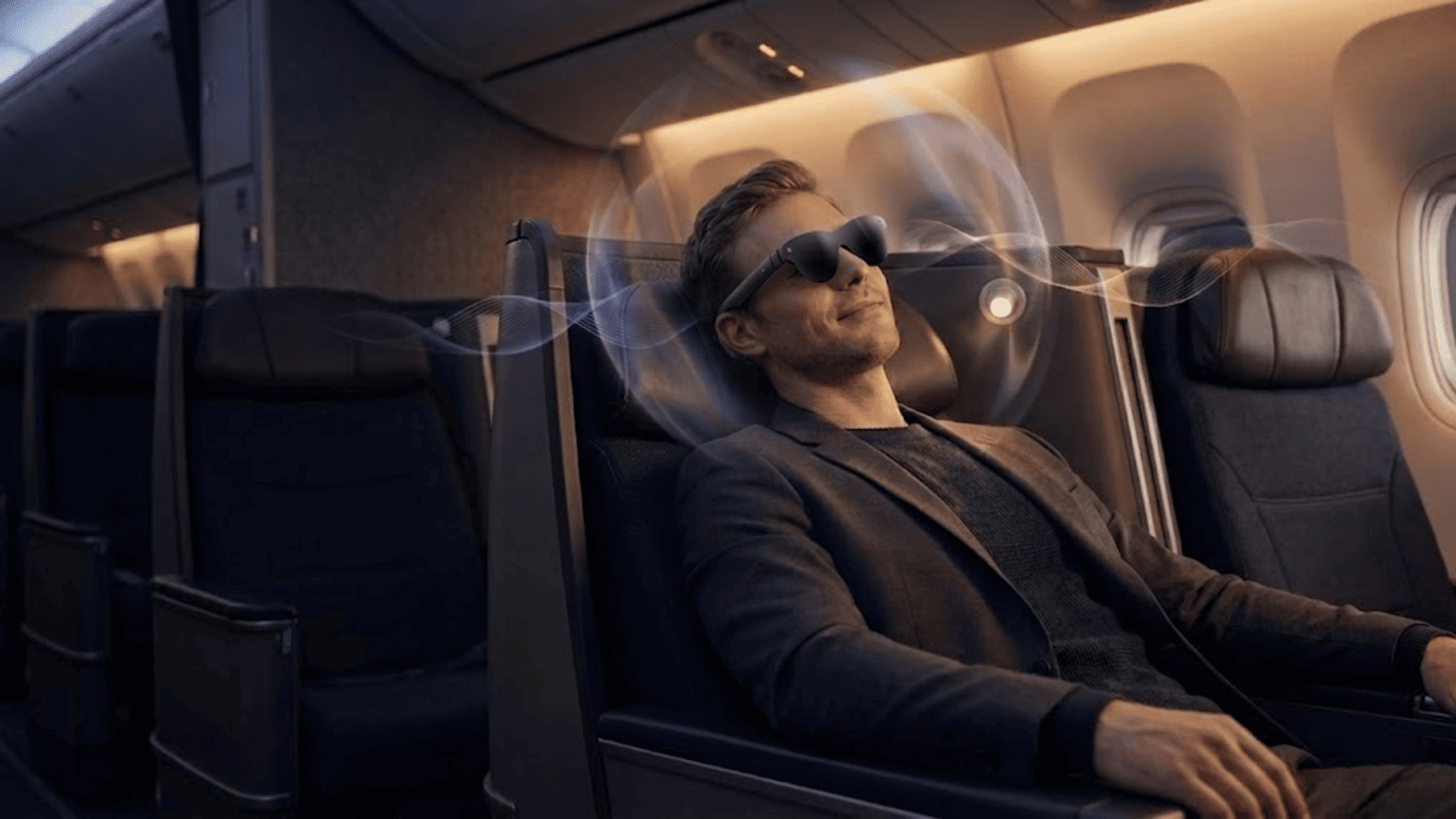
Take our new RayNeo Air 4 Pro, released in 2026, as an example. Within a total weight of just 76 grams, it integrates a four-unit directional speaker system. Combined with custom acoustic conduits, it achieves 360-degree spatial audio through multi-channel drivers. The whisper mode significantly reduces sound leakage while maintaining environmental awareness. This design specifically targets the user pain point of wanting to watch movies on a plane without wearing hot, bulky headphones or disturbing the person in the next seat.
Spatial Audio Capabilities in Wearables
At the algorithmic level, the latest AR glasses move beyond simple left-right stereo. They use head tracking and multi-unit arrays to simulate spatial effects, building a virtual sound field around the user's head. For instance, some devices use custom chips like the Vision 4000 to upmix multi-channel movie tracks into spatial audio in real time. By integrating head rotation data, the system keeps dialogue fixed at the virtual screen's position while ambient sounds surround the user. Music and special effects unfold in layers throughout the space.
The advantage of this spatial audio technology is that it provides a surround-system feel for a single viewer without taking up any physical space in the living room. Since the acoustic energy is concentrated near the ears, the required volume is relatively low. This causes far less interference for roommates or family members than a traditional soundbar, making it ideal for nighttime use. Many users in hands-on videos and community posts mention that watching a full movie with AR glasses feels like having a portable head-mounted theater. The sound position remains stable and the bass has punch, yet it lacks the physical pressure of over-ear headphones.
Comparing AR Glasses Audio to Stereo and Surround Sound
Overall, the proper role for AR glasses audio is a personal-grade surround cinema. It maximizes individual immersion while remaining friendly to those nearby. It is not intended to fully replace a multi-channel system in a living room.
From a pure acoustic perspective, the speaker size and driver power of AR glasses cannot theoretically compete with a full 5.1 or Atmos system. This is especially true in large living rooms that require a massive volume of air to build a soundstage. However, when restricted to the personal viewing scenario, AR glasses excel. Their near-ear directional channels and spatial audio algorithms create a strong sense of positioning for front, back, left, and right at low volume levels. Combined with a virtual screen equivalent to 150 to 200 inches, the overall immersion is significantly better than a traditional TV and stereo speaker combo.
Compared to stereo, AR glasses offer clear advantages in spatial depth and privacy. They are perfect for small apartments, shared living spaces, or frequent travelers. Compared to surround sound, AR glasses are like folding a theater into a portable acoustic helmet. They hold an absolute advantage in space efficiency and ease of setup. However, they still cannot replace traditional multi-channel systems for group viewing or big-room sound pressure.

Conclusion
Based on equipment trends, the content ecosystem, and real user feedback from recent years, surround sound remains the most impactful solution for home theaters. It is perfect for movie enthusiasts with a dedicated space and a higher budget. Stereo remains the primary choice for most households and small living rooms due to its simplicity and reliability. It is especially suitable for daily shows and casual viewing. Meanwhile, AR glasses with spatial audio and high-quality displays are emerging as a third pillar. They provide an immersion level close to a small cinema without taking up living room space or disturbing others. In our view, the truly better audio experience comes from the synergy of surround sound, stereo, and AR glasses across different scenarios. This allows you to find the best setup for the living room, the bedroom, or while traveling. That is the holistic experience most worth pursuing.
Share:
Portable Gaming in 2026: How AR Glasses Are Changing the Way We Play
What Is an Optical Waveguide? A Comprehensive Guide to AR Optics