

$449.00



For the estimated 4 billion people worldwide who rely on prescription eyewear, the emergence of smart glasses presents both excitement and uncertainty. Smart glasses for vision correction represent a convergence of two essential needs: clear vision and access to digital information. Whether you're nearsighted, farsighted, or managing astigmatism, understanding how AR glasses accommodate prescription lenses can help you make informed decisions about adopting this technology.
The challenge of integrating smart glasses for vision correction into daily life extends beyond simple technical compatibility. Users need to consider comfort during extended wear, optical quality when combining prescription lenses with AR displays, and practical factors like cleaning, adjustment, and use across different environments. This guide explores the technical solutions, selection criteria, and practical considerations that prescription wearers should understand before investing in smart glasses technology.
Smart glasses accommodate vision correction through several technical approaches, each with distinct advantages and limitations. The most common implementation uses magnetic attachment systems where prescription lenses clip onto the frame in front of the AR optical elements. This design preserves the integrity of the AR display path while allowing users to customize their vision correction independently.
Alternative approaches include clip-over designs that fit prescription lenses between the smart glasses and your face, though these typically add bulk and weight. Some manufacturers explore integrated prescription lens solutions where corrective elements are built directly into the optical assembly, but this approach requires manufacturer-specific customization and limits sharing devices between users.
The magnetic attachment approach has gained prominence because it balances multiple needs. Users can remove prescription lenses when wearing contact lenses, share devices with family members who have different prescriptions, and replace lenses as their vision changes without modifying the underlying smart glasses. The system works by positioning prescription lenses close enough to your eyes that they correct vision for both the real world and the virtual display projected by the AR optics.
Optical engineering challenges arise from introducing an additional lens element into the light path. Prescription lenses can create chromatic aberration, distortion at the edges of the field of view, or focusing issues if not properly aligned with the AR display system. Quality implementations account for these factors through precise mechanical positioning and optical design that maintains image clarity across the entire viewing area.
Weight becomes critical for prescription wearers planning extended use. Traditional eyeglasses typically weigh 20-30 grams, while smart glasses range from 50 to 150 grams depending on features. Adding prescription lenses adds 10-15 grams, making total weight and balance crucial.
Look for designs that distribute weight between the front frame and temples in approximately a 45:55 ratio. This balance prevents the glasses from sliding down your nose. Adjustable nose pads with at least three positions help accommodate different facial structures, while temple flexibility ensures the glasses don't create pressure points during all-day wear.
Not all smart glasses accommodate the full range of prescriptions. Most magnetic lens systems support:
Myopia (nearsightedness): -1.00 to -6.00 diopters
Hyperopia (farsightedness): +1.00 to +4.00 diopters
Astigmatism: up to -2.00 cylinder correction
Stronger prescriptions may require thicker lenses that interfere with the AR optical path. If your prescription falls outside these ranges, verify compatibility before purchasing.
The interaction between prescription lenses and AR displays varies based on optical technology. Birdbath optics, which use curved reflective surfaces, generally work well with prescription lenses because the display path remains separate from the vision correction path until they converge at your eye. Waveguide systems, which use diffractive or reflective elements embedded in transparent lenses, can be more sensitive to the additional optical element introduced by prescription lenses.
Consider the field of view specification alongside your prescription needs. Wider fields of view may increase edge distortion when combined with strong prescription lenses. A 30-40 degree diagonal field of view typically provides good usability without exacerbating optical issues for prescription wearers.
Different applications place different demands on prescription lens integration. Entertainment-focused use—watching movies, gaming, viewing content—primarily requires optical clarity and comfort during stationary activities. The prescription lens system needs to maintain image sharpness across the display area without creating eye strain during extended viewing sessions.
Productivity and mobile use introduces additional requirements. If you'll use smart glasses while walking, reading text in various lighting conditions, or frequently switching between viewing digital content and your physical surroundings, look for designs that minimize optical distortion at the edges of prescription lenses and maintain brightness across varied environments.
Start with a current prescription from your eye care professional, including your pupillary distance (PD) measurement. PD indicates the distance between your pupils and ensures lenses are centered correctly. Most adult PDs fall between 54mm and 74mm, but accurate measurement is essential for comfortable extended wear.
Manufacturers typically partner with optical laboratories that fabricate prescription lenses to exact specifications for their smart glasses. Ordering processes vary, but generally involve uploading your prescription details through a web portal. Processing time ranges from one to three weeks depending on prescription complexity and lens coatings requested.
Consider anti-reflective coatings for your prescription lenses. These coatings reduce glare from the AR display bouncing off the back surface of your prescription lenses—a common issue that can reduce contrast and create ghost images in your field of view.
Proper adjustment makes the difference between comfortable all-day wear and devices that become painful after an hour. Start by adjusting nose pad height so the glasses sit level on your face without tilting up or down. The optical center of the display should align with your natural gaze direction when looking straight ahead.
Temple adjustment involves both angle and curve. The temples should follow the contour of your head without creating pressure points, while the end pieces rest gently behind your ears. Most designs allow nine to twelve positions of adjustment, letting you dial in the perfect fit for your head shape.
After installing prescription lenses, verify that focusing comes naturally at typical viewing distances. Digital content should appear sharp without requiring you to tilt your head or strain your eyes. If you experience focusing difficulty, the prescription lenses may need repositioning relative to the AR optical system—consult manufacturer guidance for adjustment procedures.

Clean prescription lenses using microfiber cloths and lens cleaning solutions formulated for eyeglasses. Avoid paper products or clothing that can scratch lens coatings. The magnetic attachment system allows quick removal for thorough cleaning without risking damage to the AR optical components underneath.
Store smart glasses in protective cases when not in use, keeping prescription lenses attached unless you're sharing the device. Temperature extremes can affect both the electronics and lens coatings, so avoid leaving glasses in hot cars or cold environments for extended periods.
Battery management becomes important for active AR features. Entertainment-focused models that display content passively consume less power than AI-enabled systems running continuous processing. Plan for 3-5 hour typical use cycles, with the option to charge during breaks for all-day coverage.
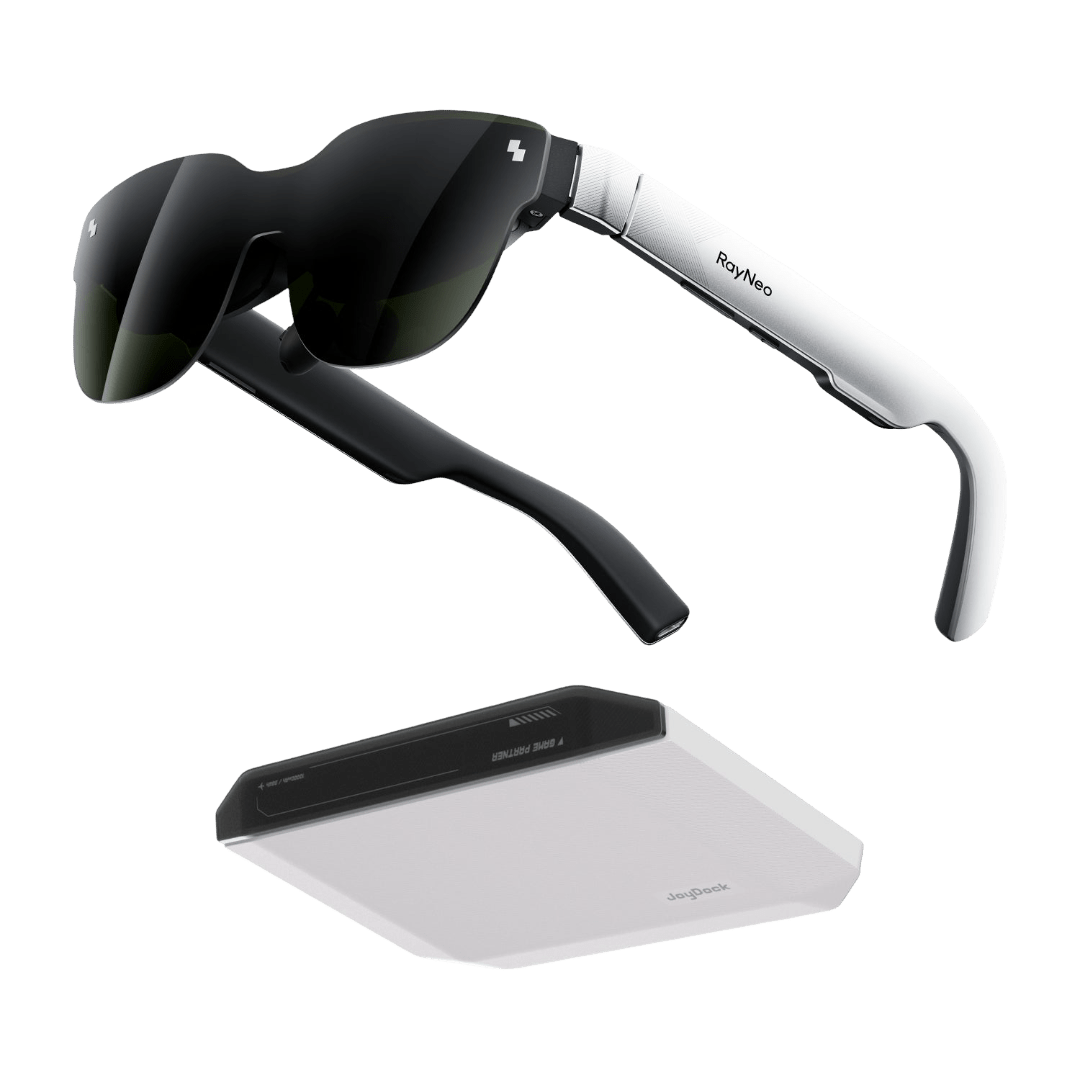
When examining how manufacturers address prescription wearer needs, RayNeo's approach illustrates current best practices in the smart glasses industry. The company offers two distinct models that demonstrate different optimization strategies for prescription lens integration.
The Air 4 Pro weighs 76 grams with magnetic prescription lens support, targeting entertainment users. The design maintains a 135-inch equivalent display and 1200 nits brightness while accommodating prescription lenses. Eye protection features include 3840Hz PWM dimming to reduce flicker-related fatigue during extended viewing. Priced at $299 MSRP, it represents accessible pricing for entertainment-focused prescription wearers.
The X3 Pro maintains the same 76-gram weight despite adding AI capabilities through Google Gemini 2.5 integration. The prescription lens compatibility works within a system designed for mobile use—real-time translation in 14 languages and hands-free AI assistance. The 43-inch floating display uses MicroLED technology for 6000 nits peak brightness, ensuring visibility outdoors. Four-hour typical use with 38-minute fast charging addresses all-day productivity scenarios. Priced at $1,299 MSRP, it targets professionals who need prescription support alongside advanced features.
Comparison for Prescription Wearers:
Both implementations maintain the critical weight threshold that enables comfortable extended wear with prescription lenses attached. The identical 76-gram weight regardless of feature set reflects intentional design prioritization—keeping weight below 80 grams prevents the fatigue and pressure points that commonly affect prescription wearers using heavier AR devices.
The smart glasses industry continues evolving its approach to vision correction integration. Emerging developments include adaptive focus systems that automatically adjust for near and far viewing, reducing the complexity of multifocal prescription implementations. Standardization efforts aim to create interoperable prescription lens systems that work across multiple smart glasses brands, potentially reducing cost barriers for prescription wearers.
As AR displays achieve higher brightness and resolution, the optical demands on prescription lens systems will increase. Future implementations must maintain image quality while accommodating stronger prescriptions and more complex corrections like progressive lenses for presbyopia.
RayNeo, initially incubated within TCL, develops AR glasses designed for everyday integration. With full in-house R&D and manufacturing capabilities for optical systems, the company leverages 25+ years of optical expertise from its TCL heritage. Products are available in over 70 countries. Visit www.rayneo.com for more information.
Q: Can I use smart glasses if I wear prescription eyeglasses?
Yes, most modern smart glasses support prescription lenses through magnetic attachment systems. These allow custom prescription lenses to clip onto the frame in front of the AR optics. Most systems accommodate myopia from -1.00 to -6.00 diopters, hyperopia from +1.00 to +4.00, and astigmatism up to -2.00 cylinder. The magnetic design lets you remove lenses when wearing contacts or share devices with family members who have different prescriptions.
Q: Will prescription lenses affect the display quality or add too much weight?
Quality implementations maintain display clarity through precise optical alignment. Prescription lenses add approximately 10-15 grams, but well-designed smart glasses like RayNeo's models stay at 76 grams total—under the 80-gram threshold for comfortable all-day wear. The key is proper weight distribution (45:55 front-to-rear ratio) and adjustable fit. Anti-reflective coatings on prescription lenses reduce glare and ghost images, ensuring the AR display remains sharp and clear.
Q: How do I get prescription lenses for my smart glasses?
You'll need a current prescription from your eye care professional, including your pupillary distance (PD) measurement. Manufacturers typically partner with optical labs that fabricate lenses specifically for their smart glasses. You upload your prescription details through their portal, and lenses arrive in one to three weeks. The magnetic attachment makes installation simple—just clip them on. Consider requesting anti-reflective coatings to minimize glare from the AR display.
Smart glasses for vision correction have matured from experimental concepts to practical devices that millions of prescription wearers can adopt. Success depends on understanding how prescription lens integration affects weight, comfort, optical quality, and use case alignment. The magnetic attachment approach currently offers the best balance of flexibility, optical performance, and user experience for most prescription wearers.
When evaluating specific products, prioritize weight under 80 grams with prescription lenses attached, verification that your prescription falls within supported ranges, and use cases that match your primary needs. Entertainment applications require excellent optics and comfort during stationary viewing. Productivity and mobile use demand durability, battery life, and optical consistency across varied lighting conditions.
The technology has reached a point where prescription wearers can adopt smart glasses without significant compromise in vision correction quality or daily comfort. Whether you're exploring entertainment options or professional productivity tools, understanding these selection criteria and implementation considerations will help you make informed decisions that align with both your vision needs and technology goals.




Share:
Smart Glasses Navigation: Hands-Free Directions for Every Journey
The Complete AR Glasses Buying Guide: 7 Essential Factors for First-Time Buyers