

$449.00


When buying gaming glasses, most players care about three specific things: how long their eyes can hold up, how immersive the visuals are, and whether the device is easy to use. Based on our long-term testing and conversations with players, different types of gaming glasses are suited for entirely different scenarios. From mobile and handheld devices to 240Hz competitive PC setups and immersive AR screens, picking the wrong pair makes the device a burden on the bridge of your nose.
In this article, we will focus on the 2026 Gaming Revolution and the real pain points of smart glasses, AR glasses, and AI glasses. We will help you find the right path among three core directions: health protection, immersive large-screen displays, and AI-assisted gaming.
Data from Statista predicts that the global gaming population will exceed 3.8 billion by 2030. In 2026, gaming penetration has already reached over one-third of the global population, meaning digital eye strain is becoming a collective occupational hazard. We are seeing a clear trend: not only are there more gamers, but the average time spent playing is also rising. Long hours in front of a screen have shifted from an occasional weekend hobby to a daily habit.
Meanwhile, screens are evolving rapidly. The transition from 60Hz LCDs to high-brightness OLEDs, and now to headset-grade Micro-OLED and Micro-LED, has significantly improved visual quality and competitive performance with higher brightness, contrast, and refresh rates. However, the human retina must now endure higher-energy blue light and more intense refresh stimuli. In our conversations with players, we frequently hear about dry eyes, tension headaches, ranking drops before bed, and a total inability to focus the day after a late-night session. This is the reality of digital eye strain.
While gaming visuals continue to advance, the limits of the human eye remain the same. The truly smart gamer in 2026 needs the right gaming eyewear to restore the balance between performance and physical health.

The 2026 Gaming Revolution is defined by cross-device and cross-scenario play. Gamers switch fluidly between smartphones, handhelds, PCs, and consoles, even using AR glasses on a subway to expand a handheld screen into a massive 200 inch display. This revolutionary experience brings very specific problems: privacy is hard to maintain in public, traditional monitors eat up desk space, and VR headsets remain too heavy and stifling. Additionally, staring at small OLED screens for long periods often leads to a grainy pixel sand sensation.
Discussions across various AR glasses communities highlight three main categories of needs. First, users want to reduce eye strain, flickering issues, and sleep disruption caused by long gaming sessions. Second, there is a demand for a plug and play large screen experience that works with any device. Third, players want to access game data and tactical advice instantly without breaking their immersion. These requirements are pushing gaming glasses to split into three distinct directions: health protection, immersive display, and AI assistance. Ultimately, your choice comes down to a trade-off between these three dimensions.
When helping users choose the right gear, we usually start with two questions. The first covers usage habits: how long do you play games on average each day? The second focuses on preference: do you care more about visual immersion or the condition of your eyes and sleep? Therefore, our recommendations prioritize identifying whether a user is health-first, immersion-first, or efficiency-and-tactics-first before making a precise selection among the three types of gaming glasses. For hardcore esports players or content creators, a large screen with high brightness, high refresh rates, and high contrast is a non-negotiable requirement. Eye fatigue can be offset as much as possible through more precise protection technologies. For office workers, students, or players in mobile scenarios, digital eye strain often already stems from work and study. In these cases, the primary mission of gaming glasses becomes controlling blue light energy, suppressing flickering, and optimizing weight distribution.
In our practical testing toolkit, one end features Blue Light and Anti-Fatigue Glasses centered on blue light suppression and visual comfort. The other end consists of AR gaming glasses that bring the screen directly to your eyes. In the middle are AI-integrated smart frames that help you analyze the battle and your operational rhythm through AI. Understanding the working principles and target audiences for these three paths will prevent you from spending hundreds of dollars on a device that is completely misaligned with your real life.
The core value of these health-focused gaming glasses is not to provide a virtual big screen. Instead, they aim to maximize eye comfort during high-intensity gaming and daily office work. When daily screen time exceeds 7 hours, almost everyone experiences some level of eye fatigue or poor sleep. Blue light energy and screen flicker are the most common invisible killers. These glasses use spectral filtering, anti-reflective coatings, and balanced weight designs to keep this invisible damage within a controllable range.
Blue light control on OLED screens is more complex than on traditional LCDs. Many phones and handhelds see blue light peaks rise in high-brightness modes. Some devices also use low-frequency PWM dimming. While this flickering is hard to see, it can cause headaches and dizziness for sensitive users. Blue light lenses precisely adjust the light spectrum. They weaken high-energy short-wave blue light between 415 and 455 nanometers. They try to keep the light above 460 nanometers, which relates to circadian rhythms and color accuracy. This protects the retina without making the screen look too yellow.
Many gamers like to dim the room lights at night. This increases reflections between the screen and the lenses, which creates minor ghosting and loses contrast. Anti-fatigue lenses usually use multi-layer coatings to lower reflection rates. The base curve design keeps the focus consistent across the center and edges. This reduces the strain of the eyes constantly adjusting their focus.
Health-focused gaming lenses fall into two categories. One is the amber-tinted high-intensity lens. The other is a clear lens for moderate protection that looks like standard eyewear. Amber lenses often reduce blue light near 420 nanometers by more than 60 percent. They are great for long night sessions or ranked matches. However, the image will look warmer, and color-sensitive players may need time to adjust. Clear blue light lenses are better for daily commutes and work. They offer lower protection but do not look like specialized gaming glasses. High-quality lenses use harder surface coatings and lower reflection to prevent image quality loss and reduce eye fatigue.
Based on our interviews and tests, these glasses suit several types of players. The first group includes people with over 8 hours of total screen time and 2 to 3 hours of gaming. These users, such as remote developers or students, often suffer from dry eyes or sleep issues. The second group consists of mobile and handheld gamers. They use phones or consoles like the Switch on subways but do not want the bulk or weight of a headset.
The third group includes users who need a two-in-one solution for work and play. They look at code or reports in the office during the day and play games at night. For these users, daily comfort is often more important than the gaming features. We recommend clear blue light solutions for this group. Pairing them with system-level eye protection modes and brightness limits helps keep the lenses subtle during daytime meetings.
AR gaming glasses are one of the most talked-about product categories in 2026. They are described as lightweight, like carrying a 200-inch TV everywhere, and a way to finally stop cluttering your desk with two monitors. These devices use micro-OLED or micro-LED displays along with waveguide optical systems to overlay virtual images onto the real world. This setup creates a personal screen ranging from 100 to 200 inches right in front of your eyes. With high refresh rates and low latency, they allow console or handheld gaming to maintain the smooth performance of an esports monitor from any location.
With the iteration of chips and optical solutions, we can now achieve 1080p resolution, 120Hz or higher refresh rates, and HDR10-level dynamic range on lightweight AR glasses. In some high-end designs, the naked-eye experience is equivalent to watching a 150 to 200-inch screen from a distance of 4 meters. The PPD (Pixels Per Degree) is high enough to make top menus and skill description text clearly readable. Some smart glass brands are testing 240Hz modes for high-frame-rate FPS or racing games. By providing higher temporal resolution, these modes reduce motion blur and ghosting. For players already used to 240Hz esports monitors, this helps in transitioning smoothly from a desktop environment to a portable setup.
Three metrics require the most attention:
PPD (Pixels Per Degree): This directly determines text clarity and distant details.
Brightness and Contrast: These ensure the screen remains visible against ambient light in environments like subways or cafes.
Refresh Rate and Input Latency: A high refresh rate combined with a proper transmission link keeps audio and video synced at a competitive level.
Given a baseline of 1080p at 120Hz or higher, we prefer to measure the rank-ready capability of AR gaming glasses by PPD and brightness stability. This is far more meaningful than simply claiming a virtual 300-inch giant screen.
Beyond visuals, another major advantage of AR gaming glasses is providing players with a semi-open yet private audio experience. This is a common point in user feedback. Many users mentioned that when playing consoles with glasses, they finally no longer need to wear a heavy headset. High-quality built-in speakers use directional sound and auricle reflection designs. The volume drops off significantly beyond 30 centimeters. This allows you to play games in a living room or airport lounge without disturbing those around you while maintaining a natural sense of space and avoiding the ear canal discomfort caused by wearing in-ear headphones for long periods.
A great audio system needs low-frequency extension and high-frequency detail, especially for footsteps, reloading sounds, and environmental positioning in FPS games. Additionally, latency control is equally important. Especially when using wireless connections or streaming solutions, audio-visual desync is often harder for players to accept than a drop in resolution. Therefore, excellent AR gaming glasses must maintain strict timing management within the audio chain.

Overall, AR gaming glasses are best suited for players who prioritize immersion and large screens. This is especially true for those who cannot fit multiple large monitors at home but still want a console-quality experience on a sofa, in bed, or while traveling. For long-term wear, we need to pay attention to neck strain and nose pad comfort. Since a single session of an RPG or open-world game often lasts three hours or more, any extra 20 grams of weight will be amplified by the body.
Handheld players are the most active segment of the AR gaming glasses user base. A typical change in experience after connecting a Steam Deck or Switch to AR glasses is that the original 7-inch screen often makes it easy to miss small UI details during intense combat, such as damage numbers and cooldown timers. Once connected to AR glasses, the entire image is enlarged to nearly home-theater levels. Combined with better color and contrast, character edges and ballistic trajectories are easier to track.
However, handheld players also face practical issues, such as the battery drain caused by driving high-brightness AR glasses and visibility in bright outdoor light. Therefore, when evaluating the combination of handhelds and AR glasses, we consider power consumption, handheld output capabilities, extra power solutions, and cable management. The goal is to achieve two to three hours of high-quality sustainable gaming rather than just a brief tech demo.
For console players, AR gaming glasses act more like a private TV you can take anywhere. They are particularly suitable for users who share a living room with family members but want an independent gaming space. In real-world cases, many players shared that since using AR glasses, nighttime gaming no longer occupies the living room TV. A partner can watch shows or rest while the player continues their progress on the sofa or in bed. This type of family-friendly upgrade has received a lot of praise.
Console players are extremely sensitive to latency, especially in fighting and rhythm games. Therefore, when recommending AR glasses for consoles, we prioritize wired direct connections or official low-latency decoding solutions. Additionally, the perceived size of the screen needs to be controlled. A virtual screen that is too large at a close distance can cause frequent eye scanning, which leads to fatigue more quickly than a 100 to 150-inch range. This is the direction we continuously refine in optical design and default projection distances.

As AI models evolve rapidly on both local and cloud levels, AI-integrated smart frames are becoming a highly promising branch of the 2026 gaming ecosystem. These typically look closer to everyday glasses but include built-in sensors, microphones, and display modules. They can capture your gaze, hand movements, and ambient sound in real time, using multimodal AI to assist in decision-making. Many players describe the experience as having a teammate who never interrupts your play but is always ready to whisper a reminder. This is the core difference in how strategy assistant glasses are positioned.
In competitive and strategy games, information density is often extremely high. Players must make split-second decisions to rotate, use ultimates, retreat, or engage. Traditional HUDs either clutter the screen or rely on voice callouts to compensate, both of which can interfere with vision or hearing. AI smart frames can use a lightweight HUD to hover key data at the edge of your vision. This includes skill cooldown timers, gold leads, damage stats, or teammate status. It allows you to maintain an information advantage without constantly looking down at the minimap.
To achieve this, three dimensions must be addressed:
HUD Update Latency: It must stay on the same time scale as the game rhythm.
Display Position and Transparency: This avoids blocking the central field of vision or creating ghost images.
Attention Load Over Time: If HUD content exceeds a certain threshold, it can actually slow down decision-making. A good design should make the HUD feel like an intuitive hint at the edge of your sight, not an extra small monitor.
Beyond the HUD, multimodal AI can take on richer roles in gaming. For example, it can analyze voice and visuals to identify your current map area, enemy lineup, or economic state. It then provides brief and clear tactical suggestions, such as prioritizing tower defense, scouting, or delaying a team fight. In single-player games, AI can help players quickly find quest clues, hidden chests, or rare resources in open worlds. This reduces the need to toggle between map interfaces and walkthrough websites, maintaining immersion.
Furthermore, the AI features most accepted by players usually share three traits:
Natural Triggers: Such as simple voice commands or gaze duration.
Brief Information: Usually restricted to a single sentence.
Toggle Control: The ability to turn it off at any time to avoid affecting competitive performance.
In the future, as local AR chip processing power grows, these strategy assistants may become a default partner in more AAA titles. However, in 2026, we still encourage players to enable cloud-based analysis features cautiously, based on their own network environment and privacy comfort.
In our view, the best form of AI smart frames is one that quietly filters out noise to keep only key prompts, rather than taking over your controls or overshadowing the game itself.
To help players using different setups make faster decisions, the key is to first identify your most frequently used gaming device. Then, choose the type of glasses based on your competitive level and physical feedback.
If you only play a few rounds on your phone occasionally, health-oriented glasses paired with a system-level eye protection mode are enough. However, if you play high-intensity ranked matches on PC or consoles every day, the value of AR gaming glasses and AI smart frames increases significantly.
For players who primarily use phones and handhelds, we have developed a checklist. First is the quality of the screen and its dimming solution. If your phone uses low-frequency PWM and you often play in dim environments, pairing it with high-quality blue light and anti-fatigue glasses can significantly reduce eye strain after long periods of scrolling. Second is battery life and portability. While the combination of a handheld and AR glasses is visually compelling, you must be prepared for extra power consumption and cable management.
We also look at your sensitivity to image details, such as whether you struggle to read small text or UI elements, and whether you play games while commuting on public transit. If you often game in moving environments, an AR giant screen is immersive, but your eyes must constantly compensate between the real-world motion and the virtual image. In these cases, health-focused eyewear is a safer choice.
In the PC esports scene, we first look at your current monitor setup, such as refresh rate, size, and panel type. For players already used to 144Hz or 240Hz monitors, we suggest viewing AR gaming glasses as a second screen. They are great for extending game time or maintaining a competitive edge in different spaces, rather than immediately replacing your main desktop display. In this case, selection priorities shift to refresh rate matching, input link latency, and image clarity, especially the sharpness of small UI fonts. For FPS and MOBA players, the PPD and contrast of AR glasses directly affect long-distance enemy detection. Therefore, it is better to sacrifice some virtual size to ensure the center of the image remains as clear as possible. Additionally, the neck and shoulder strain from long ranked sessions is amplified by the weight and balance of AR glasses. Keeping the weight under 80 grams with proper ear hook and nose pad design is a key threshold for determining if a pair is suitable for esports players.
For gamers who jump between mobile, handhelds, PC, and consoles, we recommend prioritizing the compatibility path during your selection. Many users only realize after their purchase that they need multiple extra adapters or decoders to switch between devices. This friction often leads to the glasses sitting in a drawer rather than being used. The ideal setup should allow you to plug in and restore your screen layout in seconds with just one cable or a small adapter, whether you are in your living room, bedroom, or a hotel.
In these multi-platform scenarios, AI smart frames also show their strengths. They can analyze gameplay on your PC, act as a notification filter and schedule a reminder on your phone, and serve as regular smart eyewear in your daily life.
To help gamers quickly decide if a pair of AR glasses is fit for long-term play, we have put together a data sheet covering key metrics like weight, refresh rate, brightness, and PPD. These specs directly determine wearing comfort and visual clarity. For hardcore gamers, understanding weight, PPD, and certifications is far more important than simply remembering the marketing claim of a virtual screen size.
|
Spec |
Recommended level for 2026 AR gaming glasses |
|
Weight |
Under 80g for comfortable long-term gaming |
|
Refresh rate |
At least 90Hz, ideally 120Hz or higher |
|
Resolution |
Binocular 1080p or higher; text must be crisp and readable |
|
PPD |
30 PPD or higher in central field of view to reduce pixelation |
|
Brightness |
Effective brightness over 800 nits to handle most lighting conditions |
|
Certifications |
Priority given to products with TÜV Rheinland Low Blue Light and Eye Comfort certifications |
Weight is the biggest hurdle for long-term comfort. Many users in the community complain about wanting to take their glasses off after just an hour. These users often overlook that the glasses themselves weigh close to or over 100 grams. When you add cables and adapters, the total burden increases. In our internal tests, we found that AR glasses under 80 grams are much easier to wear for two back-to-back movies or a full night of ranked gaming, provided the weight distribution and nose pads are well-designed. Once you cross that weight limit, nose bridge marks and pain behind the ears appear much sooner.
To reduce this strain, some high-end products use magnesium and titanium alloys. These materials maintain strength while keeping weight down. They also allow for more precise pressure distribution on the temples and nose pads. During our trials, we have testers play through a complete peak-hour gaming session. We record how their subjective comfort changes from the first match to the last. This approach is much closer to real life than a quick demo at a trade show.
PPD pixel density is a metric many gamers overlook when buying AR glasses, yet it directly determines if the image looks pixelated. Simply put, a higher PPD means more pixels per degree of field of view, resulting in sharper text and details. At the same 1080p resolution, products with higher PPD project the image as if it were further away, making it look much finer. In Reddit discussions, many users attribute blurry text and dizziness after long use to low PPD and optical distortion. During our testing, we prioritize checking the readability of game HUDs and chat windows.
AR glasses suitable for long gaming sessions should provide an effective pixel density of 30 PPD or higher in the central 20 degree field of view. They must also minimize distortion and blurring in the peripheral areas. Otherwise, when players scan mini-maps or UI corners, their eyes must constantly adjust focus and posture. This will increase fatigue over time.
Regarding eye health, we pay close attention to TÜV Rheinland certifications, such as Low Blue Light, Flicker Free, and Eye Comfort standards. These certifications provide results based on blue light energy, screen flickering, and overall viewing comfort. For example, the RayNeo Air 4 Pro uses 3840Hz PWM dimming and has passed TÜV SÜD low blue light and flicker-free certifications, which helps reduce visual strain during long viewing sessions. According to standards published by TÜV Rheinland, an Eye Comfort level certification typically requires a product to meet benchmarks for low blue light, no visible flicker, and reflection control simultaneously. This helps minimize the potential impact long-term use can have on eye health and sleep cycles.
Let us return to the original question: which gaming glasses are right for you in 2026? The answer depends on your device setup, game types, and physical feedback. If your main issues are dry eyes and disrupted sleep, health-focused Blue Light and Anti-Fatigue Glasses should be your top priority. If you want an immersive screen anywhere, a pair of lightweight, high-PPD AR gaming glasses will breathe new life into your handhelds and consoles. Only when you are chasing finer tactical edges and efficiency gains in competitive arenas do AI-integrated smart frames show their true strength. Mature gamers choose their glasses as carefully as they choose a GPU; you can always restart a match, but you cannot reset your eyesight.
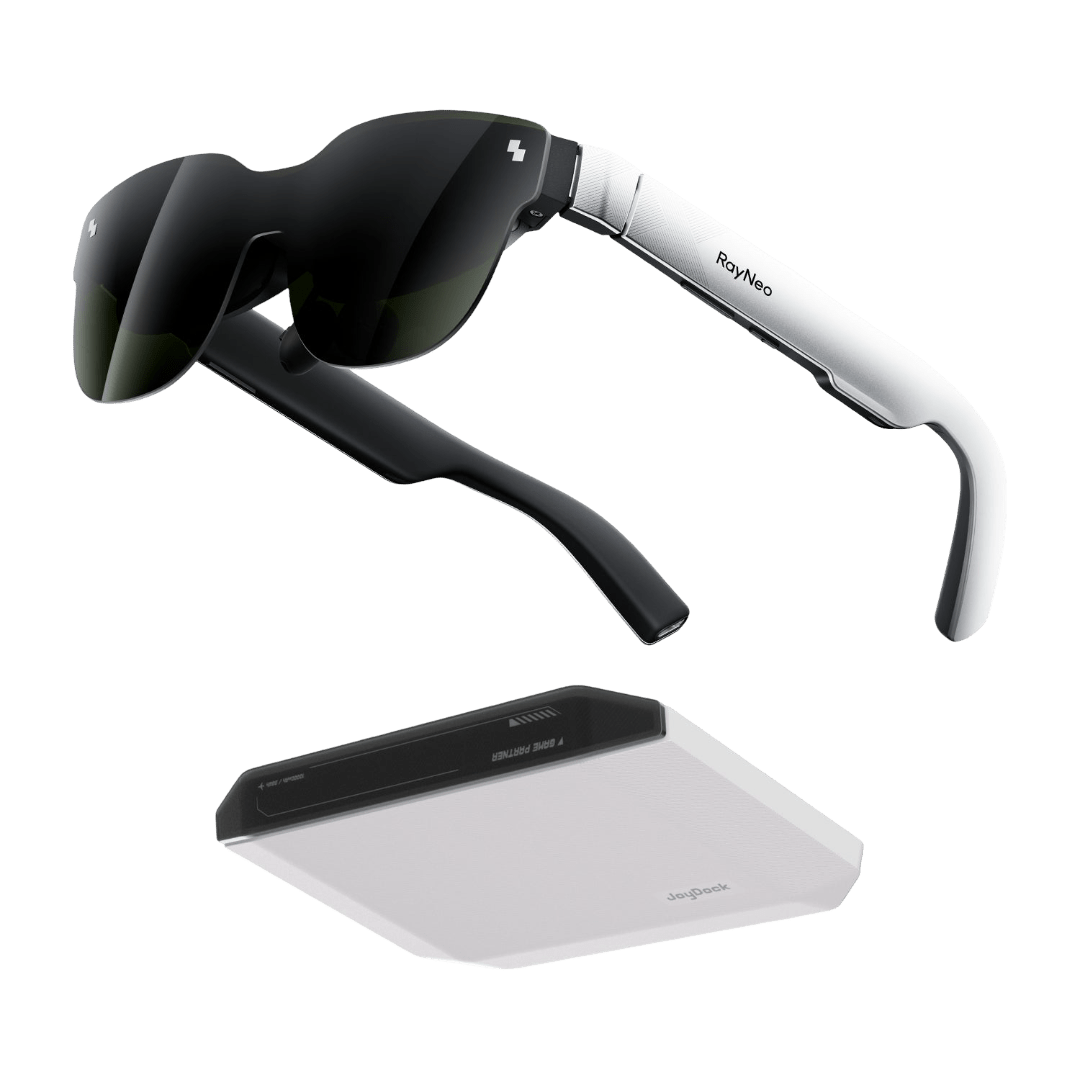
In our own lineup, the RayNeo X3 Pro uses a micro-LED optical solution and the Snapdragon AR1 Gen 1 platform. At approximately 76g, it combines high brightness and vivid color with multimodal AI, making it ideal for power users who want to balance immersive gaming with daily life. Meanwhile, the 2026 best AR glasses, RayNeo Air 4 Pro, features 1080p 120Hz HDR10 and audio co-tuned with B&O. It provides a virtual screen nearly 200 inches in size, which is perfect for users who frequently switch between handhelds and consoles. Whichever path you choose, we encourage you to prioritize the long-term health of your eyes and body, using scientific standards to define your next-generation gaming setup.
In terms of immersion and privacy, high-quality AR gaming glasses can certainly act as a personal 4K TV. This is especially true when you need to manage noise or space in a small apartment at night. However, for group viewing, parties, or scenarios requiring peak HDR brightness and high-end sound systems, traditional large-screen TVs still hold an advantage. We view AR glasses more as a top-tier portable secondary screen rather than a total replacement for the living room TV.
Most health-focused gaming glasses can be customized with myopia or astigmatism prescriptions. This significantly reduces eye focusing strain during long sessions and is ideal for long-term use. Many AR gaming glasses and AI smart frames also support Rx inserts or custom lens solutions. However, support for specific prescription ranges and the ordering process varies by brand. We recommend confirming official or partner Rx services before buying. Also, check if custom lenses might affect optical focus or edge clarity.
Higher refresh rates mean higher data bandwidth and display power consumption. If your glasses are constantly outputting high-frame-rate video from a phone or handheld, they will accelerate battery drain. Many players find that battery levels drop much faster in high-refresh and high-brightness modes compared to standard video playback. We suggest switching between 90Hz, 120Hz, and higher settings based on the game type. Lowering the refresh rate during non-competitive play can help balance battery life.
For players prone to motion sickness in FPS or racing games, the right gaming glasses can help. Reducing screen flicker, improving clarity, and minimizing reflections lessens the cognitive load when processing fast-moving images. However, motion sickness involves multiple factors like frame rate stability, network latency, and individual sensitivity. We consider gaming glasses part of a broader solution that should include regular breaks and optimized game settings, such as reducing motion blur and extreme FOV changes.




Share:
10 Augmented Reality Applications That Are Changing Everyday Life
How to Connect Smart Glasses to Phone: A Step-by-Step Guide