
Table of Contents
In the 2026 outdoor gear checklist, AI recording sports glasses have shifted from curious toys to essential tools that many outdoor enthusiasts cannot live without. If your glasses could know a moment is worth recording before you do, would you still need to press the shutter yourself? AI is more than just an auto-recording camera; it is learning to identify which moments deserve to be kept. Sudden bursts of speed, jumps in altitude, or heart rate peaks... as algorithms begin to understand the definition of a highlight, the way we record outdoor sports is undergoing a quiet revolution. This article will walk you through the seven core advantages of AI recording sports glasses and how they are redefining the outdoor recording experience.
Why Are AI Sports Glasses Trending Among Outdoor Enthusiasts?
Over the past year, several research firms noted that shipments of traditional AR headsets are under pressure. In contrast, lightweight smart glasses integrated with AI have seen significant growth. This is especially true for smart glasses with camera functions. In the first half of 2025, global shipments for these devices doubled year-over-year. Glasses driven by AI models now make up the vast majority of smart frame shipments. This shows that users prefer lightweight AI assistance and everyday wearability.
Growth of Hands-Free Recording Technology
Handheld cameras and phones are often inconvenient during real outdoor sports. For example, you cannot pull out a phone during a high-speed mountain descent. On snowy or rainy trails, equipment water damage is a constant worry. During stream trekking or bouldering, the body often blocks the camera view. Users want a truly hands-free way to record. They want to maintain their flow while climbing, trail running, cycling, or fly fishing, with the footage following their eyes. While older action cameras can be worn on the head or chest, users often complain about loose mounts, gear bumping against them, wind noise, and excessive weight during long, intense activities.
AI sports glasses are becoming popular because they turn recording from a finger action into a matter of sight and voice. Users no longer debate whether to take out their device. Instead, recording becomes a background behavior. The AI helps extract and highlight key moments as they happen. This shift from pressing a record button to letting the device capture the moment is the core driver behind hands-free technology.
Rise of AI in Wearable Devices
From smartwatches to smart rings and display-less smart glasses, the wearable field has moved from recording data to understanding context over the last three years. Shipment data confirms this trend. A 2026 wearable report stated that new forms like smart rings and non-display smart glasses will drive medium to long-term growth. This is because they combine sensor data with AI reasoning to provide contextual feedback.
In community discussions, users focus less on AI model specs and more on whether the AI understands their situation. They want a device that:
-
Automatically marks key pace changes while running.
-
Identifies traffic density and gives simple alerts while cycling.
-
Categorizes footage as scenery, people, or action to decide on stabilization and frame rates.
These tasks require high computing power, low latency, and edge-side decision-making. AI sports glasses move this entire process to your most natural perspective.
Demand for First-Person Content Creation
The importance of first-person content is rising on social media and video platforms. Platforms prefer high-engagement, immersive content, and audiences are tired of traditional handheld footage. Over the past year, POV videos in outdoor categories like car culture, fishing, cycling, and camping have seen outstanding engagement. This has pushed creators to seek better tools. They want to spend less time setting up tripods and more time on the story.
Creators using traditional action cameras face three main problems: battery and heat limits, rigid perspectives from helmet or chest mounts, and heavy editing workloads. AI sports glasses provide a natural view from an eye-level position. They integrate sensors, storage, and connectivity into the temples. This allows creators to string together life and sports clips with a consistent first-person logic, while AI helps with rough cuts and highlights in the cloud.
7 Reasons Why You Need AI Recording Sports Glasses
When we talk about 7 reasons, we are not interested in piling up features. Instead, we care about whether these functions address the specific frustrations users face outdoors. This includes missing the fleeting light of a sunrise, failing to hit the record button during a technical section, or the pain of removing gloves to use a phone in the cold. The following seven points come from our long-term experience comparing various smart glasses and action cameras in real-world scenarios.
Hands-Free POV Video Recording in Any Environment
For outdoor enthusiasts, the most fundamental and important factor is maintaining stable first-person recording across diverse environments. This includes harsh light, backlighting, alternating shadows, rain, fog, and dust, as well as sweat and temperature changes from long-term wear. Common issues with traditional equipment include lenses prone to water spots or fogging, head strap displacement causing camera shake, and sudden battery voltage drops in extreme cold that lead to shutdowns.
AI recording sports glasses place the camera in a fixed position closer to the eyes. Combined with standard 1080p30 or 4K30 encoding, electronic image stabilization, and HDR scene recognition, they can keep exposure relatively stable under complex lighting conditions.
AI-Powered Auto-Capture of Key Moments
Even with watches, cameras, and phones working together, the most spectacular action and light often happen when you have no time to press the button. This includes moments like a sudden cloud sea over a ridge, a teammate's crash during a group ride, or a brief wildlife appearance. AI sports glasses add event detection and scene understanding by analyzing acceleration data, visual optical flow, and acoustic changes. The system uses these inputs to determine if a moment has high highlight potential, automatically increasing the bitrate or generating a short clip in the background.
Truly effective AI auto-capture must meet several standards. The false trigger rate must be low enough to avoid marking every regular walking segment as a highlight. Latency must be low enough to back-record one or two seconds before a key action occurs. Finally, the tagging and review process must be simple enough to identify which clips are worth keeping at a glance within the mobile app. For athletes who frequently engage in rock climbing, trail running, or downhill cycling, this ability to automatically extract key moments significantly reduces the reliance on manual recording.
Lightweight and Comfortable for Long Outdoor Activities
The biggest pain point for current smart glasses is that they get exciting for three days and then gather dust for three months. Many users put their devices back in a drawer within a week or two because of discomfort, weight, and battery anxiety. Some industry observers noted that monthly active retention rates for smart glasses fell below 20% in 2024. This shows that most products fall short in long-term comfort and daily integration.
AI sports glasses that are truly fit for the outdoors require deep optimization in weight, temple grip, nose pad design, and lens curvature. During several rounds of hiking and trail running, we found that a body weighing between 80 and 100 grams stays stable for hours. When paired with flexible temples and replaceable nose pads, this weight range avoids excessive pressure on the temples and the bridge of the nose. For cycling and long-distance hiking, fatigue increases non-linearly for every extra 20 grams. This is why many users would rather sacrifice some display and computing features for a lighter frame.

Real-Time Data and Performance Insights
Beyond memory and documentation, another key value of AI sports glasses lies in real-time awareness. This helps users make better decisions during an activity. For example, they can provide clear prompts for elevation gain, heart rate zones, and remaining distance during a trail run. While cycling, they can offer voice alerts for gradient changes and estimated cadence. In fishing or hunting, they can use non-intrusive ways to tag geographic locations and time stamps for later review.
This capability relies on three fundamental pillars. First is stable sensor input, including the fusion of GPS, IMU, and heart rate data. Second is low-latency local AI or edge inference, which simplifies complex multi-source data into a single phrase or simple metric. Finally, connectivity with phones and sports watches is essential to avoid wearing multiple redundant sensor devices. A truly excellent solution hides all complex data in the background and only provides feedback in the simplest way when the user needs it. This ensures you stay focused on the rock face, singletrack, or riverbank.
Seamless Integration with Mobile Apps and Social Media
For content creators, the level of integration between a device and its app determines whether that device gets used long-term. The old workflow—pulling a TF card and waiting until you get home to edit on a computer—cannot keep up with high-frequency posting. Users now expect to select clips, create rough cuts, apply filters, and distribute content directly from their phones.
The advantage of AI sports glasses lies in their native connectivity. By syncing with phones or cloud platforms via Bluetooth and Wi-Fi, they can automatically generate several editing suggestions as soon as an activity ends. This might include a 15-second Reel, a 30-second highlight, or a one-minute vlog base, leaving you only to add text and music.
Enhanced Safety with Situational Awareness Features
Safety is a dimension often overlooked when trying smart glasses, yet its impact in real outdoor environments is direct. Because many bulky AR headsets limit your field of vision, it becomes difficult to monitor surrounding pedestrians or vehicles. In these cases, immersive displays can actually create extra risk outdoors.
To be truly fit for outdoor use, AI sports glasses must find a balance between increasing information density and keeping the field of vision open. We look for lenses with proper light transmission and polarization, as well as open-ear audio structures that do not block environmental noise. The alert methods should also be restrained, using short tones or subtle voice prompts rather than large visual pop-ups. For night running, urban commuting, or remote hiking, these awareness-enhancing features are often more valuable than flashy AR effects.
All-in-One Alternative to Multiple Devices
A common pain point for veteran outdoor enthusiasts is the gear dilemma before heading out. You find yourself wondering whether to pack an action camera, a gimbal, a backup phone, or a high-capacity power bank. Every extra device means another charging cable, another mounting bracket, and another chance for something to fail on the trail.
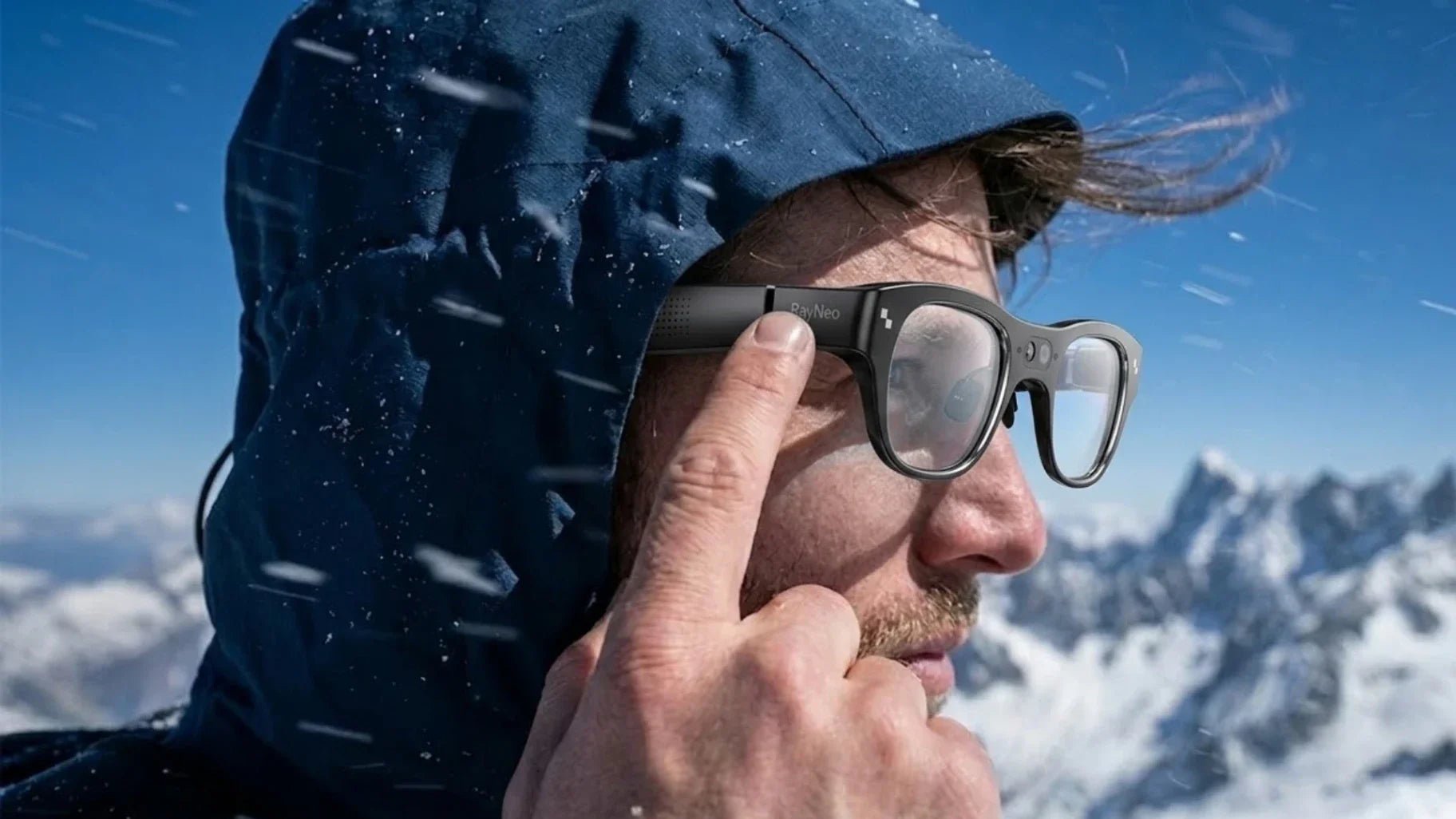
The all-in-one nature of AI recording sports glasses like RayNeo X3 Pro lies in how they integrate basic recording, real-time data awareness, and content distribution into a single form factor. In several short weekend trips, we tried carrying only smart glasses and a phone. For most hiking, casual riding, urban exploration, and light travel, this combination covered the vast majority of recording needs. It significantly lightened the gear load in the backpack. For those who prefer traveling light, this is often the deciding factor for a purchase.
What Outdoor Activities Benefit Most from AI Recording Glasses?
Of course, not every outdoor activity requires AI sports glasses. However, certain scenarios offer exceptionally high returns, particularly those involving frequent movement, long periods where your hands are occupied, or routes with low repeatability. Below, we will break down several high-impact use cases based on real-world experience to help you determine if they fit your specific activity.
Hiking and Trail Exploration
In hiking and trail exploration, the biggest loss is often not the photos you missed, but the fleeting changes in light and terrain. This includes moments like clouds rolling over a ridge, a brief wildlife sighting, or specific foot placement on technical sections. Relying on a phone or camera requires stopping, removing gloves, and framing the shot. Over long distances, this breaks your rhythm and can even compromise safety.
Wearing AI recording sports glasses allows you to maintain your pace while the device captures key trail sections from a first-person perspective. During camp stops or the commute home, you can quickly review the route and highlights via a mobile app. For group leaders who share routes with teammates, the ability to automatically generate visual records of the path traveled is incredibly practical. When combined with real-time altitude and mileage data, it becomes much easier to identify which sections were most taxing and plan future campsites or resupply points more effectively.
Cycling and Mountain Biking
For road cyclists and mountain bikers, the value of AI sports glasses is even more direct. Traditional action cameras mounted on helmets or handlebars often introduce extra vibration and wind noise. In dense woods, they are easily snagged by branches. Many riders prefer to sacrifice image quality just to reduce the weight on their helmets. Integrating the camera and sensors into the glasses allows the lens to follow your head movement naturally while reducing overall wind resistance.

Fishing and Hunting
Fishing and hunting share a common trait: long wait times followed by short, critical bursts of action, all while requiring maximum use of your hands. We often find that the moment a fish strikes, it is too late to hit a record button. By the time you react, the fish has already slipped the hook or reached the shore, leaving the record incomplete.
AI recording sports glasses use motion recognition to detect sudden changes in tension, body weight, or sound. The device then automatically tags these moments as potential highlights. Combined with buffer recording, it captures the entire process from the initial bite to the final catch without you ever needing to let go of your gear. For hunting activities that require safety documentation or post-match review, a full first-person record is invaluable for analyzing whether a decision was sound.
Running and Outdoor Fitness
For road running, trail running, and outdoor training, traditional equipment suffers from heavy shaking and disruptive workflows. Holding a phone is impractical, and chest or waist mounts rarely capture a natural perspective. Helmet-mounted cameras are also unrealistic for runners due to weight and stability issues.
When recording a run with smart glasses, the focus shifts to stability, reliability against sweat, and real-time feedback during tempo runs or interval training. Through voice prompts for pace and heart rate zones, the glasses act as a coach that does not interrupt your flow. After finishing, you can review your form and route from a first-person view, using the data to make targeted adjustments to your running posture and pacing strategy.
Travel and Adventure Vlogging
Travel and adventure vlogs involve fast-paced scene changes, complex lighting, and constant switching between landscapes and street life. Traditional camera setups require frequent lens swaps and exposure adjustments, and carrying heavy gear during long walks creates significant fatigue.
The advantage of AI sports glasses here is that what you see is what you record. The AI helps filter through large amounts of footage, keeping only the key transitions, emotional peaks, and story beats. In our experience, a three to four-hour city trek can result in hundreds of clips. Sorting these manually is time-consuming. With AI-selected highlights, you only need to refine a few clips to finish a rough cut of a vlog, significantly lowering the barrier to content creation.
AI Sports Glasses vs Action Cameras vs Smartphones
Many users, when considering AI sports glasses, immediately ask: I already have a phone and an action camera, so where does this device fit into my setup?
A truly mature equipment system is about combining tools for specific scenarios rather than blindly replacing them. The key for outdoor enthusiasts to avoid buyer's remorse is understanding the unique strengths of each device and deciding whether to streamline or layer their gear.
Hands-Free Convenience Comparison
The difference in hands-free capability among these three device types is clear. Smartphones have the highest dependency on manual handling. While chest mounts or ring stands can partially free your hands, framing and stability remain limited, and there is a high risk during water activities, climbing, or intense movement. Action cameras achieve better hands-free results through helmets, chest straps, and handlebar mounts. However, setting up and adjusting these mounts takes time, and switching perspectives on the fly is difficult.
AI sports glasses turn a daily wearable into an invisible recording and sensing hub. Whether walking in the city, cycling in the wild, or shopping during a trip, users can naturally remain hands-free while the perspective stays synced with their eyes. In practice, we found that once you get used to being ready to record at any moment, going back to a handheld device feels like a constant interruption.
Video Perspective and Usability
Regarding perspective, action cameras still hold a unique edge in extreme sports and large-scale scenes thanks to ultra-wide lenses. They capture deeper depth of field and more environmental data, though this distorted, wide-angle look is not always ideal for storytelling. Smartphones sit in the middle, offering standard focal lengths and stabilized footage through software cropping, but the first-person experience remains limited.
The field of view in AI sports glasses sits right between a telephoto and an ultra-wide lens, closely mimicking what the human eye sees. This natural perspective makes it easier for viewers to feel immersed in the story. Since there is no step involved in picking up a device, the actual usability in daily life and light sports is significantly higher than that of an action camera.
Portability and Setup Time
Smartphones have a natural advantage in portability as they are always with you. However, complex shooting scenarios still require extra gear like gimbals or stands. Action cameras require you to install mounts, tune angles, and check stability beforehand, which adds prep time to every outing.
AI sports glasses leverage the form factor of everyday eyewear, making them as portable as a smartphone—and even replacing traditional sunglasses in many cases. The real differentiator is setup time. During multiple short rides and daily commutes, we could simply put them on and go. Starting a recording via voice and putting them back in the case when finished is no different from using regular sunglasses.
Best Use Case Scenarios
In summary, these three devices represent different preferences. Action cameras are best for extreme sports, diving, and environments requiring high-intensity protection. Smartphones are the choice for planned shoots where composition and image quality are priorities, such as portraits and night scenes. AI sports glasses excel at capturing the process, including trail exploration, training reviews, daily rides, and travel vlogs.
If you have a limited budget and your activities mainly consist of hiking, cycling, running, or city travel, a combination of AI sports glasses and a smartphone is a great priority. This setup values the recording experience and story continuity, leaving the action camera for more professional imaging needs. If you already own a high-end action camera, adding smart glasses allows you to focus on daily wearability and AI assistant features, giving each device a clear, distinct role.
|
Equipment Type |
Hands-Free Level |
Perspective Style |
Setup Time |
Best Scenario Summary |
|
AI sports glasses |
High |
Natural First-Person |
Extremely fast, same as putting on glasses |
Daily sports and travel recording |
|
Action camera |
Medium |
Ultra-wide, high impact |
Longer, depends on mounts |
Extreme sports and professional filming |
|
Smartphone |
Low |
Multi-focal, flexible quality |
Fast, but not naturally hands-free |
Portraits, night scenes, precise composition |
Are AI Recording Sports Glasses Worth It?
The question of value ultimately depends on the return on investment for different users. Based on extensive feedback, we see two distinct groups: casual users who occasionally head out for photos and social check-ins, and outdoor enthusiasts who travel frequently and have a heavy habit of documenting their journeys. These two groups have completely different expectations for AI sports glasses.
Benefits for Casual vs Professional Users
For casual users—those who go on a monthly hike, take light city trips, or cycle occasionally—the biggest benefit of AI sports glasses is making the recording process more natural. You no longer need to stop and pull out your phone, allowing you to stay present in the moment. On the way home, you can use AI to generate a daily story clip as a life log. For these users, frequency of use is not the issue. The key is wanting to wear them every time they head out, which requires the product to be close to everyday glasses in terms of look, weight, and battery life.
For professional users, such as commercial content creators, serious runners training multiple times a week, cyclists, and outdoor leads, AI sports glasses act as a long-term data and content collection terminal. They help build route libraries, technical archives, and instructional materials. As long as the device stability and data quality meet their standards, these users are willing to invest more for better sensing, encoding, and AI capabilities. They are also more motivated to integrate smart glasses into their professional workflow.
Cost vs Value Analysis
Looking at the cost structure, AI sports glasses integrate lenses, cameras, processors, storage, and wireless modules. The price typically sits between a high-end action camera and a flagship smartphone. While some users worry about high initial costs, these glasses have the potential to replace multi-device setups in certain scenarios. For daily commutes and casual sports, a pair of AI sports glasses combined with a phone can serve as a primary kit, reducing reliance on action cameras and extra mounts.
On the value side, we suggest measuring the extra recording gains brought by each wear rather than just looking at specs and benchmarks. If you average two to three record-worthy outdoor activities per week, the glasses could help you naturally capture hundreds of key moments over a year. If AI then organizes these into shareable stories, the marginal value of the device becomes much higher than a headset you only open occasionally. Conversely, if your activity frequency is low and you prioritize one-time high-quality editing, a high-end action camera might be a better fit.
Long-Term Usability and Versatility
What determines the long-term value of AI sports glasses is not the launch feature list, but whether you still want to wear them out the door two or three years later. History shows that complex products with heavy daily wear burdens are often sidelined within weeks. The devices users actually stick with are those with just the right amount of presence—reliable in key moments without demanding too much attention.
In this regard, AI sports glasses that support software iterations and open connectivity with other platforms have a better chance of extending their lifecycle. This includes firmware updates that improve AI scene recognition, add new sport modes, or optimize battery and compression algorithms. For users planning for the long term, we suggest focusing on the product update roadmap for the next two years and its compatibility with mainstream sports and content ecosystems.
Final Thoughts on AI Recording Sports Glasses
Packing a camera adds a piece of luggage; wearing smart glasses is simply wearing smart glasses. These seven reasons ultimately boil down to one thing: only when capturing memories becomes effortless can you truly and fully immerse yourself in the outdoors.
Your next journey deserves to be preserved in its entirety.
Share:
Handheld Consoles Meet AR Glasses: The Ultimate Portable Gaming Setup
5 Ways to Make Your Commute to Work More Relaxing